

Multilingual Transcription Services: How Global Teams Turn Foreign-Language Audio into Usable Text
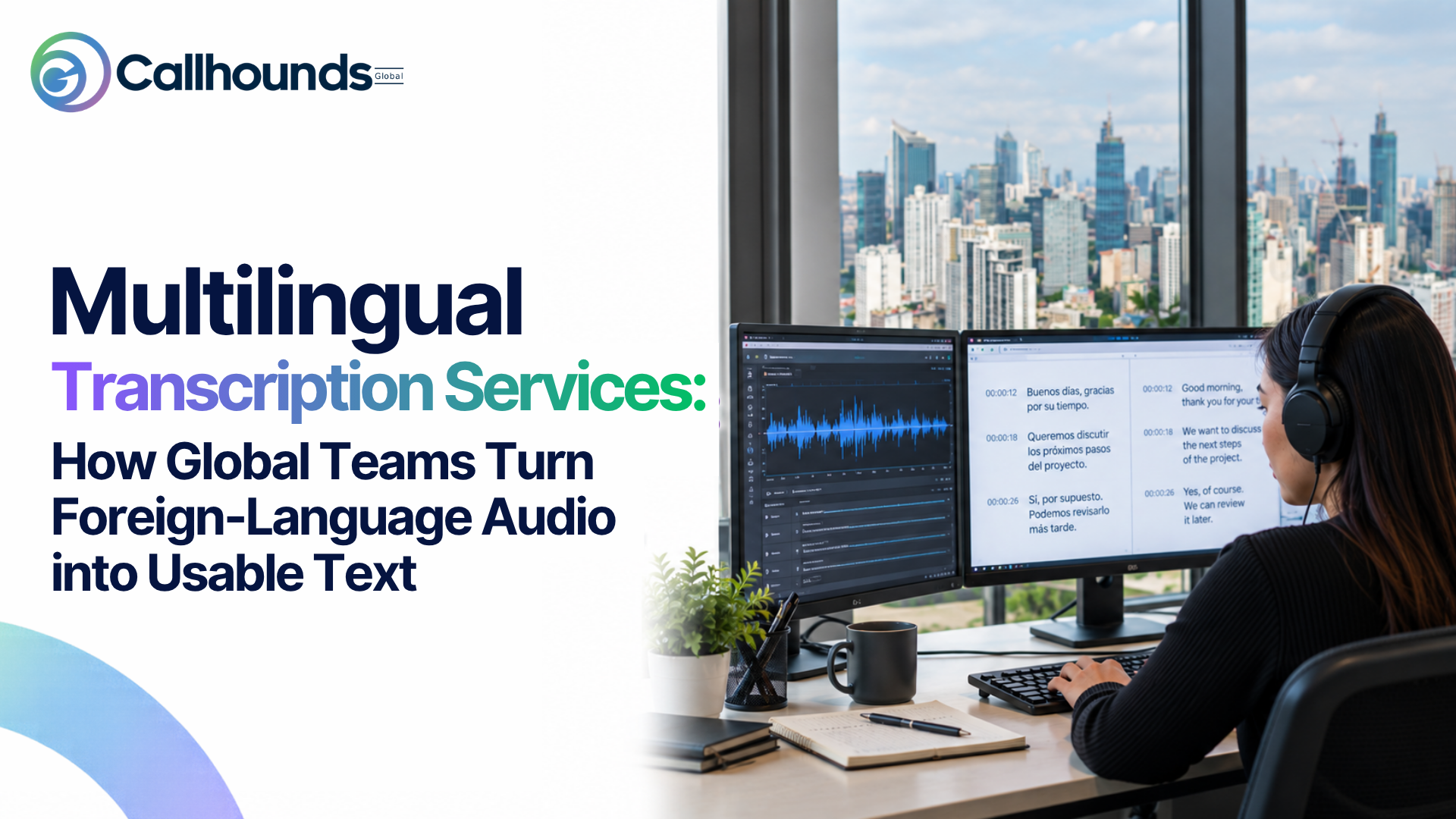
Multilingual audio creates a productivity problem when the words remain trapped in recordings.
Spanish client calls, Tagalog witness interviews, and board meetings that switch between English and Mandarin can quickly create hundreds of hours of content that teams cannot easily search, quote, review, or analyze.
That’s where multilingual transcription services come in. They turn spoken audio into accurate, time-stamped text with speaker identification, creating a searchable resource that can be translated, captioned, reviewed, and analyzed across languages.
The real cost often appears later. A compliance team needs a statement from a call recorded months ago. Marketing wants to repurpose a webinar for multiple markets. Quality managers need to review customer interactions in languages their team doesn’t speak.
Without a reliable transcript, valuable information stays locked inside the recording.
This guide breaks down what multilingual transcription services include, why demand is growing in 2026, how AI, human, and hybrid transcription compare, and what to look for when choosing a provider for multilingual content.

At its core, transcription is speech turned into text. The multilingual version handles recordings in languages other than your team’s main one, or recordings where speakers switch languages mid-sentence. A solid service covers a lot more than typing. It usually includes:
These three get confused constantly, and the confusion costs money. A native-language transcript keeps the original language: a Spanish call becomes Spanish text. A mixed-language transcript, often called code-switched, captures speakers who move between languages, which is routine in the Philippines, India, Singapore, and many multilingual households in the US, UK, and Australia. A translated transcript converts a finished transcript into another language.
Translation always sits on top of transcription. If the source text is wrong, the translation inherits every error, so the quality of the first step sets the ceiling for everything built on it.
Customers have been clear about language for years. CSA Research surveyed 8,709 consumers across 29 countries and found that 76% prefer to buy products with information in their own language, while 40% said they never buy from websites in other languages. The survey dates to 2020, but the habit behind it hasn’t gone anywhere. Video, podcasts, and recorded webinars are now the main way companies explain what they sell, and each of those assets starts as audio that needs a transcript before it can be translated or captioned.
Regulation is pushing in the same direction. The European Accessibility Act began applying on June 28, 2025, and it covers a range of consumer-facing digital services, including audiovisual media, with requirements for accurate, synchronized captions. In the United States, the Justice Department’s ADA Title II web rule sets compliance dates that begin April 24, 2026, for larger public entities and April 26, 2027, for smaller ones, and video captions fall under it. Vendors that publish content for those agencies, or that serve EU customers, often get asked to match the same standard.
Work habits matter too. Distributed teams record more meetings than ever, and many of those meetings include speakers from three or four countries. A recording nobody can search is a recording nobody will use again. Transcripts also help search engines and AI answer engines understand your audio and video, because both read text far better than they read sound.
No single workflow suits every file. The right choice depends on risk, volume, and how many languages are involved. The table below shows how the main options compare.
| Workflow | How it works | Speed | Cost | Best fit |
| AI only | Speech recognition produces the full transcript with no human check. | Minutes per hour of audio | Lowest | Internal notes, rough search, low-risk recordings |
| Hybrid (AI plus human review) | AI drafts the transcript; trained reviewers correct it against the audio. | Hours to one day | Moderate | Training, marketing video, customer calls, QA |
| Fully human | Transcriptionists type and proofread every line without an AI draft. | Slowest | Highest | Legal, medical, regulatory, and noisy or heavily accented audio |
| Managed offshore team | A dedicated team runs the hybrid or human workflow under your rules. | Agreed in writing | Lower than onshore | Ongoing volume across several languages |
Cost and speed are relative because pricing varies by language pair, audio quality, and turnaround. Ask any provider for a pilot quote on your own files.
In practice, hybrid wins for most business content. AI speech models have improved quickly and handle clean audio in widely spoken languages well, but accuracy drops with less common languages, regional dialects, background noise, and overlapping speakers. A trained reviewer catches the errors a model can’t recognize as errors: a surname rendered as a common word, a drug name misheard, a joke that flips the meaning of a sentence.
Fully human work still has a place. When a single wrong word could change a legal position or a clinical record, paying for a person to type and proof every line is sensible insurance.
Providers love to quote one accuracy percentage. Treat that number with caution. It usually describes clean, single-speaker audio in one language, which is not what most business recordings look like. These are the factors that move accuracy more than the tool does:
In our experience, the quickest accuracy win is also the cheapest: send a one-page glossary and a speaker list with every batch. It takes a few minutes to prepare and removes most of the proper-noun errors a reviewer would otherwise have to chase down one by one.
Pick the style before work starts. Switching from clean to full verbatim after delivery means redoing the file, and that’s a cost most budgets don’t plan for. The table below matches each style to its usual job.
| Transcript style | What it captures | Typical use |
| Clean verbatim | Removes filler words, false starts, and stutters while keeping the meaning. | Meeting notes, training, publication interviews |
| Full verbatim | Keeps every word, filler, pause, and laugh exactly as spoken. | Legal interviews, investigations, research |
| Timestamped | Adds time markers at set intervals or at each speaker change. | Review, editing, caption creation |
| Translated | Renders the finished transcript in a second language, source text kept alongside. | Cross-border teams, international clients |
| Caption files (SRT/VTT) | Splits text into timed segments that match the video. | Accessibility and video localization |
Almost any organization that records speech in more than one language has a use for it. These are the groups that rely on it most:
The Philippines has spent three decades building a services workforce that handles voice, chat, and back-office work for clients in the US, UK, and Australia. English is widely used in schools and business, accent training is standard across the industry, and Filipino and regional languages are native for the workforce. A good number of professionals also work in languages such as Spanish, Japanese, Mandarin, or Korean. Language coverage differs from team to team, so confirm the exact list during scoping.
Cost is the other draw. Offshore delivery generally runs well below onshore staffing for comparable work, and a dedicated team means the same people learn your glossary, your style rules, and your clients’ names. The guide to offshore staffing in the Philippines explains how dedicated teams are built, from recruitment through day-to-day management.
Time zones help as well. A file uploaded at the end of a US or UK workday can be waiting for review the next morning, because the team works while you sleep. For Australian clients, the overlap is close to a full business day, which makes questions about unclear audio easy to settle in real time.
A provider’s website tells you very little about the work. These six checks tell you a lot more:
Most failed vendor relationships trace back to the same few errors: buying on price alone, skipping the pilot, and leaving quality standards vague. The list of common outsourcing mistakes to avoid in 2026 covers those traps and how to sidestep them before you sign.
You don’t need to transcribe everything at once. A workable start looks like this:
Multilingual transcription services turn audio that sits unused into text your whole team can search, quote, translate, and audit. The best results come from matching the workflow to the risk, giving the provider a glossary, and testing on real files before committing.
If your team has recordings in more than one language waiting, Callhounds Global can scope the languages, volume, and output formats with you and set up a dedicated team to handle them. Reach out through the Callhounds contact page to start with a short conversation.
Key Takeaways
Multilingual transcription services convert recorded speech in one or more languages into written text. A good service labels speakers, adds timestamps, flags unclear audio, and delivers the transcript in the format your team needs. Translation into another language can be added once the original transcript is complete.
Price depends on the language, audio quality, number of speakers, turnaround, and the workflow you choose: AI only, hybrid, or fully human. Providers usually charge per audio minute or hour. Rare languages, heavy accents, and rush jobs cost more, so request a pilot quote based on your own files.
AI performs well on clean audio in widely spoken languages. Accuracy falls with background noise, regional dialects, overlapping speakers, and code-switching. For training, marketing, and support content, a hybrid workflow with human review is the safer choice. For legal and medical recordings, use fully human review.
No. Transcription turns speech into text in the spoken language. Translation converts that text into a different language. Translation depends on transcription, so errors in the original transcript carry into every translated version.
Usually not. Transcripts from a general vendor work well for review, research, and internal use. Courts and regulators often require certification from a licensed court reporter or sworn translator. Check the requirement with your attorney before relying on any transcript in a filing.