

Common Outsourcing Mistakes to Avoid in 2026
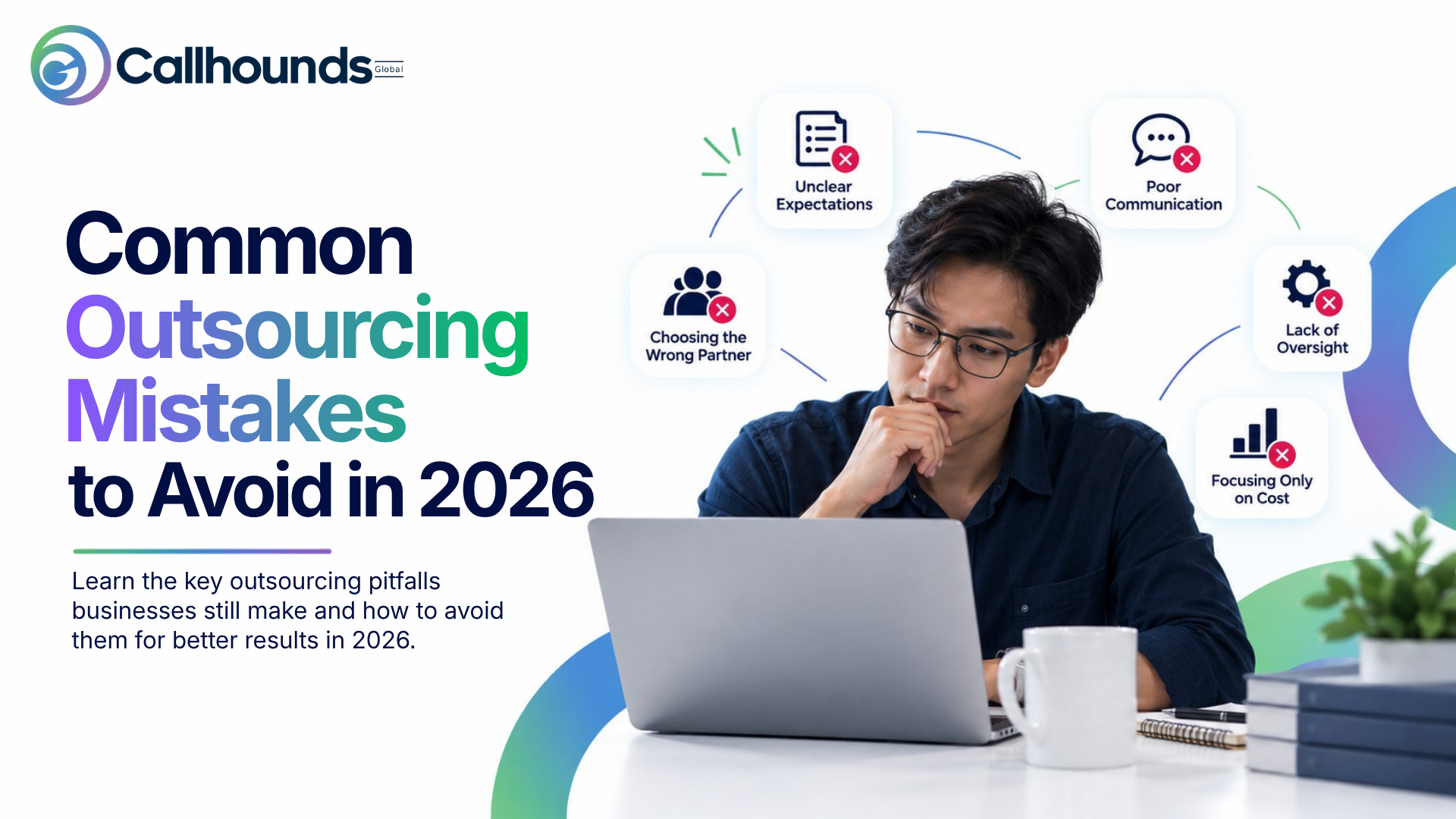
Outsourcing mistakes can turn a cost-saving strategy into an expensive operational headache.
Choosing a vendor based on price alone, overlooking communication and cultural fit, setting unclear KPIs, underestimating data security requirements, rushing the onboarding process, or treating outsourcing as a one-time handoff can quickly lead to poor service, frustrated customers, higher turnover, and unexpected costs.
The good news? Most outsourcing mistakes are avoidable. Knowing what to look for before, during, and after the transition can help you choose the right partner, set clear expectations, and build an outsourcing relationship that delivers results.
This guide breaks down the most common outsourcing mistakes, and the straightforward fixes that can help you avoid them.
Outsourcing is one of the more reliable ways for a company to add capacity, cut overhead, and get access to skills it doesn’t have in-house, and that’s true across industries and across the US, UK, and Australian markets alike. But the relationship only pays off if it’s built correctly from the start.
Industry research on outsourcing failures points to the same handful of root causes over and over: vendors chosen for price rather than fit, unclear scope, and communication breakdowns that never get resolved because no one set up a process for resolving them. None of these problems are unique to any one industry or region. They show up in finance and accounting outsourcing, IT services, HR, and customer support alike, and they tend to compound. A vague SLA leads to a missed deadline, which leads to a frustrated customer, which leads to a client pulling work back in-house at a cost far higher than if the relationship had been set up properly the first time.
The good news is that these mistakes are predictable, which means they’re preventable. Below are the ones that show up most often, along with what to do instead.
Cost savings are usually the first reason a business looks to outsource, and there’s nothing wrong with that. The trouble starts when price becomes the only factor in the decision. A quote that sits far below every competing bid is rarely a sign of unusual efficiency. It’s more often a sign that the provider is cutting corners somewhere: undertrained staff, high turnover, minimal quality assurance, or facilities and data protections that wouldn’t survive a proper audit.
The fix is to compare providers with total value rather than sticker price. That means asking about employee attrition rates, training programs, quality assurance processes, and how the provider staff supervises remote or offshore teams. A useful starting point is understanding realistic outsourcing cost in the Philippines so you have a market benchmark before you start comparing quotes, a bid that undercuts that benchmark by a wide margin deserves harder questions, not an easier signature. In the end, a provider who invests in quality talent will almost always save more money over the life of the contract than the cheapest bidder, once your account for rework, churn, and lost customers.
Some vendors listen closely to a client’s requirements and then quietly steer them toward whatever staffing model or technology package is easiest for the vendor to deliver. It’s an understandable instinct on the vendor’s side, and it’s an easy trap for a first-time outsourcing client to fall into, since the provider “does this for a living” and the client doesn’t.
A good provider still starts with your goals, not their org chart. If you need two part-time specialists and you’re told you need five full-time seats, or if you’re pushed toward a system you didn’t ask for and don’t need, that’s a signal worth taking seriously. Push back, ask for the reasoning behind every recommendation, and don’t sign on to a structure that was built around the vendor’s convenience rather than your actual workload.
Plenty of businesses treat vendor selection like a procurement exercise: compare a few quotes, check a couple of references, sign the contract. That level of vetting misses the details that predict how a partnership will go.
The table below breaks down the difference between a vetting process that catches problems early and one that doesn’t.
Table 1: Surface-Level Vetting vs. Real Vendor Vetting
| What Most Businesses Check | What a Careful Vetting Process Covers |
| Price quote and contract length | Employee attrition rate and training program details |
| A short reference call or two | Direct conversations with current long-term clients, including ones who’ve had a problem resolved |
| General company overview | Data security certifications, facility audits, and remote-work supervision practices |
| Sales team’s pitch on capabilities | A pilot project or trial period before a full commitment |
| Marketing materials on “quality” | Actual QA scorecards and how often they’re reviewed |
Ask for attrition numbers directly. A provider with high turnover will struggle to keep your account staffed with people who understand your business, no matter how good the sales pitch sounded. Ask, too, how the provider trains and supervises remote employees, since so much outsourced work today happens outside a traditional office. If a vendor won’t share this information, treat that reluctance as an answer.
A contract without measurable performance targets is a wish list, not an agreement. Yet a surprising number of outsourcing relationships launch with only a vague sense of what “good” looks like, which makes it almost impossible to tell if the partnership is working until something has already gone wrong.
The fix is straightforward, even if it takes real effort to do right: define specific, measurable targets before day one. These should cover both output (tickets closed, calls handled, invoices processed) and quality (accuracy rates, customer satisfaction scores, first-contact resolution). Good SLAs also run in both directions, they hold the provider accountable for their delivery and hold your team accountable for giving the provider what they need on time, including data access, approvals, or timely feedback. Review these metrics on a set schedule, not only when something breaks.
Once work moves outside your own building, your data does too, and that shift carries risk that a lot of businesses underestimate until an audit or an incident forces the issue. This matters even more for functions handling sensitive information, such as customer support outsourcing, where agents routinely handle payment details, personal records, and account credentials.
Before signing anything, confirm what security certifications the provider holds, how they screen and train employees who’ll have access to your systems, and what their incident response process looks like if something does go wrong. Ask about physical security at their facilities as well as remote-work protocols, since hybrid and work-from-home arrangements have become standard across the outsourcing industry. None of this should be treated as an afterthought bolted onto the contract later. It belongs in the vetting stage, right alongside cost and capability questions.
A rushed transition is one of the most common outsourcing mistakes, and it’s also one of the easiest to avoid, since it’s entirely within your control. Handing a provider a thin process document and expecting them to fill in the gaps sets the entire relationship up for friction. The provider ends up guessing at your standards, and your internal team ends up spending months correcting avoidable errors.
A proper transition documents current processes in detail, identifies exceptions and edge cases, and builds in real training time before the provider takes over live work. For a role like appointment setting, where a missed or mishandled call reaches a real customer immediately, the onboarding period should include supervised calls, scripted quality checks, and a clear escalation path for anything outside the norm before the account moves to full production. This kind of groundwork is exactly why a dedicated appointment setting outsourcing program should include a defined ramp-up phase, not a same-day handoff.
Technical skill gets most of the attention during vendor selection, and communication style gets treated as a nice-to-have. That’s backward. A provider can check every box on paper and still create daily friction if their communication cadence, tone, or escalation habits don’t match how your team works.
Before signing, get specific answers: Will you have a single point of contact, or will you be routed to a different person every time you reach out? How are updates delivered, and how often? What happens when a KPI is missed, is there a structured conversation, or does it just quietly repeat next month? A provider who treats these questions seriously, and who can point to long client relationships as proof, is a far safer bet than one who brushes past them to get to the pricing discussion.
The last mistake on this list is the one that undoes all the good work from the first seven: signing the contract, launching the account, and then checking in only when something goes wrong. Outsourcing relationships that last and perform well are managed actively, with regular reviews, updated KPIs as the business changes, and real conversations about what’s working and what isn’t.
The table below contrasts the “set it and forget it” pattern with the ongoing management approach that tends to produce better long-term results.
Table 2: Common Mistake vs. Better Approach
| Common Pattern | Better Approach |
| Sign the contract and hand off with minimal documentation | Build a detailed transition plan with training and supervised ramp-up |
| Check performance only when a customer complains | Review KPIs and QA scorecards on a fixed schedule |
| Renew automatically without renegotiating scope | Revisit scope, pricing, and KPIs at each renewal point |
| Treat the provider as a vendor to manage from a distance | Treat the provider as a partner with shared goals and regular check-ins |
| Keep security and compliance reviews to the initial contract | Repeat security and compliance reviews on an ongoing basis |
Companies that keep this kind of rhythm going tend to get outsourcing right not because they picked a perfect provider on day one, but because they built a process for catching and fixing small problems before those problems became expensive ones.

Pulling the eight mistakes above into a short pre-signature checklist:
None of these steps require special expertise to carry out. They require time, a willingness to ask direct questions, and a provider willing to answer them honestly. Businesses that build this checklist into their vendor selection process consistently report fewer surprises and shorter timelines to a working, productive partnership.
Key Takeaways
Choosing a provider mainly on price is the single most common outsourcing mistake. A quote that sits far below the market rate usually reflects cost-cutting somewhere in staffing, training, or security, and those gaps tend to surface only after the contract is already signed.
Ask for employee attrition rates, direct references from long-term clients, details on training and QA processes, and proof of data security certifications. A short trial project before a full commitment is one of the most reliable ways to see how a provider performs.
Most failures trace back to unclear scope, missing or vague KPIs, and communication breakdowns rather than a flaw in outsourcing as a model. Relationships that set specific metrics and review them on a fixed schedule are far less likely to collapse early.
It matters as much as technical skill. A provider with strong technical capability can still create daily friction if their communication style, escalation habits, and reporting cadence don’t match how your team works day to day.
A solid SLA includes specific, measurable output and quality targets, a defined review schedule, and two-way accountability that covers both what the provider delivers and what the client needs to provide, such as data access and timely approvals.