

Multilingual Support Outsourcing: Serve Global Markets
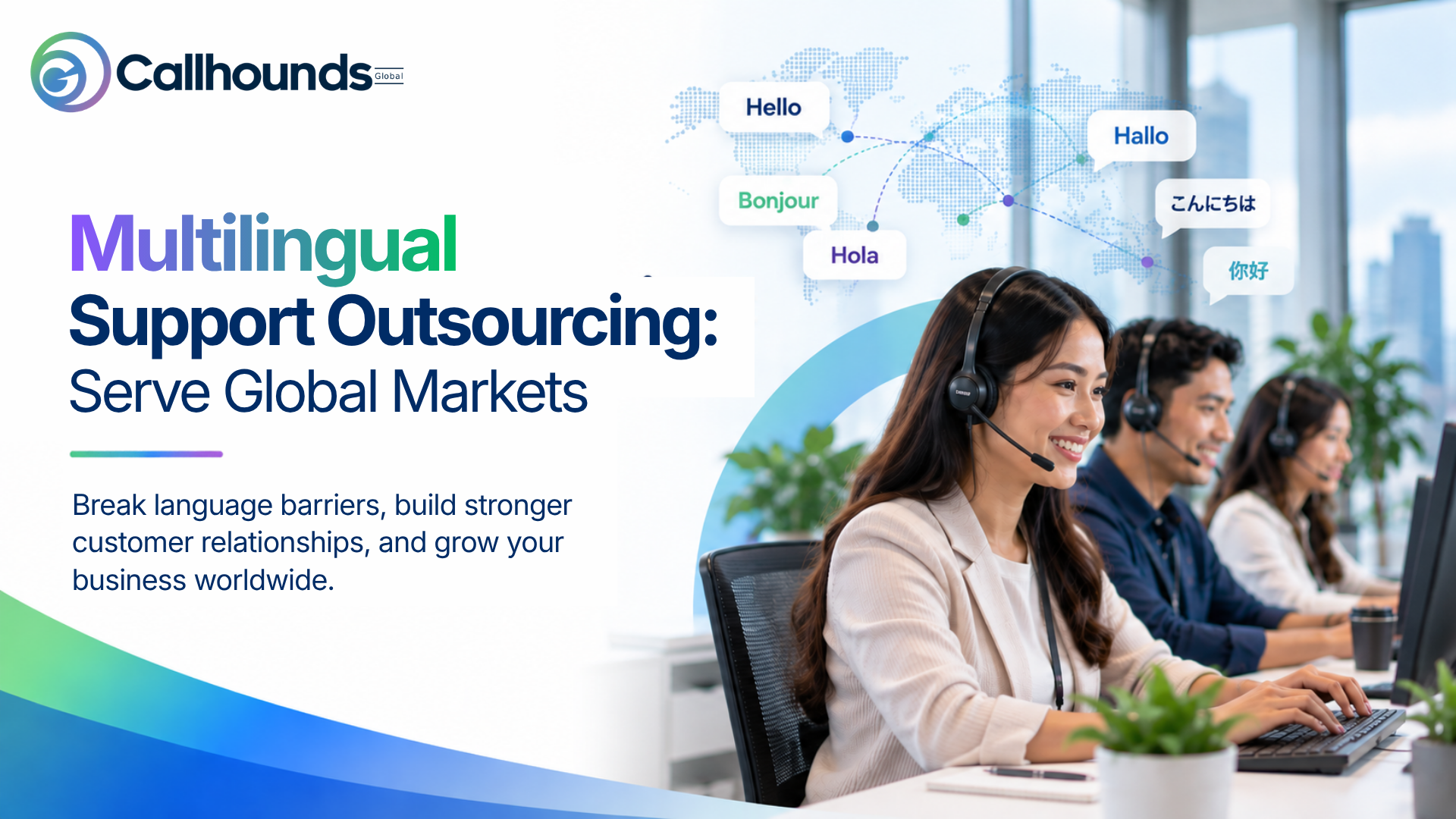
What happens when your customers speak three different languages, but your support team only speaks one?
Outsourcing multilingual support gives businesses access to trained customer service agents who can communicate with customers in their preferred languages while understanding the cultural context behind each interaction.
Instead of building an in-house multilingual team from scratch, companies can partner with an experienced outsourcing provider and scale language-specific support as they enter new markets.
Because when customers cannot clearly communicate with your support team, simple questions can turn into long conversations, delayed resolutions, frustrated customers, and lost business. Multilingual outsourcing helps close that communication gap while allowing companies to expand globally without letting support quality fall behind.
Multilingual support outsourcing is a specific arrangement inside the broader outsourcing industry. A company contracts with a business process outsourcing (BPO) provider that staff agents fluent in the languages the client’s customers speak, then routes tickets, calls, and chats to the agent best matched to each customer. This differs from simple translation software layered onto an English-speaking team, because the agents themselves understand the language, the regional phrasing, and often the cultural context that shapes how a customer describes a problem.
The arrangement usually covers one or more of the following: dedicated agents assigned only to one client, shared agents who split time across several client accounts, or a hybrid model where a small dedicated team handles peak hours while a shared pool covers overflow. Pricing, staffing, and reporting all shift depending on which model for a business pick, which is part of why comparing providers on more than sticker price matters.
Three forces are pushing more companies toward outsourced language coverage this year.
First, ecommerce and SaaS companies sell globally almost by default now. A product launched in the United States can pick up paying customers in France, Brazil, and Japan within its first quarter, and each of those customers expects support in their own language, not a translated FAQ page.
First call resolution rates drop sharply when an agent and a customer do not share a first language, which pushes average handle time up and satisfaction scores down. Outsourcing partners fix this by matching tickets to agents on language and, where possible, region, so a Spanish-speaking customer in Mexico City and one in Madrid can both get an agent who understands their dialect and local references.
Second, hiring multilingual staff directly is expensive and slow. Recruiting a fluent French speaker, a fluent Korean speaker, and a fluent Portuguese speaker in-house means three separate hiring pipelines, three sets of training materials, and three managers overseeing performance in languages the company’s own leadership may not speak. An outsourcing partner already has that staffing built, tested, and ready to scale up or down.
Third, support now spans more channels than a phone line. Customers move between live chat, email, social media direct messages, and voice within the same interaction, and every one of those channels needs the same language coverage as the others. Teams that already manage support across multiple regions and time zones know that coverage gaps compound quickly once a customer base spans continents (see: managing multi timezone customer support), the same is true when the gap is language instead of time zone.

| Factor | In-House Multilingual Team | Outsourced Multilingual Support |
| Setup time | Months to recruit, train, and onboard agents per language | Weeks, since agents are already trained and available |
| Cost structure | Fixed salaries, benefits, and management overhead per language | Variable cost tied to ticket or seat volume |
| Language scaling | Requires new hiring for each additional language | New languages added through the existing provider relationship |
| Coverage hours | Limited to the hours in-house staff can work | Extended or 24/7 coverage through shift-based staffing |
| Quality control | Built and managed internally from scratch | Provider-managed QA frameworks and reporting already in place |
| Best fit | Companies with one or two core markets and steady volume | Companies expanding into several markets or handling variable volume |
Neither model is universally better. A company with a stable customer base concentrated in one or two languages may find an in-house team easier to manage in the long-term. A company adding new markets every year, or one whose ticket volume swings seasonally, usually gets more value from a partner that can flex staffing without the company absorbing the hiring risk itself.
A capable partner covers more ground than translation. The core of the service includes native or fluent-level agents screened for both language proficiency and customer service skill, quality assurance scorecards that measure resolution and tone in each language rather than only in English, and technology that routes each incoming ticket to the right agent automatically based on language detection.
Specialized categories of support also fall under this umbrella. Technical troubleshooting requires agents who can explain a fix accurately in a second language without losing precision, which is why some businesses look specifically for providers experienced in multilingual tech support outsourcing rather than general-purpose agents. General account questions, billing, and order status inquiries, on the other hand, are typically covered through a broader customer support outsourcing arrangement that a provider staffs across every language a client needs.
A short list of questions separates a solid partner from a risky one:
Pricing matters, but a lower rate on a language with thin quality control usually costs more later in refunds, churn, and repeat contacts. A provider willing to walk through its screening and QA process in detail, rather than offering only a rate card, is usually the safer long-term partner.
Most companies do not need coverage in twelve languages on day one. The starting point should be data, not assumptions.
| Signal to Check | What It Tells You |
| Website traffic by country | Where interest already exists before a purchase happens |
| Existing ticket language (even if answered in English) | Which customers are already trying to communicate in another language |
| Payment method and currency data | Which regions are converting into paying customers |
| Sales or lead volume by region | Where growth is happening fastest right now |
| Social media mentions by language | Where customers are talking about the brand organically |
A company selling software to European businesses, for example, often finds German, French, and Spanish cover the bulk of non-English demand before any other language becomes worth the investment. A company selling consumer goods across Latin America may find Portuguese and Spanish alone cover most of the region. Outsourcing partners can usually pull ticket-language reports even when tickets were originally answered in English, which gives a company real numbers instead of a guess.
Customers do not stay on one channel. A person who emails in Japanese today may call tomorrow and expect the same language on the phone, then message the brand’s Instagram account in the same language next week. Coverage gaps between channels are one of the most common complaints in multilingual support, and they usually happen because a company outsourced phone support in a language but left chat and email in English by default.
The channels that most often need matching language coverage are live chat, email, phone, and social media direct messages. Self-service resources such as help center articles and chatbot scripts should also exist in the top languages a company supports, since an English-only knowledge base undercuts language-matched live support the moment a customer tries to self-serve first.
A few patterns show up again in companies that struggle after outsourcing language coverage:
Serving customers well in languages is no longer optional for a company selling outside its home market. Outsourcing multilingual support gives a business a faster, lower-risk path to that coverage than building each language team from the ground up, provided the company picks a partner with real screening standards, per-language quality reporting, and coverage across every channel customer uses. The businesses that get the most out of this arrangement treat language coverage the same way they treat any other support decision: driven by customer data, measured continuously, and adjusted as the customer base changes.
Key Takeaways
Outsourcing multilingual support means hiring an external customer service provider that employs agents fluent in two or more languages to handle a company’s customer inquiries, instead of building and managing that language capability with in-house staff.
In most cases, yes, because a company avoids the cost of recruiting, training, and managing separate staff for each language, and instead pays coverage tied to ticket volume or seats through a provider that already has agents trained and ready.
There is no fixed number; the right starting point comes from checking existing website traffic, ticket language, and sales data by region, then covering the two or three languages that data already shows demand for before expanding further.
Yes, though it depends on the provider. Some outsourcing partners staff agents trained specifically in technical troubleshooting in multiple languages, while others focus on general account and billing questions, so it is worth confirming which type of coverage a provider offers before signing up.
Key factors include how agents are tested for language fluency, what security certifications the provider holds, if quality reporting is broken out by language, and how the provider handles sudden volume spikes in a single language.