

Call Center Attrition: Causes, Costs, and Solutions for 2026

Call center attrition is one of the most closely watched workforce metrics in the contact center industry because employee turnover affects far more than headcount. When agents leave, contact centers can absorb additional recruiting and training costs while experienced-agent productivity, service levels, and team capacity are disrupted.
Call center attrition measures the percentage of employees who leave a contact center over a defined period. But the headline percentage only tells part of the story. Leaders also need to understand whether employees are leaving voluntarily or involuntarily, whether new hires are dropping out during their first 90 days, and how turnover varies by account, site, shift, tenure, and role.
For BPO providers in the Philippines and other competitive outsourcing markets, understanding these patterns can help operations teams identify where turnover originates and which retention strategies deserve attention.
What Is Call Center Attrition?
Employee attrition is the percentage of employees who leave an organization during a defined period, typically calculated against the average number of employees during that period, most often measured monthly or annually. In a call center, this includes agents who resign or are dismissed during the period, expressed as a percentage of the average number of agents employed during that same period. The formula itself is simple:
Attrition Rate (%) = (Number of employees who left during the period) ÷ (Average number of employees for the period) × 100
Example: If 40 agents leave during a year and the average workforce is 400 agents:
40 ÷ 400 × 100 = 10% annual attrition
The “average” part is where a lot of reporting goes wrong. Using end-of-period headcount instead of an appropriate average headcount can materially understate or overstate the attrition rate, particularly when workforce size changes significantly during the measurement period, which matters when that percentage feeds into a client scorecard or a staffing forecast.
Call Center Attrition vs. Turnover
Call center attrition and employee turnover are often used interchangeably, but organizations may define them differently. Attrition generally refers to employees leaving the workforce or organization, while turnover can be used more broadly to describe the rate at which employees leave and are replaced. Because definitions vary between companies and benchmarking reports, operations leaders should confirm how a provider calculates the metric before comparing results.
Why the Number Runs So High in Contact Centers
Frontline phone work combines repetitive tasks, emotional labor from difficult calls, rotating shifts, and, in outsourced environments, distance from the end of the client’s brand. These conditions can contribute to elevated attrition in contact-center environments, particularly when workload, scheduling, management, and job expectations are not well aligned. ContactBabel’s UK contact-center benchmarking research found that one in five contact centers reported annual attrition above 30%, Research on contact-center retention also indicates that early-tenure departures can account for a meaningful share of employee exits.
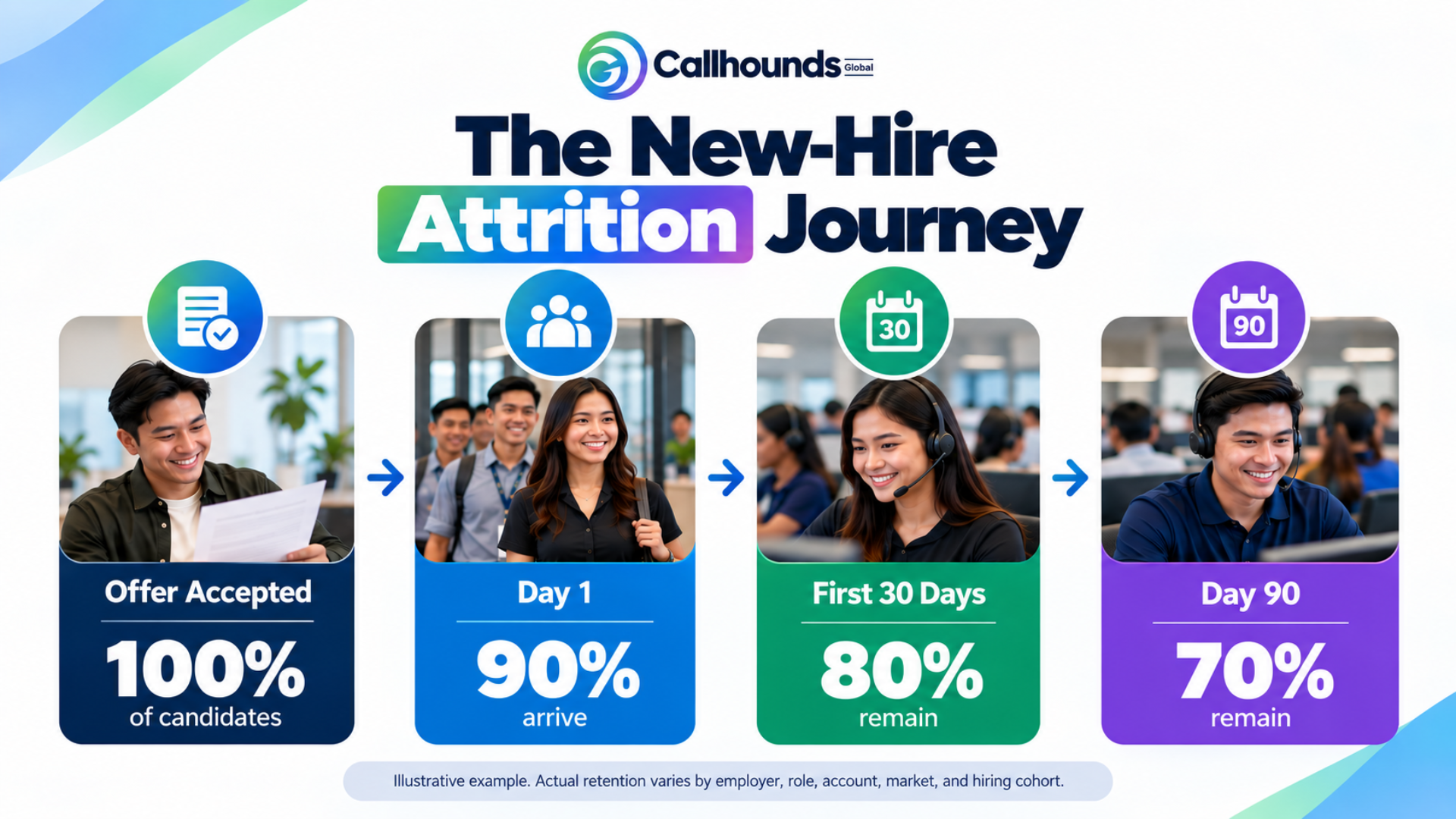
The first-day period deserves particular attention because it is often undercounted. Some operations track call center attrition only from the training start date onward, meaning an accepted offer that never results in a day-one arrival, commonly called “ghosting,” disappears from the numbers entirely. In one reported case study involving a 1,153-agent hiring cohort, 967 candidates arrived onboarding, meaning 186 candidates, or approximately 16%, were lost before training began. If that gap isn’t tracked, the true cost of a broken recruiting or preboarding process remains invisible to leadership.
A Regional Note: Attrition in the Philippines BPO Market
The Philippines remains a major destination for outsourced customer service and business-process operations. In major BPO hubs such as Metro Manila and Cebu, employers compete for experienced customer service, technical support, sales, and back-office talent. This competitive environment can make retention especially important for accounts that require experienced agents and specialized skills.
Shift requirements can also influence employee experience. Many Philippine contact centers support customers in North American, European, and other international markets, which can require evening, overnight, or rotating schedules. Rather than treating attrition as a company-wide number, BPO leaders should analyze turnover by account, site, shift, tenure, role, and reason for leaving.
Breaking Down the Three Attrition Metrics
Lumping every departure into a single percentage hides where the real problem lives. Many workforce planning teams track three related but distinct figures side by side.
Table 1: Attrition Metric Comparison
| Metric | What It Measures | Formula | Why It Matters |
| Voluntary Attrition | Employees who resign | Voluntary leavers ÷ average headcount × 100 | Helps identify retention, engagement, compensation, scheduling, or management issues |
| Involuntary Attrition | Employees terminated or dismissed | Involuntary leavers ÷ average headcount × 100 | Can reveal hiring, performance-management, or quality issues |
| New-Hire Attrition | Employees who leave within a defined early-tenure period | New hires who leave ÷ new hires × 100 | Helps identify recruiting, job-expectation, preboarding, and onboarding problems |
Tracking these separately shows a leader exactly where the problem sits, recruiting screening, day-one experience, or long-term engagement, and each of those needs a different fix.
What Losing an Agent Actually Costs
Imagine a contact center loses one trained agent shortly after nesting. The financial impact may include recruiting and screening expenses, paid training time, trainer capacity, temporary overtime, reduced productivity during the replacement agent’s ramp period, and potential service-level pressure while the position remains unfilled.
The exact cost varies by location, role, compensation structure, training length, and account requirements. For that reason, organizations should calculate their own fully loaded cost rather than applying a generic industry figure.
Table 2: Key Cost Drivers of Employee Replacement
| Cost Category | Direct or Indirect | Typical Driver |
| Recruiting and screening | Direct | Sourcing, interviews, background checks |
| Classroom and nesting training | Direct | Trainer hours, materials, paid non-production time |
| Productivity ramp gap | Indirect | Lower AHT, FCR, and conversion during first 90 days |
| Team overtime and coverage | Indirect | Backfilling open seats until the next hire is trained |
| Client service-level risk | Indirect | Missed SLAs and CSAT dips tied to under-staffed queues |
| Manager and trainer capacity | Indirect | Time diverted from coaching tenured agents |
The cost of replacing a frontline agent varies significantly by market, role complexity, training duration, compensation structure, and time to productivity. Organizations should therefore calculate their own fully loaded replacement cost rather than rely on a generic industry estimate. When ramp time and coverage gaps are included, the impact can extend well beyond the HR budget, particularly when replacement hiring takes time. Attrition rarely remains an HR-only cost.
The Root Causes Behind the Turnover Curve
Three patterns show up again in exit data and engagement surveys.
Job shock
Roughly one in four frontline employees surveyed in COPC’s Employee Engagement Research Series said the job they were hired for did not match the role described during recruiting. The same research found that agents who reported receiving an accurate job description showed nearly twice the reported job satisfaction and retention of those who said the role did not match what they were told during recruitment.
A weak preboarding window
The gap between an accepted offer and the first day of training can be a vulnerable period for engagement, particularly when communication and onboarding preparation are limited. Candidates who receive little communication between offer acceptance and day one may be more vulnerable to competing offers, uncertainty about the role, or simply failing to show up.
Limited growth visibility
Limited visibility into career progression can make it harder to retain agents once the initial appeal of the role or compensation wears off.
Practical Ways to Reduce Call Center Attrition
Fix the job description before the job posting goes live. Recruiting and operations teams should agree on the minimum skills, tasks, and shift expectations together, then keep the posting and the interview guide consistent with that list.
Build a structured preboarding sequence. Assign a named point of contact, send orientation materials and FAQs ahead of day one, and confirm system access and login credentials are ready before the agent walks in. A short video introduction from the future supervisor and teammates can help new hires feel more familiar with the team before training begins.
Track ghosting attrition separately from post-training attrition. If a hiring cohort loses agents between offer acceptance and day one, that number needs its own line in the report. Otherwise, it stays buried inside a “90-day attrition” figure that mixes several different problems together.
Give new hires a reason to stay past the first paycheck. Recognition programs, clear coaching feedback loops, and visible promotion paths can support retention by giving employees clearer feedback, development opportunities, and reasons to remain with the organization.
Review attrition on a rolling basis. A single annual percentage can hide seasonal spikes and cohort-specific problems. Monthly or weekly monitoring, depending on workforce size and reporting needs, can surface changes while there is still time to investigate and act.
Put the cost figure next to the percentage. A turnover rate on its own rarely moves budget conversations. Once a workforce planning team attaches recruiting spend, training hours, and the productivity gap during ramp-up to that percentage, the same number tends to get a very different level of attention from finance and operations leadership alike.
Separate involuntary attrition from the headline figure but never ignore it. For some benchmarking purposes, organizations may report voluntary and involuntary attrition separately because they represent different workforce outcomes. Internally, though, a rising involuntary rate can indicate a hiring, coaching, performance-management, attendance, compliance, or quality issue that deserves its own root-cause review.
Where Outsourcing Fits into the Attrition Conversation
For companies deciding between building an in-house contact center and partnering with a BPO provider, agent turnover is an important workforce metric to evaluate alongside pricing, language coverage, service capabilities, and operational performance.
Broader outsourcing market trends and relevant benchmarking data can help buyers put a quoted attrition figure into context and identify potential outliers before they become a larger operational concern. The goal is not simply to find a provider with the lowest reported attrition rate, but to understand how consistently the provider measures, explains, and manages workforce turnover across accounts.
Key Takeaways
- Call center attrition measures employee departures over a defined period relative to average headcount.
- Attrition should be segmented by voluntary, involuntary, and new-hire departures to identify different workforce issues.
- Early-tenure attrition deserves close attention because recruiting and onboarding problems can appear before long-term engagement issues.
- The cost of attrition can include recruiting, training, nesting, productivity loss, overtime, management capacity, and potential service-level pressure.
- Accurate job expectations, structured preboarding, career development, effective management, scheduling practices, and competitive employment conditions can all contribute to retention.
- BPO buyers should evaluate workforce stability using account-level and cohort-level data, rather than relying on one company-wide attrition percentage.
References
- ContactBabel. UK Contact Centre HR & Operational Benchmarking Report.
- COPC Inc. Employee Engagement Research Series.
- Call Centre Helper. What Is Attrition Rate and How to Calculate It?
- Centrical and COPC Inc. Improving Contact Center Retention Series.
Frequently Asked Questions
What is a good attrition rate for a call center?
There is no universal call center attrition rate that can be considered healthy across every operation. Benchmark levels vary by market, role, account type, shift pattern, tenure, and methodology used to calculate attrition. Organizations should compare rates using the same definition, population, and measurement period. For example, a contact center should avoid comparing its voluntary annual attrition rate with another provider’s total attrition rate because the two figures measure different populations.
How is call center attrition calculated?
Divide the number of agents who left during a period by the average number of agents employed during that same period, then multiply by 100. Using the average headcount rather than a single point-in-time figure keeps the percentage accurate.
What’s the difference between voluntary and involuntary attrition?
Voluntary attrition covers agents who resign on their own, often tied to engagement, pay, or scheduling. Involuntary attrition covers agents who are dismissed or terminated, which can reflect hiring, performance-management, attendance, compliance, or quality issues.
Why do so many agents leave within the first 90 days?
Early departures can result from a mismatch between the job candidates expected and the job they experienced, as well as weak preboarding, onboarding challenges, scheduling expectations, compensation, management, or other factors.
Can outsourcing reduce attrition-related risk for a business?
Outsourcing can help manage some attrition-related operational risks when a BPO provider has established recruiting, preboarding, workforce management, and retention processes. However, outsourcing does not eliminate employee turnover. Buyers should evaluate how transparently the provider measures attrition, replacement time, new-hire retention, and workforce stability.