

BPO Market Update 2026: Growth, Trends & Forecast to 2033

According to Grand View Research, the global business process outsourcing market is estimated at $358.6 billion in 2026 and projected to reach $695.8 billion by 2033, representing a 9.9% compound annual growth rate from 2026 to 2033.
Those figures show the market’s scale, but the more important question for buyers is what is driving that growth, and which services, regions, technologies, and workforce models are capturing the demand.
That single number tells you the direction of travel, but it doesn’t tell you why buyers are moving, which regions and services are absorbing the growth, or what a founder, operations lead, or CX director should do with that information in the next twelve months.
Most industry write-ups treat outsourcing as a cost-saving play, a way to trim headcount and hand the leftovers to someone cheaper. The framing is outdated. The providers attracting growing demand are increasingly being asked to improve customer journeys, support compliance requirements, and run AI-assisted operations that internal teams may not have the resources or expertise to build themselves.
Market Size and Growth Trajectory
Grand View Research places the global BPO market at $328.4 billion in 2025, stepping up to $358.6 billion in 2026 and climbing to $695.8 billion by 2033. That trajectory unfolds through a period shaped by remote-work normalization, tighter compliance regimes, and a wave of generative AI tools that are changing what outsourced teams are actually capable of.
Several structural forces are contributing to continued demand across the BPO market:
- Digital transformation budgets keep flowing through outsourced partners. Organizations are deploying cloud platforms, AI-driven analytics, and automation tools faster than their internal IT teams can absorb them, and BPO providers with the technical depth to implement and manage those systems are capturing a growing share of that spend.
- Customer experience has become a boardroom metric. Consumers expect consistent service across voice, chat, email, and social media, and few internal support teams are staffed or tooled to deliver that around the clock.
- Cloud-native infrastructure has removed the old excuse for staying in-house. Cloud deployment now holds the largest share of BPO infrastructure spending because it gives providers a scalable base to run automation and analytics without the capital outlay of physical data centers.
For a longer view of how these figures compare against prior forecasts, our breakdown of the global BPO industry market size, growth trends, and outlook for 2026 tracks the segment-by-segment shifts in more depth.
Table 1: Global BPO Market Snapshot (2025–2033)
| Metric | Figure |
| Market size, 2025 | $328.4 billion |
| Market estimate, 2026 | $358.6 billion |
| Market forecast, 2033 | $695.8 billion |
| CAGR, 2026–2033 | 9.9% |
| Largest regional share (2025) | North America, 37.4% |
| Largest service segment by revenue share (2025) | Finance & Accounting, 21.4% share |
| Fastest-growing service segment (2026–2033) | Customer Services, 11.2% CAGR |
| Dominant deployment model | Cloud |
Source: Grand View Research, Business Process Outsourcing Market Report, 2026–2033
Regional Momentum: Where Demand Is Concentrated
North America currently represents the largest regional share of the global BPO market. The region accounted for 37.4% of global revenue in 2025, driven by demand across BFSI, IT, telecommunications, and HR functions. Within that footprint, the U.S. market alone is projected to grow at 9.7% annually through 2033, with healthcare, finance, and IT driving demand for providers that bring domain-specific knowledge rather than generic call-handling capacity.
The UK and broader European markets are following a similar path, but the reasons behind outsourcing are different. In the UK, businesses are outsourcing customer service to provide round-the-clock, multichannel support without having to hire and manage three internal shifts. In markets like Germany, GDPR compliance and data protection are major factors when choosing an outsourcing provider. Buyers are more likely to choose providers that can clearly demonstrate and document their security measures rather than simply choosing the lowest-cost option.
Asia-Pacific remains the most varied region in the mix, spanning mature markets like Australia, Singapore, and Japan alongside fast-scaling talent hubs such as the Philippines and India. For Australian buyers weighing where to place outsourced work, that regional mix matters: offshore providers in Southeast Asia continue to combine English-language proficiency with meaningfully lower labor costs, while nearshore and onshore options trade some of those savings for tighter time-zone alignment.
For a deeper comparison of regional outsourcing hubs, the 2026 outsourcing market trends and global growth data provide additional country-level context.
Service Segments: Finance Leads, Customer Experience Accelerates
Finance and accounting held the largest service segment share in 2025 at 21.4%. Providers are increasingly integrating RPA, AI, and advanced analytics into invoice processing, expense management, forecasting, and reporting, helping organizations streamline financial operations and reporting workflows.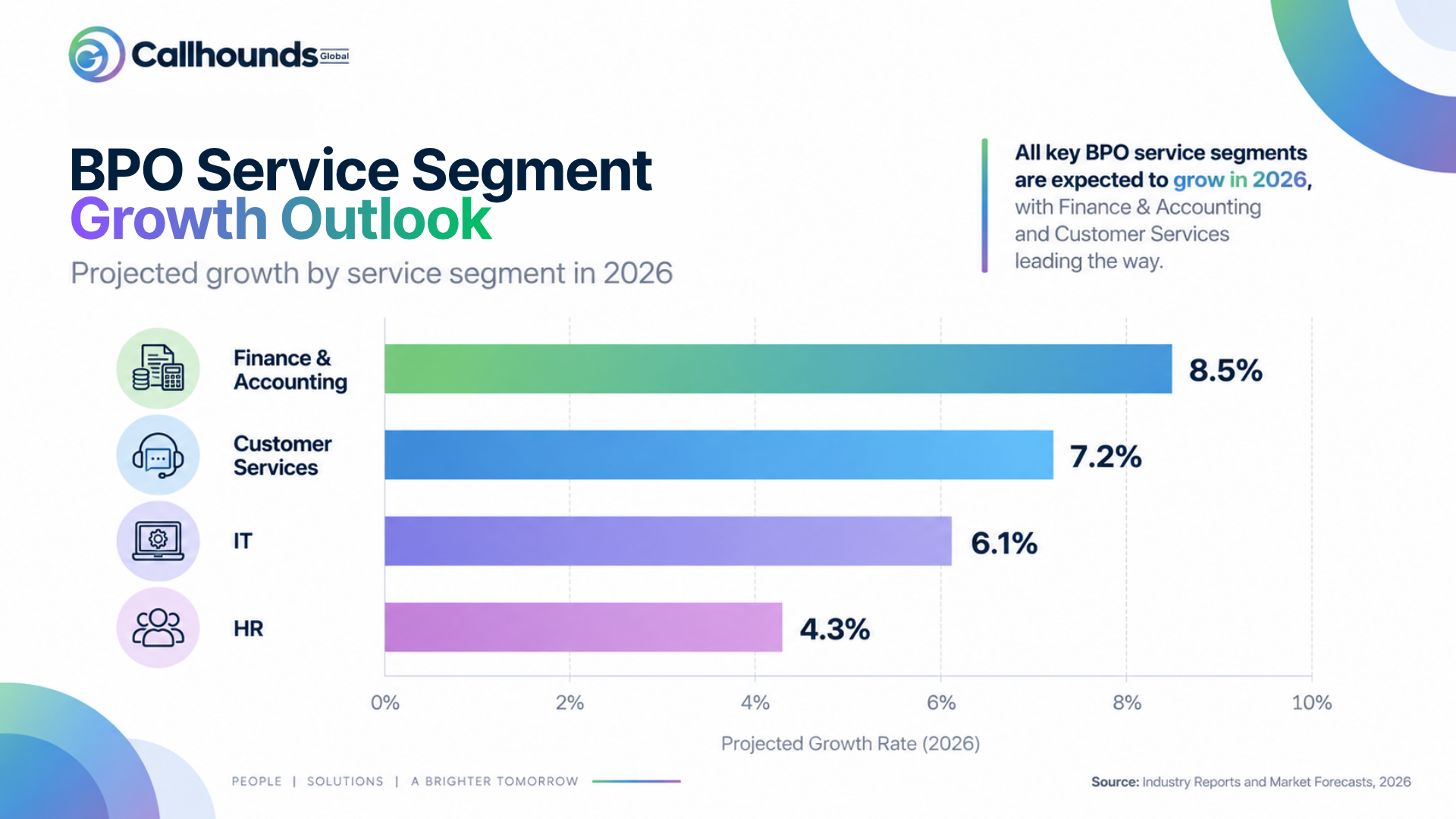
Projected growth rates shown for 2026. These figures represent the near-term growth outlook and should not be compared directly with the longer-term 2026–2033 CAGR figures cited in the market analysis.
Customer services is projected to be the fastest-growing service segment over the 2026–2033 period, with an 11.2% CAGR. The growth reflects rising consumer expectations for fast, consistent, and personalized support across voice, chat, email, social media, and messaging, delivered by trained agents using standardized processes rather than ad hoc scripts. Retail and e-commerce brands are a big part of that demand curve, outsourcing order processing, customer support, and even parts of supply chain coordination as order volumes and return complexity outpace what internal teams can handle.
Outbound and lead-generation functions follow a similar pattern. Sales organizations that need consistent pipeline activity without the overhead of a full internal team are increasingly turning to dedicated outsourced desks; an approach covered in more depth in this guide to outbound call center and cold-calling outsourcing services.
Table 2: Onshore vs. Offshore Outsourcing
| Factor | Onshore | Offshore |
| Primary driver | Wage differences within the same country, cultural and legal alignment | Access to global talent pools at significantly lower cost |
| Cost savings | Moderate | High |
| Time-zone alignment | Same or similar | Varies; often managed with shift overlap |
| Compliance complexity | Lower, single jurisdiction | Higher, cross-border data and labor rules |
| Best fit for | Regulated industries needing tight legal alignment | Scaling customer support, back-office, and F&A functions |
Source: Grand View Research, Outsourcing Type Insights, 2026–2033
AI’s Role: Augmentation, Not Replacement
Every BPO conversation in 2026 eventually turns to AI, and the market data backs up why. Companies are leaning on BPO providers with advanced digital capabilities to manage, integrate, and optimize AI tools rather than trying to build that expertise internally from scratch. Providers, in turn, are positioning themselves as transformation partners: supporting process re-engineering, improving data transparency, and enabling faster, insight-driven decisions across the operations they run.
That doesn’t mean agents are being phased out. Conversational AI and automation are handling the repetitive, high-volume parts of the job, freeing trained human agents to manage the interactions that require judgment, empathy, or escalation handling. For providers, demonstrating how AI improves service quality, not simply reduces manual workload is becoming an increasingly important part of the value proposition. For buyers, the practical question is no longer simply whether a provider uses AI. It is how AI is governed, where human oversight remains necessary, and whether automation produces measurable improvements in accuracy, response times, resolution rates, or cost efficiency.
Compliance and Security Are Now Deal-Breakers
Data security has moved from a back-office concern to a front-line buying criterion. On-premises deployment remains relevant for organizations handling sensitive financial, healthcare, or government data because it can provide greater direct control over access, infrastructure, and data exposure. In markets governed by strict data protection standards, providers that can demonstrate documented security controls, data-protection practices, and transparent processes are better positioned to meet the requirements of buyers in regulated markets.
For buyers, this means vendor selection now runs through a security and compliance checklist before it ever gets a rate card. Multi-factor authentication, documented data-handling procedures, and clear audit trails are increasingly treated as baseline requirements for providers handling healthcare, financial, or government-adjacent work.
Talent and Workforce: The Quiet Variable Behind Every Forecast
None of these growth numbers hold up without people delivering the work, and that’s the part of the BPO market update that gets the least airtime. Providers across the Philippines, India, and other established outsourcing hubs are competing for skilled, English-proficient talent. As the market evolves, workforce strategies increasingly include career development, training, and retention initiatives alongside traditional performance targets.
A few workforce shifts are worth tracking through the rest of 2026:
- Hybrid and remote work models have become a retention tool as well as a cost lever. Providers offering greater flexibility may have more options for attracting and retaining talent in a labor market where turnover has historically been a challenge.
- Countryside and secondary-city expansion is opening new talent pools. Established outsourcing hubs are pushing capacity beyond their traditional metro centers, which widens the available workforce without forcing providers to compete purely on wage inflation in already-saturated cities.
- Upskilling around AI tools is now part of onboarding, not an afterthought. Agents are being trained to work alongside conversational AI and automation platforms rather than compete with them, which is changing what “entry-level” support roles actually look like.
- Quality assurance is shifting from spot-checks to continuous scoring. AI-assisted QA scorecards let providers monitor call quality and compliance in near real time, rather than relying on a small sample of manually reviewed interactions.
For buyers, the practical takeaway is that pricing alone is a poor proxy for quality. Two providers quoting similar rates can deliver very different outcomes depending on how they recruit, train, and retain their workforce, and that gap tends to show up fastest in first-call resolution and customer satisfaction scores rather than in the initial sales pitch.
What This Means for Buyers Over the Next 12–18 Months
Pulling the trends together, a few practical shifts stand out for anyone evaluating outsourcing partners heading into the rest of 2026:
- Specialization is increasingly important. Buyers in finance, healthcare, and IT may place greater value on providers with domain-specific knowledge rather than broad, undifferentiated call-handling capacity.
- Cloud-native operations are increasingly important. Providers relying heavily on legacy, on-premises-only infrastructure may face greater challenges when integrating automation and analytics into their operations.
- Customer experience outsourcing is growing quickly. A projected 11.2% CAGR for customer services indicates that CX-focused outsourcing is one of the faster-growing areas of the market, creating additional opportunities for providers with strong customer experience capabilities.
- Compliance credentials are an important consideration for regulated industries. Providers that can clearly document their security controls, data-handling practices, and compliance processes can give buyers greater visibility into how sensitive information is protected.
- Offshore outsourcing remains an important growth area, but buyers are becoming more selective. Lower labor costs still matter, but access to skilled, English-proficient talent and proven service quality are also important considerations when evaluating providers.
For a broader look at how these near-term shifts fit into the industry’s longer arc, our analysis of the future of outsourcing and the global trends shaping 2026 and beyond maps out where buyer priorities are likely to go next.
Final Thoughts
The headline numbers, a market climbing from $358.6 billion to $695.8 billion by 2033, matter less than what’s driving them. Buyers aren’t outsourcing simply to reduce internal workload anymore. They’re partnering with providers that can run complex, compliant, AI-assisted operations while delivering measurable improvements in efficiency and service quality. That’s a meaningfully different relationship than the one the industry had a decade ago, and it’s shaping outsourcing decisions going into 2027.
For US, UK, and Australian companies evaluating outsourcing, the focus is increasingly on whether a provider can demonstrate the right combination of compliance, technology capabilities, talent, and measurable service outcomes. That makes upfront due diligence an important part of evaluating potential outsourcing partners before commercial terms are finalized.
Key Takeaways
- The global BPO market is estimated at $358.6 billion in 2026 and is on track to reach $695.8 billion by 2033, growing at a 9.9% compound annual rate.
- North America holds the largest regional share at 37.4%, with the U.S. market itself projected to grow 9.7% annually through 2033.
- Finance and accounting is the largest service segment at 21.4% share, while customer services is the fastest-growing segment at an 11.2% CAGR.
- Cloud deployment holds the largest share of BPO infrastructure, giving providers the flexibility to layer AI and automation on top of existing workflows.
- Buyers are placing greater emphasis on specialized capabilities, compliance, data security, and measurable service outcomes when evaluating outsourcing providers.
References
- Grand View Research. “Business Process Outsourcing Market Size, Share & Trends Analysis Report, 2026–2033.”
- Grand View Research. “Business Process Outsourcing Market Summary: Deployment and Technology Insights.”
- Grand View Research. “Business Process Outsourcing Market: Regional Insights, North America, Europe, and Asia Pacific.”
- Grand View Research. “Business Process Outsourcing Market: Service Insights, Finance & Accounting and Customer Services.”
- Grand View Research. “Business Process Outsourcing Market: End Use Insights, Retail and E-Commerce.”
- Grand View Research. “Business Process Outsourcing Market: Outsourcing Type Insights, Onshore and Offshore.”
Frequently Asked Questions
-
What is the current size of the global BPO market in 2026?
The global BPO market is estimated at $358.6 billion in 2026, up from $328.4 billion in 2025, according to Grand View Research.
-
How fast is the BPO industry expected to grow through 2033?
The market is projected to grow at a 9.9% compound annual growth rate from 2026 to 2033, reaching an estimated $695.8 billion by the end of that period.
-
Which region leads the global BPO market?
North America leads with a 37.4% revenue share as of 2025, driven largely by demand from BFSI, IT, telecommunications, and HR sectors seeking cost efficiency and operational focus.
-
Which BPO service segment is growing the fastest?
Customer services are the fastest-growing segment, expanding at a projected 11.2% CAGR from 2026 to 2033 as consumer expectations for fast, multichannel support continue to rise.
-
How is AI changing offshore outsourcing?
Offshore outsourcing remains relevant in 2026 because it can provide access to skilled talent and lower operating costs. AI and automation can be layered into offshore delivery models to support productivity, quality control, and service consistency while allowing human teams to focus on tasks that require judgment, empathy, and escalation handling.