

AI Agents and Outsourced Teams: How to Split Customer Support Work in 2026
AI agents and outsourced teams should not be competing for the same support to work. They should work together.
AI agents are built for speed, scale, and repetitive requests. They can handle routine questions, check order statuses, process simple refunds, and respond around the clock. Outsourced support teams bring something AI cannot reliably replace human judgment, empathy, problem-solving, and the ability to understand complex customer situations.
The key is not choosing between AI agents and outsourced teams. It is deciding which tasks belong to AI, which require a human, and where the handoff should happen.
When companies route simple, repetitive requests to AI and send complex or sensitive issues to trained outsourced agents, they can reduce cost per ticket, shorten wait times, and maintain a human touch when customers need it most.
That makes AI agents and outsourced teams more effective as a connected support system than rival options. The companies that get the most value from both are not simply adding AI or outsourcing more work; they are designing the right workflow between the two.
This guide explains what AI agents and outsourced teams do best, where human handoffs matter, how the two approaches compare, and how to build a hybrid customer support model without sacrificing customer trust.
An AI agent is software that reads a customer request, decides what to do, and takes action inside your systems. A basic chatbot follows a script. An AI agent goes further: it can look up an order, check a refund policy, update a ticket, and close the case without a person touching it. Some AI agents work as copilots instead, drafting replies and surfacing knowledge articles for a human agent to approve.
An outsourced team is a group of trained customer support professionals employed by a business process outsourcing (BPO) provider dedicated to your brand. Many companies in the United States, the United Kingdom, and Australia build these teams in the Philippines, where strong English skills, a deep customer service talent pool, and overnight coverage are well established. Outsourced agents handle phone, chat, email, and social channels under your quality standards and your brand’s voice.
Pair them and cover the other’s blind spot. The AI agent brings speed and constant availability. The outsourced team brings judgment and empathy. Gartner predicted in 2025 that agentic AI will resolve 80% of common customer service issues without human help by 2029. That forecast changes the question for support leaders: the issue is no longer about adopting AI, but about organizing the people who handle everything the AI cannot.
Four pressures push companies toward a hybrid setup, and in our experience running outsourced support programs, they show up together.
AI agents earn their place on work that follows the same steps every time and costs little to correct if something goes wrong. Typical examples include:
A quick test helps here. Ask two questions about any type of request. Does it follow the same steps each time? Is the wrong answer cheap to fix? If both answers are yes, automate it. If either answer is no, keep a person involved.
Some conversations depend on context, history, and emotion. A trained human agent reads tone, remembers what happened last month, and bends a policy when a loyal customer deserves it. Give these contacts to people:
Customers can feel it when a machine handles something that deserves attention, and one bad exchange can undo months of goodwill. Our breakdown of ai automation vs human empathy shows where customers draw that line and why speed alone does not win them back.
Table 1: Which Support Tasks to Automate and Which to Keep Human
| Support Task | Best Handled By | Why |
| Tracking and delivery status | AI agent | Same steps every time; data lives in one system |
| Password reset and login help | AI agent | Rule-based and easy to verify |
| Policy and shipping FAQs | AI agent | Answers are fixed and easy to keep current |
| Standard refund within policy | AI agent | Low risk if capped by clear rules |
| Repeated billing error | Outsourced human agent | Needs account history and an apology that sounds sincere |
| Cancellation or churn risk | Outsourced human agent | Retention depends on listening, not scripts |
| Angry or distressed customer | Outsourced human agent | Emotion needs a human reply |
| Complex technical troubleshooting | AI drafts, human resolves | Copilot speeds up research; a person owns the fix |
| Regulated or sensitive requests | Outsourced human agent with review | Errors carry legal or safety exposure |
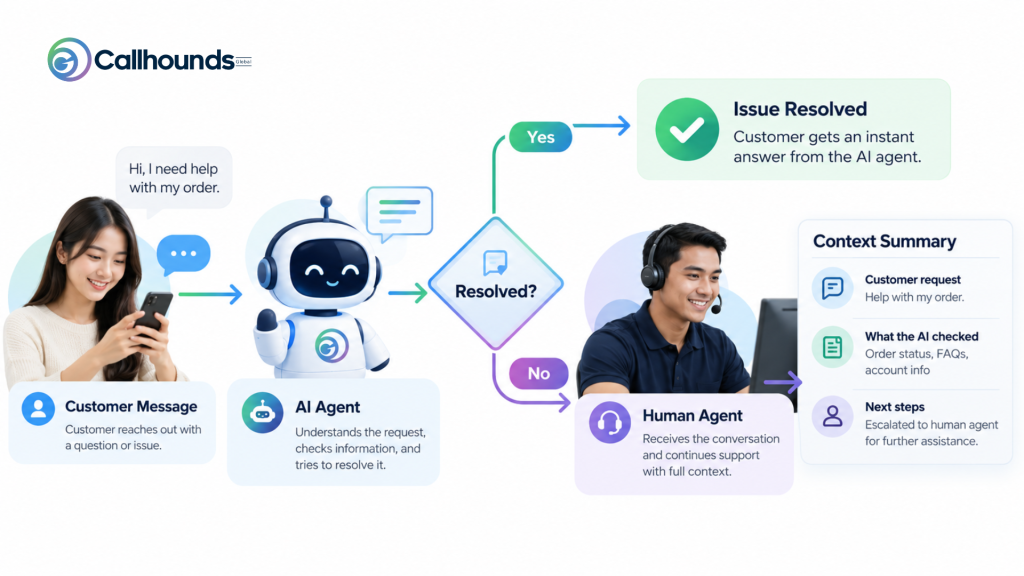
The handoff is where most hybrid setups win or fail. A good one feels invisible to the customer. A bad one makes them repeat their story to a second stranger. Here is the flow we recommend building:
Many teams also run the AI in copilot mode on live conversations, where it suggests replies and pulls up policy text while the human stays in control. That approach is covered in more detail in our guide to the ai agent copilot, and it works especially well for newer agents who are still learning your product.
One rule matter more than any other: never trap a customer in a loop. If someone asks for a human, route them to one. In our experience, the fastest way to lose trust is a bot that keeps rephrasing the same unhelpful answer.
No single model wins on every measure. The table below compares the three common approaches, so you can see where each one fits.
Table 2: AI Agents, Outsourced Teams, and the Hybrid Model Compared
| Factor | AI Agents Only | Outsourced Team Only | Hybrid Model |
| Availability | 24/7, instant | 24/7 with shift planning | 24/7, instant first response plus live humans |
| Cost per contact | Lowest for simple requests | Lower than in-house, higher than AI | Lowest blended cost across all ticket types |
| Complex issues | Weak; needs escalation | Strong | Strong, with AI preparing the case |
| Empathy and tone | Limited | High | High where it matters most |
| Scaling speed | Very fast | Moderate; needs hiring and training | Fast for simple volume, planned for complex |
| Consistency | High on scripted tasks | Depends on training and QA | High, with QA on both sides |
| Main risk | Wrong answers and frustrated customers | Higher cost on repetitive work | Poor handoff design |
| Best for | High-volume, low-variability requests | Relationship-heavy or regulated work | Most growing support operations |
Read the last column with care. The hybrid model does not remove risk. It moves the risk to the handoff, which is why the design work in the previous section deserves real attention before you launch.
Chatbots cut overhead, but they also frustrate customers when they are given work beyond their ability. Four problems come up again and again.
These are governance questions, not just technical ones. Our article on ai ethics in customer service walks through disclosure, data handling, and accountability in more depth. The NIST AI Risk Management Framework is also a solid public reference for building review habits around AI tools.
Outsourced teams carry their own risks: uneven training, weak security controls, and turnover. Ask any provider for their attrition rate, their quality assurance process, their access controls, and their compliance certifications. A good partner answers those questions without hesitation.
Export three to six months of tickets and sort them by topic, volume, handling time, and customer sentiment. Mark each topic as low or high variability. Most teams find that a handful of topics drive a large share of volume, and those are the first automation candidates. Interview your best human agents too. They know which “simple” requests are not simple.
Launch the AI agent on two or three request types only. Staff the outsourced team on the escalation path and on every topic the AI does not cover. Review a sample of conversations daily and log every failed handoff. Keep the pilot small enough that you can read what happened, not just count it.
Add request types one at a time, each with its own success threshold. Train outsourced agents on the AI’s summaries and suggested replies and give them a simple way to flag bad suggestions. Set a monthly review where support, operations, and your BPO partner look at the same dashboard.
Containment rate, the share of tickets the AI closes alone, is the metric most vendors show first. It can mislead you. A bot can “contain” a ticket by exhausting the customer. Pair it with these measures:
Review these numbers monthly and adjust the split. Some request types will move from human to AI as the model improves. Others will move the other way after a bad quarter. The right balance is a moving target, and the teams that check it regularly stay ahead of the ones that set it once.
AI agents and outsourced teams are not a choice between machines and people. They are a division of labor, and the companies that draw the line carefully win on cost, speed, and customer loyalty at the same time. Start with your own ticket data, automate only what is repetitive and low risk, and staff the rest with people who are trained, supported, and measured on real outcomes.
Callhounds Global provides customer support outsourcing from the Philippines for companies in the United States, the United Kingdom, Australia, and beyond, with dedicated teams that work alongside your AI tools. If you are planning a hybrid model, talk with our team about the right split for your ticket mix.
Key Takeaways
Let AI agents take the first contact and resolve routine requests, then route anything emotional, complex, or high value to trained outsourced agents through a warm handoff. Define escalation triggers before launch, share full conversation context with the human agent, and review the results monthly.
Not entirely. AI agents are taking over a growing share of repetitive tickets, but customers still want a person for disputes, cancellations, and sensitive problems. Outsourced teams are shifting toward higher-skill work such as escalations, quality review, and relationship management, rather than disappearing.
It depends on your ticket mix. Companies with many order-status, passwords, and FAQ requests can automate a large portion, while companies with technical, regulated, or high-value contacts will automate less. Audit three to six months of tickets to find your real number instead of relying on vendor averages.
Yes, as a best practice, and in some regions by law. Transparency builds trust, and rules like the EU AI Act require disclosure for many chatbot interactions. A short, clear message at the start of the chat, plus an easy option to reach a human, covers most needs.
Limit each system to the data it needs, mask sensitive fields such as card numbers, and require role-based access for agents. Ask your BPO partner for its security certifications and audit practices and review your AI vendor’s data retention and training policies before you connect to any customer records.