

AI Automation vs Human Empathy: Finding the Right CX Balance
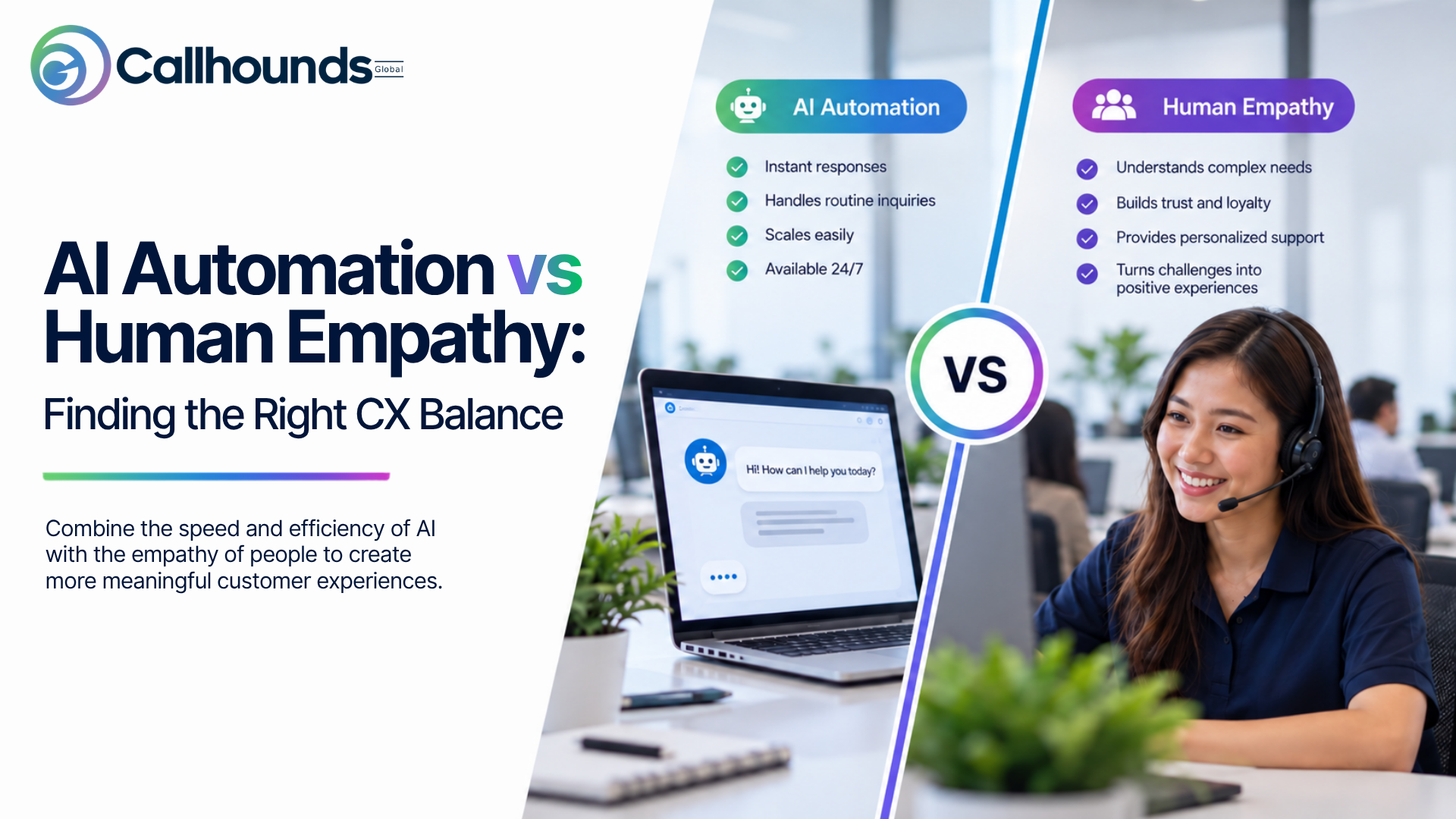
Customers want fast answers, but they also want to feel understood. That’s where AI Automation vs Human Empathy becomes more than a technology debate. Use too much automation, and customers can feel ignored. Relying too heavily on human support, and slow response times, rising costs, and agent burnout can quickly follow.
The real advantage isn’t choosing AI over people, or people over AI. It’s knowing when speed matters and when sensitivity matters.
AI can instantly handle routine questions, track orders, process simple requests, and support customers around the clock. But when a customer is frustrated, confused, or dealing with a problem that falls outside the usual script, human judgment and empathy can make all the difference.
The strongest customer experience strategies combine both. AI handles volume and speed. Humans handle complexity, emotion, and moments that require genuine understanding.
So, where should businesses draw the line? This article explores AI Automation vs Human Empathy, where each approach performs best, and how a hybrid customer support model can deliver faster service without making customers feel like just another ticket.
Speed is the most obvious advantage, but it is not the only one. AI automation, when built on natural language understanding and natural language processing rather than rigid decision trees, can read intent behind imperfect phrasing, pull account data instantly, and resolve routine requests without putting anyone on hold.
Password resets, order status checks, appointment rescheduling, billing lookups, and return initiations are the classic use cases, and for good reason: customers rarely want a heartfelt conversation about a forgotten password. They want it fixed in under a minute. Modern agentic AI goes a step past answering questions; it can act inside connected systems, retrieving an order ID from an ERP platform and processing a return without a human ever touching the ticket.
Consistency is another underrated strength. A well-trained AI agent applies the same policy the same way at 3 a.m. and at 3 p.m., across every language it supports, without a bad night’s sleep or a rushed shift changeover affecting the answer. For businesses running support across US, UK, and Australian time zones simultaneously, that round-the-clock consistency is difficult to match with staffing alone.
Cost efficiency follows naturally from all of this. Every ticket a bot resolves correctly is a ticket a human agent never has to touch, which frees that agent’s attention for the conversations that need a person.

Complexity and emotion are where the gap between simulated and genuine empathy becomes obvious. Independent survey data has found that a majority of consumers still want a human when a question turns complicated or when the situation calls for real emotional understanding, even among people who are otherwise comfortable using AI for quick tasks.
Part of the reason is what researchers describe as the uncanny valley effect: once an AI response gets close to sounding human but not quite right, trust in that response can drop sharply rather than rise. A slightly off tone, a canned apology, or a response that ignores context a person clearly stated two messages earlier reads as worse than no attempt at empathy at all.
There’s also a structural limit worth naming plainly. Sentiment analysis can detect frustration in a customer’s word choice or voice tone, and long-term memory can help a chatbot recall a previous complaint, but detecting an emotion and genuinely caring about it are different things. AI can be responsive and non-judgmental, which are real advantages, but attaching emotional language to a system that cannot reciprocate care risks reading as manipulation rather than comfort once a customer notices the pattern.
Human agents also bring judgment that no current model fully replicates: the ability to bend a policy when the situation warrants it, to read between the lines of what a customer is actually asking for, and to make a case-by-case call that a rules engine was never built to make. Healthcare scheduling changes, bereavement-related account closures, billing disputes tied to financial hardship, and any conversation involving safety or legal exposure belong with a trained person, not a script.
The Data Behind the AI Automation vs Human Empathy Debate
| Customer Preference by Scenario | AI Automation Preferred | Human Agent Preferred |
| Quick factual answers (order status, hours, pricing) | High | Low |
| Password resets and account access issues | High | Low |
| Complex billing disputes | Low | High |
| Emotionally sensitive situations (health, loss, hardship) | Low | High |
| Multilingual or after-hours support | High | Moderate |
| First-time complaint escalation | Moderate | High |
| AI Capability | What It Detects or Does | Current Limitation |
| Sentiment analysis | Reads tone in text or voice for frustration or urgency | Detects emotion; does not experience it |
| Natural language understanding (NLU) | Interprets intent behind imperfect phrasing | Can misfire on sarcasm, slang, or mixed intent |
| Retrieval-augmented generation (RAG) | Grounds answers in live, relevant data | Only as accurate as the knowledge base behind it |
| Agentic AI | Acts across systems, not just answers | Needs clear guardrails to avoid overstepping authority |
| Long-term memory | Recalls prior interactions for continuity | Raises privacy and consent questions if unmanaged |
These figures line up with what most support leaders already sense from their own queue data: customers are pragmatic, not anti-technology. They want a fast answer when the request is simple and a person when it is not, and they can tell within a few exchanges which one they are getting.
The businesses getting this right are not choosing a side; they are designing a handoff. A well-built hybrid model lets AI take the first pass at every request, resolve what it can resolve cleanly, and pass the rest to a human with the full conversation history attached, so the customer never has to repeat themselves. That last detail matters more than most brands realize: forcing a customer to re-explain their problem after being transferred is often what turns a minor inconvenience into a genuine complaint.
Getting there takes three deliberate steps. First, decide what AI owns and what stays with people, based on real ticket data rather than guesswork; most teams find that thirty to fifty percent of incoming volume is routine enough to automate safely. Second, train the AI on actual customer phrasing, not just textbook questions, since real customers rarely ask for what they need in the cleanest possible words. Third, set brand and tone-of-voice guidelines, so the AI sounds like an extension of the team rather than a generic script.
Readers weighing how those guidelines should read can review a closer look at what customers prefer when comparing ai vs human agents for a deeper breakdown of the preference data by scenario.
One pattern worth watching closely is copilot-style deployment, where AI works alongside a live agent instead of replacing the conversation outright, suggesting responses, surfacing account history, and drafting replies to the agent’s reviews before sending. Teams evaluating that middle path often start by exploring a ai agent copilot setup, since it keeps a person in the loop on every emotionally weighted exchange while still cutting average handle time on the routine parts of the call.
Most AI rollouts that damage customer trust share the same few root causes, and nearly all of them are avoidable with planning rather than better technology.
The first mistake is deploying AI without an obvious, easy exit to a human. If a customer has to hunt for a way out of the bot, frustration compounds fast, and the goodwill the AI built by answering the first question quickly gets erased entirely. The second mistake is training AI on outdated knowledge bases, which produces confident-sounding wrong answers. A failure mode worse than no answer at all because it damages trust in every future interaction. The third mistake is skipping tone-of-voice work, leaving AI responses that are technically correct but emotionally flat or, worse, inconsistent with how a human teammate would phrase the same message.
The fourth and most overlooked mistake is treating the rollout as a one-time project instead of an ongoing practice. Chat transcripts and escalation patterns should be reviewed regularly, so new intents, phrasing variations, and edge cases get folded back into the system. Teams evaluating a full-stack platform built around this ongoing feedback loop, including routing logic, escalation rules, and reporting, often compare options like ai contact center software before committing, since the underlying platform determines how easily these adjustments can happen later without a rebuild.
The AI automation vs human empathy question is not about picking a winner. It is about matching the right resource to the right moment and doing it consistently enough that customers stop noticing the mechanics and start noticing that their problems are solved. Companies that get this right treat AI as a teammate that handles volume and consistency, freeing human agents to spend their time on the conversations where a person’s judgment, patience, and genuine care make the actual difference between a customer who stays and one who leaves a bad review.
The support teams winning this balance right now share three habits: they measure which requests genuinely need a human before building automation around guesses, they train their AI on the customer’s real words instead of an idealized script, and they never make a person fight their way past a bot to reach help. None of that requires abandoning automation. It requires building it with the same care a good manager would use to train a new hire, because in a real sense, that is exactly what deploying AI support actually is.
Key Takeaways
AI automation reduces the volume of routine tickets that reach human agents, but it does not eliminate the need for people. Complex, emotional, or policy-sensitive conversations still perform better with a trained agent, so most support teams shift headcount toward those harder cases rather than cutting staff outright.
AI can detect emotional signals through sentiment analysis of word choice, punctuation, and voice tone, and it can adjust its response accordingly. What it cannot do is genuinely feel concern about the way a human agent does, which is why emotionally complex situations still benefit from human oversight.
There is no universal number, but many support teams find that thirty to fifty percent of incoming volume, mostly routine and repetitive requests, can be automated safely once ticket data is reviewed. The right figure depends on industry, customer base, and how sensitive the typical request tends to be.
Most customers accept a chatbot for quick, factual questions like order status or account access, and many prefer the speed. Acceptance drops sharply once the request becomes complicated or emotionally charged, at which point customers expect a clear, fast path to a human.
A standard chatbot answers questions using natural language processing to interpret intent. Agentic AI goes further by acting inside connected systems, such as processing a return or updating an account, rather than simply describing what the customer should do next.