

The Future of Global Work
The future of global work is a distributed, technology-supported model in which talent is sourced across borders, teams operate across time zones by design, and results depend less on where employees sit than on how well a company manages engagement, skills, and technology together. Organizations that build around this model can expand access to talent, support cross-border operations, and create greater flexibility in how work is organized.
Picture a customer inquiry opened in Sydney at nine in the morning, picked up by an agent in Manila before lunch, and closed out by a technical specialist logging in from Manchester that same afternoon. No one in that chain has ever met in person, yet the handoff feels instant to the customer who filed it. That is not a thought experiment. It is how a growing number of American, British, and Australian companies already run day-to-day operations, and the practice is moving from novelty to default.
Three forces are pushing this shift along faster than most leadership teams expected: a global engagement problem that traditional office culture has not solved, a labor market that keeps tightening for specialized skills, and artificial intelligence that is changing what a job even looks like. Together, these trends are shaping the future of global work, where distributed teams, cross-border collaboration, and technology-enabled roles are becoming increasingly central to how businesses operate.
What follows is a look at where global work is heading, what the latest workforce data says about it, and how companies can plan for the next few years instead of reacting to them.
Why the Global Work Model Is Changing Faster Than Expected
Three pressures are converging at once. Employers are dealing with tight labor markets for specialized roles, persistent engagement problems among their own teams, and a wave of new technology that is changing how work gets assigned and measured. Add to that ongoing economic and geopolitical uncertainty, and it becomes clear why so many leadership teams are rethinking the assumption that work must happen in one building, in one city, or under one payroll structure. These shifts are also shaping the future of global work, where companies can access specialized talent beyond traditional geographic boundaries.
The pandemic normalized remote and hybrid arrangements within a single country. The next phase looks different: companies are not just letting existing staff work from home; they are actively building teams made up of people who were never local employees to begin with. This distinction matters because this approach changes how a business plans to hire, budget, manage teams, and invest in technology from the ground up rather than treating global work as an afterthought.
The Rise of Distributed, Borderless Teams
Companies now build teams that span several countries at once, for reasons that go well beyond lower labor costs. A distributed structure gives a business near-continuous coverage across time zones, access to specialized skill pools that may not exist locally, and a cost base that is easier to scale up or down than a fixed office lease. For a closer look at how offshore staffing is reshaping cost structures and hiring plans this decade, see our Future of Outsourcing white paper, which breaks the numbers down by industry and region.
This is not a call center trend anymore. Legal review, software quality assurance, financial reconciliation, and technical support all now run through distributed teams as a standard operating choice rather than a cost-cutting exception. Businesses can get more value from this model when offshore and outsourced staff are treated as an extension of the core team, with consistent onboarding, performance management, and career development.
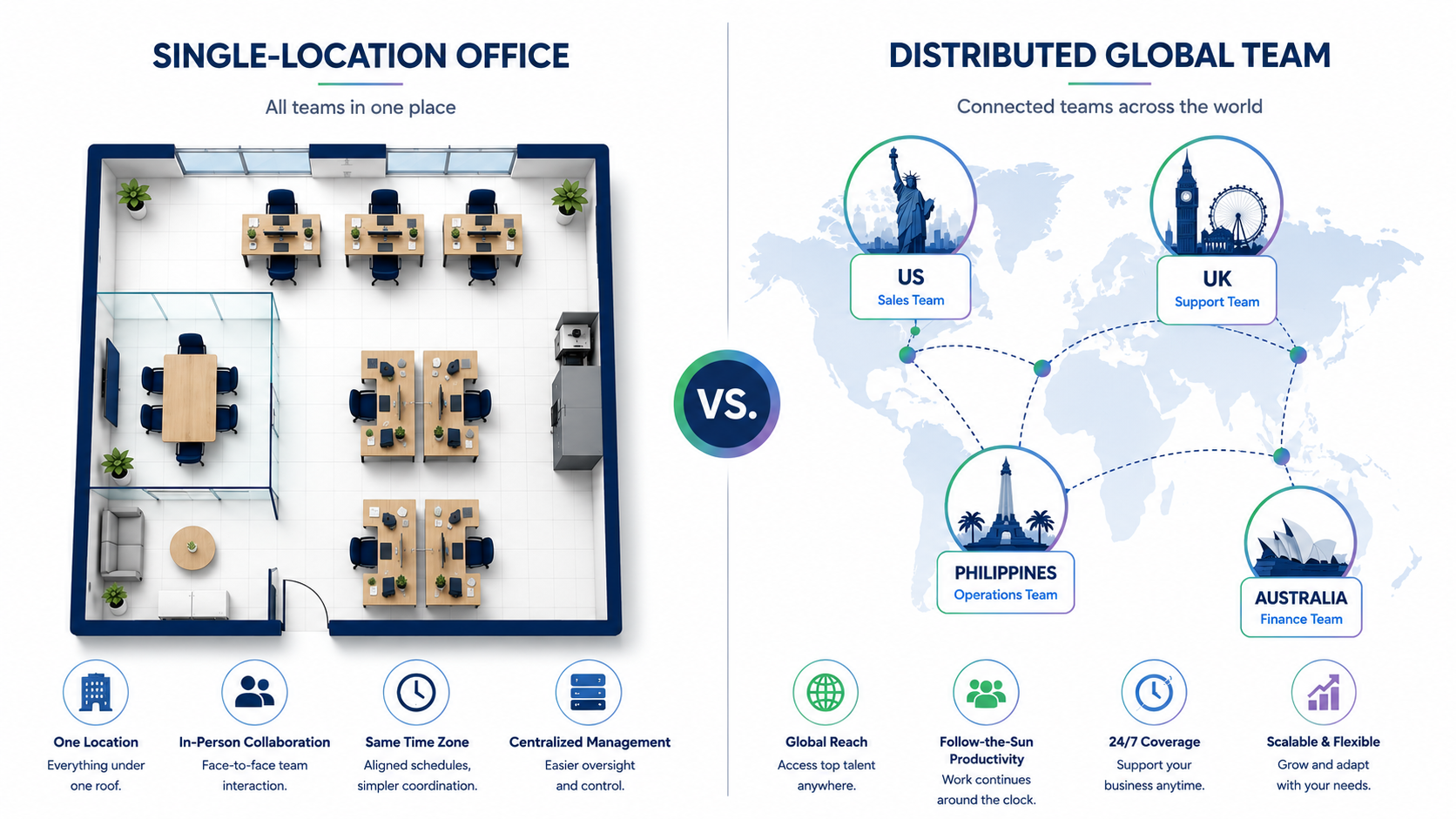
Table 1: Traditional Office Model vs. Distributed Global Workforce
| Factor | Traditional Single-Location Office | Distributed Global Workforce |
| Talent Pool | Limited to the local commuting radius | Access to specialized talent across multiple countries and time zones |
| Operating Hours | Fixed to one time zone, typically 8-10 hours a day | Near-continuous coverage across regions such as the US, UK, and the Philippines |
| Overhead Costs | High: real estate, utilities, and equipment for every employee | Lower fixed overhead, with costs shifting toward staffing partners and technology |
| Scalability | Slow, tied to lease terms and local hiring pace | Faster scaling up or down through an established staffing partner |
| Business Continuity | Vulnerable to local disruptions such as weather or transit issues | More resilient, since a disruption in one location does not halt every function |
AI, Automation, and the Skills Employers Need Now
Recent workforce research shows a clear split between what AI does for individual employees and what it does for a company. Among U.S. workers whose organizations have rolled out AI tools, 65% say the technology has had a somewhat or extremely positive effect on their personal productivity. Yet only 12% strongly agree that AI has changed how work gets done across their organization. A separate survey of executives across the US, UK, Germany, and Australia found that 89% of leaders saw no measurable impact of AI on company-wide labor productivity over the past three years, even as they expect a modest 1.4% productivity gain over the next three.
The gap between individual gains and organizational results points to a management problem more than a technology one. Employees whose managers actively support AI adoption are 8.7 times more likely to say AI has changed how work gets done, and 7.4 times more likely to say it frees them up to focus on higher-value tasks. Despite that, fewer than one in three U.S. employees in AI-adopting organizations say their manager actively supports the team’s use of these tools, and comparable research in Germany puts that figure at just 21%.
For companies without the internal resources to build AI infrastructure, train managers, and redesign workflows simultaneously, outsourcing can provide access to specialized teams while internal leaders focus on adoption, governance, and higher-value work. One practical path is pairing outsourced tech support teams with AI-assisted tools, so front-line agents get real-time guidance without the company needing to build that infrastructure from scratch. It also puts the management layer in the hands of a partner who is already trained on getting adoption right.
Employee Engagement and Wellbeing in a Global Workforce
Global employee engagement dropped to 20% in 2025, its lowest point since 2020 and the second consecutive annual decline. A trend researchers estimate cost the world economy close to $10 trillion in lost productivity, or roughly 9% of global GDP. Most of that decline traces back to managers rather than individual contributors: manager engagement fell from 31% in 2022 to 22% in 2025, while engagement among non-managers slipped only slightly, from 20% to 19%, over the same period.
This pattern makes sense once you consider what has landed on managers’ desks in the past few years: leading hybrid and distributed teams, absorbing pressure from AI rollouts, and making harder calls about headcount, all while feeling less supported themselves. There is a silver lining in the same data set: overall employee wellbeing rose to 34% in 2025, up from 33%, the first improvement in three years, with Latin America and the Caribbean and Europe posting the largest regional gains at two points each.
For a distributed or outsourced team, this data carries a direct lesson. Moving a function offshore does not automatically fix an engagement problem, and it can make it worse if the same weak management habits simply follow the work to a new location. Businesses can strengthen the performance of their global teams by treating them the way they would treat any other team: with real coaching, clear goals, and managers who are trained to lead people they may never meet in person.
Table 2: Regional Shifts in Job Market Optimism (2025 vs. 2024)
| Region | Change vs. 2024 | Context |
| Australia/New Zealand | -12 points | Fell from the world’s best-perceived job market to second place, behind Southeast Asia |
| United States/Canada | -10 points | Now near the bottom of global job-market rankings, down 23 points since 2019 |
| Southeast Asia | Improved | Moved into the top-ranked position for job market optimism worldwide |
| Global Average | +1 point | Gain came almost entirely from on-site, non-remote-capable workers |
How Businesses Can Prepare for the Future of Global Work
Getting ahead of this shift takes more than opening a new office abroad. A handful of practical moves separate companies that manage the transition well from those that struggle with it:
- Map skill gaps first, then decide where to source talent, rather than choosing a country and working backward.
- Train managers specifically leading distributed and AI-assisted teams, since manager support is one of the strongest predictors of successful AI adoption.
- Spread hiring across more than one region to reduce exposure to a single volatile labor market.
- Formalize onboarding and engagement measurements for offshore and outsourced staff, using the same standards applied to in-house teams.
- Modernize back-office systems and workflows alongside any staffing changes, so new team structures and new technology arrive together instead of in separate phases.
Because so much of this depends on updated systems and workflows, many companies pair their global staffing plans with a broader Digital Transformation in 2026 initiative, rolling out new tools and new team structures on the same timeline instead of treating them as separate projects.
The Global Talent Equation: What US, UK, and Australian Companies Should Watch
Each of these three markets is facing its own version of the same underlying shift. In the United States and Canada, business media described 2025 as a “no hire, no fire” climate, and revised job figures show the US added roughly 181,000 jobs last year, down sharply from 1.5 million the year before. That caution is pushing more American companies to fill specialized and support roles through outsourcing partners rather than committing to new local headcount.
Australia and New Zealand, long home to one of the world’s best-perceived job markets, dropped to second place behind Southeast Asia in 2025 after a 12-point decline in worker optimism. Employers there are increasingly looking outward for scale, particularly in customer support, back-office, and technical roles where near-shore or offshore staffing can fill gaps faster than local recruiting.
Across the UK and the wider European market, employee thriving rose by two points in 2025, one of the largest regional gains recorded, even as job market sentiment stays uneven overall. For UK businesses, that combination highlights the importance of investing in how their people are managed and supported, wherever those people happen to be located.
Final Thought
According to Gallup’s State of the Global Workplace: 2026 Report, global employee engagement dropped to 20% in 2025. The future of global work is already visible in the data: a distributed talent base, an engagement problem that will not solve itself, and an AI transition that rewards companies with strong management more than companies with the most tools. Businesses that treat global staffing as a full operating model, not a quick fix, can build a stronger foundation for the next several years.
Key Takeaways
- Global employee engagement fell to 20% in 2025, the lowest level since 2020, an outcome tied to roughly $10 trillion in lost productivity worldwide, a sign that management practices, not geography, are the bigger obstacle to workforce performance.
- Distributed and borderless staffing is evolving from a pandemic-era response into an established operating model for many companies competing across the US, UK, and Australia.
- Treat AI adoption as a management initiative, not simply a technology rollout. Individual productivity gains do not automatically translate into organization-wide results.
- Job market optimism dropped sharply in Australia/New Zealand (-12 points) and the United States/Canada (-10 points) in 2025, pushing more employers toward flexible, cross-border talent plans.
- Companies that pair global staffing with active management, structured onboarding, and clear technology integration see stronger retention than those that simply move work offshore without changing how it is run.
- Working with an established outsourcing partner can shorten the time it takes to build a reliable, well-managed global team.
References
- Gallup, State of the Global Workplace: 2026 Report.
- Boston Consulting Group (BCG), Future of Work Research.
Frequently Asked Questions
What does “future of global work” mean?
It refers to a workforce model where companies hire and manage talent across multiple countries and time zones as a standard practice, not an exception. That includes a mix of in-house, remote, and outsourced roles coordinated through shared technology and management standards, rather than a single team working from one office.
Is remote work still growing, or has hybrid become the norm?
Hybrid arrangements have stayed stable, while pure remote work has cooled slightly, with optimism among fully remote workers down five points in 2025. Fully on-site roles that could be done remotely saw an even larger 14-point drop in perceived opportunity, which suggests hybrid, rather than fully remote or fully on-site, is emerging as the more durable middle ground.
How is AI affecting global teams right now?
AI is improving output for individual employees in many organizations, with 65% of U.S. workers in AI-adopting companies reporting a positive effect on their own productivity. Company-wide gains are lagging, though, largely because manager-led adoption remains inconsistent. Teams with active manager support around AI are far more likely to report real changes in how work gets done.
Why is employee engagement dropping worldwide, and does it affect outsourced teams too?
Global engagement fell to 20% in 2025, driven mainly by a steep decline in manager engagement rather than individual contributors. The same pressures apply to outsourced and distributed teams: without active coaching and clear management, moving work to a new location will not fix an underlying engagement problem, and can sometimes carry it along.
How can a company start moving toward a more global workforce model?
Most companies start with a single function, often customer support, technical support, or back-office processing, and work with an outsourcing partner experienced in that specific role and region. From there, they build onboarding, reporting, and technology integration before scaling the model to other departments.