

The Economics of Offshoring: Cost Savings, Global Talent, and Sustainable Growth

Every dollar a company sends overseas for production, or support work is really a bet on two things: cost and capability. The economics of offshoring is the branch of trade and business economics that studies why that bet so often pays off, how firms weigh wage gaps, fixed costs, and market access against the risk of losing day-to-day control over quality, timing, and data. For call center operators, manufacturers, and IT leaders alike, offshoring remains an important strategy for reducing operating costs while giving firms access to skilled labor pools outside their domestic markets.
In 2026, the underlying math has shifted again as wage gaps between advanced and developing economies narrow, automation spreads into back-office work, and near-shoring gains ground in North America and Europe. Yet the core economic logic that has guided six decades of production migration has not changed: firms move tasks to wherever they can be performed at the lowest total cost without sacrificing the output the customer needs.
This guide breaks down what offshoring means in economic terms, the factors that push a firm toward an offshore decision, the basic cost mechanics behind it, and what the research says about who wins and who loses when jobs move across borders.
What “Economics of Offshoring” Actually Means
Economists generally treat offshoring as a form of trade rather than a separate phenomenon. When a company moves a task abroad, call center support, software testing, or parts assembly, among other examples, it is functionally importing a service or an intermediate good instead of producing it domestically. The distinction between “outsourcing” and “offshoring” matters here: outsourcing simply means paying for an outside party to do work that was once done in-house, and that outside party can be down the street. Offshoring specifically means the work crosses a border, either to a foreign subsidiary of the same company (captive offshoring) or to an independent foreign supplier (non-captive offshoring).
Viewed this way, offshoring follows the same logic as any other cross-border trade decision: a firm compares the price of producing a good or service at home against the price of importing it, factoring in freight, communication, coordination, and risk. If the imported version is cheaper once every cost is counted, the economically rational move is to import it, which, in the labor market, looks like a job moving overseas.
The Core Drivers Behind an Offshoring Decision
No single factor explains why one company offshores, and another does not. In practice, decisionmakers weigh a mix of the following:
- Comparative cost: If a task costs less to perform abroad after transportation and coordination costs are included, it makes financial sense to move it.
- Falling communication and logistics costs: Fiber-optic networks, cloud tools, and cheaper freight have turned non-tradable tasks, like phone support or medical transcription, into tradable ones.
- Scale economies abroad: As a foreign market or supplier base grows, average costs there tend to fall, making the location more attractive over time.
- Task separability: Work that can be broken into discrete, standardized steps is far easier to offshore than work that depends on constant back-and-forth with headquarters.
- Time-zone coverage: Splitting a task across time zones lets a company run support or development around the clock without paying overtime.
- Risk-shifting under uncertainty: When technology or demand is hard to predict, shifting production to a contract supplier abroad can move some of that risk off a firm’s own balance sheet.
- Regulatory and trade liberalization: Deregulation and privatization in both developed and developing markets have opened service sectors, banking, insurance, telecom, that were once closed to foreign competition.
- Institutional quality: Legal protections, political stability, and worker training all affect how much a company trusts a given country to handle sensitive or complex work.
- Tax and investment climate: Favorable tax treatment abroad can tip the decision even when raw labor costs are close between two locations.
- Currency diversification: Spreading operations across countries also spread exposure to any single currency’s movement.
These factors rarely act alone. A country with a modest wage advantage but strong institutions and a well-trained workforce, such as the Philippines in customer support or India in software development, often wins out over a cheaper but riskier alternative.
The Cost Economics of Offshoring: A Simple Model
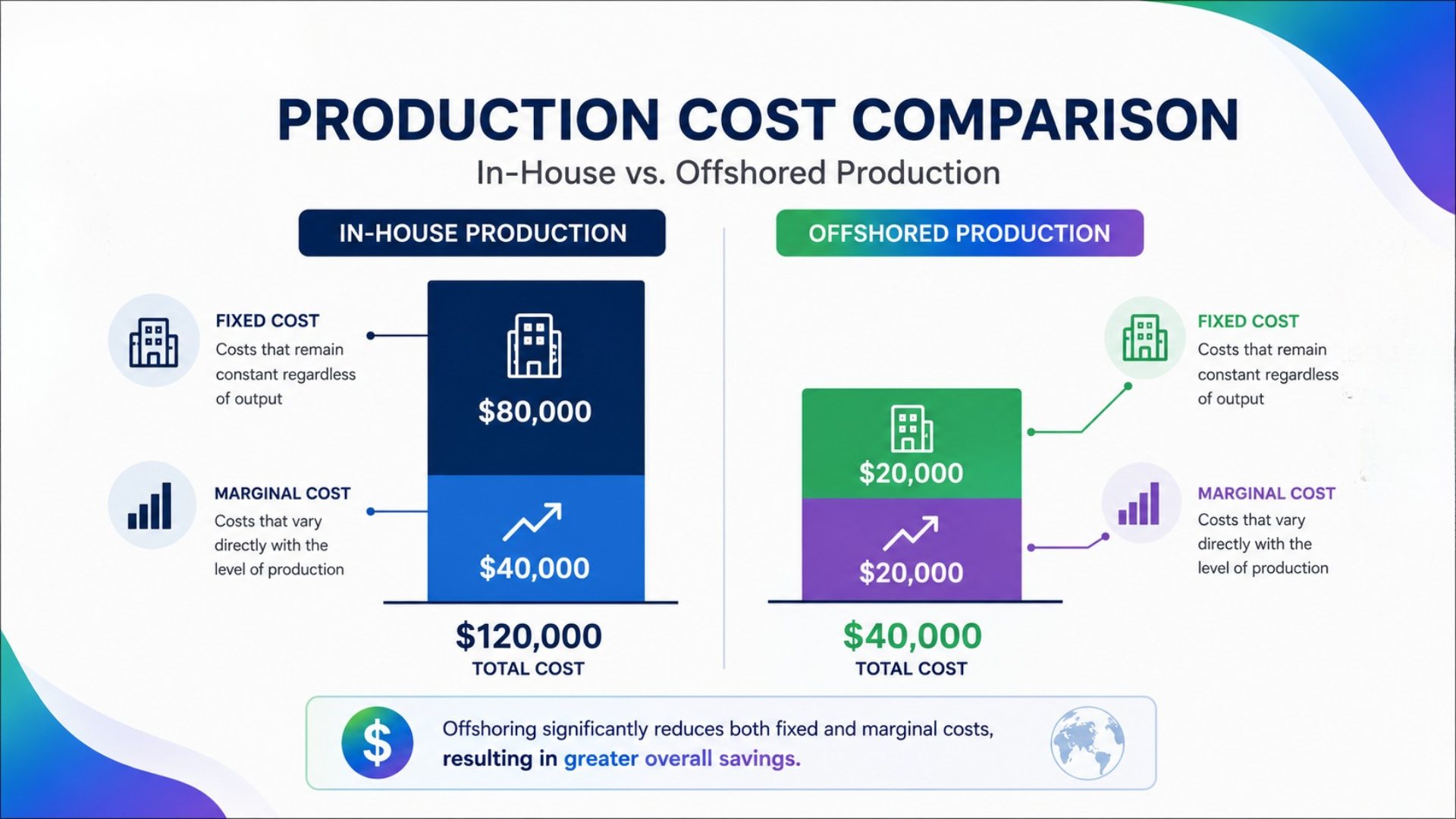
The basic case for offshoring is easiest to see by splitting production into two stages: design (a fixed cost) and assembly or execution (a marginal, per-unit cost). Picture a domestic company with a lower fixed cost than a foreign competitor but a higher per-unit cost. If that domestic firm keeps both stages in-house, it pays its own marginal cost on every unit it produces. If it offshores the execution stage to the foreign firm, which has a lower marginal cost, its total cost per unit drops, output can expand, and profit rises even after accounting for the fixed cost it already paid.
This is the mechanism behind most offshoring business cases: a firm does not need every stage of production to be cheaper abroad. It only needs the stage it chooses to take offshore to carry a lower marginal cost than doing it domestically. The same logic extends to firms with many production stages, design, assembly, testing, customer support, each of which can be offshored independently to whichever location offers the best price for that specific task. This is why a single finished product, from a toy to a piece of software, can carry components, code, or service touchpoints sourced from half a dozen countries.
A related gain comes from specialization rather than cost alone. A firm that produces two inputs in-house can often increase total output by specializing in the input where it holds a comparative advantage, exporting the surplus, and importing the other input from a foreign partner instead of trying to make both well. This is the same principle that underpins classical trade theory, applied at the level of a single firm’s supply chain.
The Four Modes of Service Offshoring
Service offshoring is not one-size-fits-all. The World Trade Organization’s widely cited framework splits it into four modes, each carrying a different level of investment and control.
| Mode | Description | Common Examples | Typical Investment |
| Mode 1 | Arm’s-length supply; buyer and supplier stay in their home countries | Call centers, back-office processing, software development | Low-Mod. |
| Mode 2 | The customer travels to the supplier’s location to receive the service | Medical tourism, education abroad | Low |
| Mode 3 | The supplier establishes a commercial presence in the buyer’s country | Foreign bank branches, insurance subsidiaries | High |
| Mode 4 | The supplier’s workforce temporarily relocates to the buyer’s country | Construction crews, visiting consultants | Mod. -High |
Mode 1 is what most people picture when they hear the word “offshoring,” and it is the mode that dominates the business process outsourcing industry today. It requires no physical relocation of staff or capital on either side, which is part of why it scales so quickly once the underlying communication infrastructure is in place. For a broader look at how these delivery models are evolving, our outsourcing trends shaping 2026 and beyond analysis breaks down where buyers are placing new work.
Offshoring by the Numbers: Growth and Trends
The growth of offshoring tracks closely with the growth of trade in intermediate goods and services. While early offshoring was concentrated heavily in manufacturing, advances in telecommunications and digital infrastructure expanded the model into services. Academic research going back to the 1990s documented that the share of imported inputs in U.S. manufacturing output roughly doubled between the mid-1970s and mid-1990s, and similar patterns showed up in the United Kingdom and Canada. On the export side, the share of imported content embedded in goods produced for export grew by nearly a third among a group of OECD and emerging-market economies between 1970 and 1990.
IT and business process offshoring picked up sharply in the 2000s, led by India and, later, the Philippines, as companies such as HP, Citibank, Dell, and Amazon built large customer support and processing operations abroad. Asia-based surveys from the mid-2000s found that roughly half of surveyed companies in the region were already outsourcing IT services, with accounting, debt collection, and tax processing following close behind.
The picture in 2026 looks different in scale, but the underlying economics remain similar. Wages in long-established outsourcing hubs have risen steadily, narrowing, though far from closing, the gap that once made offshoring an easy call on price alone. Buyers now weigh talent depth, data security, time-zone alignment, and delivery-model flexibility alongside raw labor cost. Readers who want current figures on where offshore spending is heading by region and sector can review our outsourcing market growth data for 2026.
Who Offshores and Who Benefits: Firm Characteristics
Firms that offshore and export tend to look different from those that do not. Research across manufacturing and services exporters shows a consistent pattern: companies engaged in offshoring and exporting are generally larger, more productive, pay higher average wages, and are more likely to survive and grow than firms that keep their operations entirely domestic. Business service exporters, for example, have been found to employ around 70 percent more staff, generate roughly double the sales, and pay about 20 percent higher wages than otherwise similar non-exporting firms in the same industry.
This pattern helps explain the economics of offshoring. Both offshoring and exporting require a certain level of scale, capital, and management sophistication that smaller, purely domestic firms may lack. Companies that clear these barriers are often already stronger performers within their industries, while offshoring can provide additional cost advantages that help reinforce their competitive position.
The Welfare Debate: Winners, Losers, and Net Effects
The hardest question in the economics of offshoring is not if it raises total output; most economists agree it does, but how the gains and losses are distributed. From a national standpoint, offshoring functions like any other form of trade liberalization: it expands the overall economic pie by allowing each country to concentrate on what it does most efficiently. From a household standpoint, the picture is more mixed. Workers whose tasks move abroad often face real income loss, at least in the short term, even as consumers benefit from lower prices and firms benefit from lower costs.
One often-cited estimate of the split illustrates this tension. For every dollar of work sent from the United States to India, researchers found the transaction created roughly 33 cents of net benefit captured in India, split among local profit, labor income, supplier income, and tax revenue, while the United States retained more than a dollar of net benefit through consumer and investor savings, reemployment value, and repatriated profit from U.S.-based providers operating in India.
| Illustrative Distribution of Benefits from U.S.–India Offshoring | Approximate Share |
| U.S. consumer and investor savings | $0.58 |
| U.S. net direct benefit retained domestically | $0.67 |
| U.S. indirect benefit from worker reemployment | $0.45-$0.47 |
| India: local firm profit | $0.10 |
| India: local labor income | $0.10 |
| India: local supplier sector income | $0.09 |
| India: government tax revenue | $0.04 |
Note: The figures shown are illustrative estimates from the cited research and should not be interpreted as mutually exclusive components of a single $1 allocation. U.S. benefit categories may overlap because they capture different channels through which gains from offshoring accrue.
Displaced workers, however, do not experience these averages evenly. Studies of trade-related job loss have found that roughly two-thirds of displaced manufacturing workers find new jobs within two years, but close to half of those reemployed take a pay cut of 15 percent or more. Service workers displaced by trade have shown a similar pattern, with the majority re-employed within six months but at a median wage roughly 11 percent below their prior job. This is the core justification for wage insurance, retraining, and adjustment assistance programs: the national gains from offshoring are real, but they do not automatically reach the individuals who bear the short-term cost.
Risk Considerations for 2026 Buyers
The economics of offshoring extends beyond national and worker-level effects. Companies evaluating an offshore move face a narrower, more practical set of risks, including data security, geopolitical exposure, currency fluctuations, vendor concentration, and service continuity during regional disruptions. These considerations have become increasingly important as offshore delivery expands into higher-value and more sensitive areas such as financial processing and healthcare support.
A structured risk framework covering vendor due diligence, data governance, and business continuity planning is an important part of a comprehensive offshoring evaluation. Our outsourcing risk management guide for 2026 walks through the assessment steps buyers now use before signing a contract.
Reshoring, Near-Shoring, and the Changing Calculus
Offshoring has never been a one-way trend. As wages rise in each outsourcing hub, the cost advantage that initially attracted foreign work can gradually erode, prompting companies to move some production back home or shift operations to a third location with a more favorable cost gap. Research from the early 2010s already highlighted this pattern in Chinese manufacturing, where rapidly rising labor costs contributed to some production returning to the United States.
A similar rebalancing is visible today. As wage growth continues across mature outsourcing markets, businesses are increasingly combining offshore delivery with nearshore options in Latin America or Eastern Europe, as well as selective domestic operations for functions that require closer collaboration with headquarters. This evolving approach is an important part of the economics of offshoring, where cost savings must be weighed against talent availability, proximity, operational complexity, and business requirements. Rather than eliminating the value of offshoring, these shifts show that the lowest-total-cost location can change over time. Companies that continuously evaluate these factors can adapt more effectively than those that assume their current offshore arrangement will remain optimal indefinitely.
Policy and Worker Support Programs
Because the economics of offshoring can concentrate costs on specific workers and communities even as its benefits spread broadly, most advanced economies maintain some form of adjustment support. In the United States, this has historically included unemployment insurance, trade-specific assistance programs that extend income support and training funds beyond standard unemployment benefits, and notification requirements that give workers advance warning of mass layoffs.
Economists studying these programs generally find mixed results on whether formal retraining requirements improve reemployment outcomes. This uncertainty keeps the policy debate around wage insurance, portable benefits, and regional development grants active among policymakers.
What This Means for Businesses in 2026
The economics of offshoring are no longer determined by labor costs alone. Companies evaluating offshore delivery should compare total cost, talent availability, service quality, technology readiness, data security, time-zone coverage, vendor concentration, and business continuity. The strongest operating models increasingly combine offshore capabilities with appropriate levels of domestic and nearshore support.
Key Takeaways
- Offshoring is a form of international trade, not a special category outside it. Firms relocate tasks abroad when the total cost of doing so, including transportation, coordination, and risk, is lower than producing in-house.
- Wage differences remain a major driver of offshoring decisions, although companies increasingly evaluate talent availability, data security, time-zone alignment, service quality, and delivery risk alongside labor costs.
- Service offshoring falls into four recognized modes under the World Trade Organization framework, each with different levels of control and investment.
- Academic research consistently finds that offshoring firms are larger, more productive, and pay higher wages than firms that keep every function in-house.
- The net welfare effect of offshoring is broadly positive at the national level, but the costs land unevenly on displaced workers, which is why adjustment programs and reemployment support matter.
- Rising wages in traditional outsourcing hubs, automation, and supply-chain risk are pushing some 2026 buyers toward blended models that combine offshore, near-shore, and domestic delivery.
References
Chang, W. W. (2012). The Economics of Offshoring. Global Journal of Economics, 1(2), 1250009.
Bernard, A. B., & Jensen, J. B. (2004). Exporting and Productivity in the U.S. Oxford Review of Economic Policy, 20, 343-357.
Jensen, J. B., & Kletzer, L. G. (2008). “Fear” and Offshoring: The Scope and Potential Impact of Imports and Exports of Services. Peterson Institute for International Economics, Policy Brief PB08-1.
Kletzer, L. (2001). Job Loss From Imports: Measuring the Costs. Institute for International Economics.
Agrawal, V., & Farrell, D. (2003). Who Wins in Offshoring. The McKinsey Quarterly, Special Edition: Global Directions, 37-41.
World Trade Organization (2005). Offshoring Services: Recent Developments and Prospects. World Trade Report.
Boston Consulting Group (2011). Made in the USA, Again: Manufacturing Is Expected to Return to America as China’s Rising Labor Costs Erase Most Savings from Offshoring.
Frequently Asked Questions
What is the simplest definition of the economics of offshoring?
It is the study of why and how firms relocate production or service tasks to another country, based on comparing the full cost of producing domestically against the full cost of importing the same output, including transportation, coordination, and risk.
Does offshoring always lower costs for a company?
Not automatically. It lowers costs when the marginal cost of the offshored task abroad, plus coordination and logistics expenses, is lower than the cost of doing the same task domestically. Poor vendor selection or weak oversight can erase the expected savings.
Is offshoring the same thing as outsourcing?
No. Outsourcing means paying for an outside party to handle work once done in-house, and that party can be local. Offshoring specifically means the work moves to another country, either to a foreign branch of the same company or to an independent foreign firm.
Who benefits most from offshoring, home country, or host country?
Research generally shows both countries gain in net terms, though the split is uneven. Studies of U.S.-to-India offshoring have found the United States retaining a larger overall dollar benefit through consumer savings and reemployment value, while the host country gains through local wages, profit, and tax revenue.
Is offshoring declining because of rising wages in traditional hubs?
It is evolving rather than declining. Wage gaps have narrowed in mature markets, which have pushed some work toward near-shoring or automation, but offshoring remains a major driver of global service delivery as buyers diversify across multiple countries instead of relying on one.