

What to Include in an Outsourcing Request for Proposal (RFP)

Three outsourcing proposals. Three different pricing models. Zero clear answers.
That is what happens when an outsourcing request for proposal (RFP) fails to set clear expectations. Without a standardized scope of work, service levels, operational volumes, security requirements, pricing template, transition plan, and vendor scoring criteria, comparing providers becomes a guessing game.
One vendor charges per seat. Another bills per minute. A third bundles training, software, and management fees into a single line. Without consistent requirements, determining the true cost, service quality, and overall value of each proposal becomes difficult.
A well-structured outsourcing RFP eliminates this confusion before it becomes an expensive mistake. This guide explains what to include in your RFP, how to evaluate vendor responses, and which common mistakes can derail your outsourcing project before it even begins.
An outsourcing request for proposal is a formal document you send to a short list of providers, asking them to explain how they would handle a defined piece of work and what it would cost. It sets the rules of the contest: the same scope, the same questions, the same deadline, and the same scoring method for everyone.
It is not a sales brochure, and it is not a contract. Think of it as a structured interview on paper. You describe the job. Vendors answer in writing, and the best ones challenge your assumptions along the way. How much detail you need depends on how much you already know, which is where two related documents come in. The table below shows how an RFP differs from the RFI and RFQ.
| Document | Main purpose | Best used when | What you get back |
| RFI (Request for Information) | Learn what providers exist and what they offer | You are early, unsure of scope, or new to outsourcing | General capability summaries, rough models |
| RFQ (Request for Quotation) | Compare prices for a clearly defined job | Scope is fixed and the work is simple or repeatable | Price quotes, little detail on approach |
| RFP (Request for Proposal) | Compare solutions, pricing, risk, and fit | The work is complex, ongoing, or touches customers or data | Full proposals with approach, team, pricing, and evidence |
Table 1. RFI vs. RFQ vs. RFP
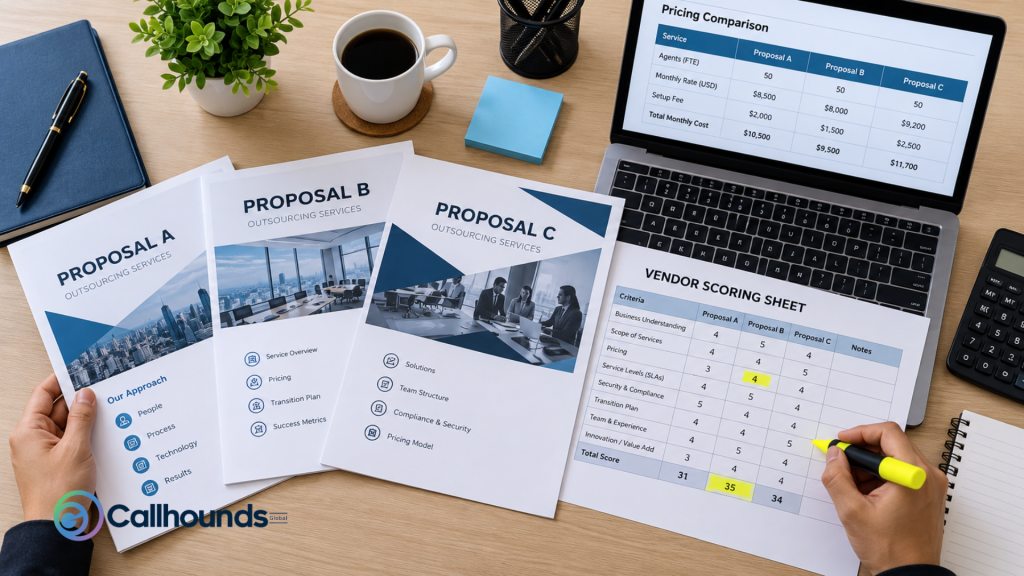
Most buyers treat the RFP as paperwork before the real work of reading proposals. It is the other way around. The quality of the answers you receive is capped by the quality of the questions you ask. A vague brief produces vague proposals padded with stock language, and vague proposals push the final decision toward whichever vendor gives the smoothest presentation.
A clear outsourcing request for proposal does three jobs. It forces your own team to agree on what success looks like before any vendor enters the room. It gives providers enough detail to price honestly instead of padding for unknowns. And it leaves a paper trail that explains, months later, why you chose one provider over another. That last point matters when finance, legal, or a new executive starts asking questions.
Use these ten sections as the spine of your outsourcing request for proposal. Keep each one short, specific, and written so that two different vendors would read it the same way.
Open with two or three paragraphs on who you are, what the work supports, and why you are outsourcing it. State the goal in numbers where you can: cut cost per ticket by 30 percent, extend coverage to 24/7, or shorten hiring time from 60 days to 15. Vendors design a different solution for a cost goal than for a growth goal, and they can only do that if you tell them which one you have.
List the processes you want to hand over, the ones you plan to keep, and the ones still undecided. Add real volumes: monthly call counts, average handle time, ticket categories, seasonal spikes, languages, and channels. A provider quoting a voice program needs call arrival patterns by hour to size a team. If you are comparing inbound call center outsourcing options, share your queue structure and after-hours rules too. Missing volumes are the most common reason two quotes for the same job land far apart.
Spell out the targets you expect and how each one is measured: service level (for example, 80 percent of calls answered within 20 seconds), first contact resolution, quality score, CSAT, average handle time, and attendance. Define the data source, the reporting frequency, and what happens when targets are missed, including service credits. Ask bidders to commit to specific numbers rather than ranges, and to name any target they consider unrealistic and explain why.
State your requirements before the first call. Name the frameworks that apply: ISO/IEC 27001 certification, SOC 2 reports, PCI DSS for payment data, HIPAA for U.S. health information, GDPR and UK GDPR for European and British customers, the Australian Privacy Act, and the Philippine Data Privacy Act when work happens in Manila or Cebu. Ask how agent desktops are locked down, how call recordings are stored, who can see customer data, and how the vendor handles a breach. Security answers deserve their own scoring line, not a footnote.
Say which platforms the provider must work inside: your CRM, helpdesk, telephony, workforce management, and QA tools. Decide if the vendor brings its own stack or uses yours, and who pays for licenses. If AI tools such as call summaries, chatbots, or quality scoring are part of the plan, ask how they are governed and where customer data goes. Request a short description of the integration approach and a realistic timeline.
Ask who will run the account. Request an org chart showing team leads, trainers, quality analysts, and a named account manager. Cover recruitment standards, English assessment methods, training length, and how the vendor keeps good agents. High turnover quietly drains service quality, so ask for twelve months of attrition data on comparable programs. Also clarify if you get a dedicated team or a shared pool.
State where you are open to having the work done. Many buyers in the US, UK, and Australia weigh onshore, nearshore, and offshore options in the same RFP, and each brings a different mix of time-zone overlap, labor cost, and risk. Ask bidders to explain site locations, business continuity plans, power and connectivity backups, and work-from-home policies. If offshore is on the table, a primer on offshore outsourcing services helps stakeholders understand what the model looks like before scoring begins.
This is where most comparisons fall apart. Provide a spreadsheet and require every vendor to fill it in. Ask for the pricing model (per full-time agent, per hour, per transaction, or outcome-based), onboarding and setup fees, technology charges, training costs, management fees, overtime and holiday rates, and annual escalation. Request a three-year total cost view, and require vendors to list assumptions in a separate column so you can see what drives each number.
Describe the handover you expect: knowledge transfer, a pilot period, a ramp-up schedule, and go-live criteria. Ask who sits on the governance team, how often business reviews happen, and how escalations work. Then ask the question most RFPs skip: what happens if the relationship ends? Request data return terms, notice periods, and the vendor’s support during a move to another provider. Vendors who answer exit questions plainly tend to be confident in their service.
Search engines reward content that shows first-hand experience and checkable evidence, and buyers should hold vendors to the same standard. Ask for three client references of similar size and industry, a sample monthly performance report, and copies of certifications. Your outsourcing request for proposal should also tell bidders how they will be judged: your criteria, their weights, your timeline, and who to contact with questions. Publishing the scoring approach keeps vendors honest and keeps your own team from changing the rules halfway through.
A scoring matrix like the one below keeps the evaluation consistent. Adjust the weights to fit your priorities, but lock them in before proposals arrive.
| Criterion | Sample weight | What to look for | Evidence to request |
| Service quality and operational fit | 25% | Clear approach to your volumes, channels, and KPIs | Sample staffing model, QA scorecard, reporting example |
| Security and compliance | 20% | Certifications and controls that match your data risk | ISO 27001 or SOC 2 report, data-handling policy |
| Pricing and total cost | 20% | Complete, itemized, and based on stated assumptions | Completed pricing template with three-year view |
| Team and people practices | 15% | Stable leadership, solid training, low attrition | Org chart, training outline, attrition data |
| Transition and governance | 10% | Realistic ramp-up and a defined escalation path | Transition plan, governance calendar, exit terms |
| References and track record | 10% | Comparable clients willing to speak candidly | Three references, case examples |
Table 2. Sample scoring matrix for an outsourcing RFP (weights total 100%).
Send your outsourcing request for proposal to three to five providers, not fifteen. Every extra bidder adds reading time and rarely improves the outcome. Start from trusted sources: peer referrals, industry listings, and roundups such as best outsourcing companies in the Philippines are useful for narrowing the field by size, specialty, and client base. A short qualification call before the full RFP helps you spend time only on realistic fits.
A typical timeline looks like this:
Most failed outsourcing requests for proposals go wrong in predictable ways. Watch for these:
A well-built outsourcing request for proposal takes real effort up front, and that effort pays back at every later stage. Clear goals produce relevant proposals. A shared pricing template makes costs comparable. Published scoring keeps the decision fair, and exit terms protect you if the relationship does not work out.
If you are drafting an RFP for customer support, sales, or back-office work, Callhounds Global can help you pressure-test your scope and volumes before you send it out. Still building your vendor list? Start with this roundup of the best outsourcing companies in the Philippines, then reach out to our team to talk through your requirements.
Key Takeaways
An outsourcing request for proposal is a written brief sent to selected providers that describes the work you want outsourced, the evidence you need, and how you will score responses. Vendors reply with their approach, team, pricing, and references so you can compare them on equal terms.
Include your business goals, scope and volumes, service levels, security and compliance requirements, technology needs, team structure, delivery location, a standard pricing template, transition and exit terms, and your evaluation criteria with weights and timeline.
Most run between 10 and 25 pages, plus a separate pricing spreadsheet. Keep questions specific. A bloated document leads vendors to recycle boilerplate, and the best providers may decline to bid at all.
Three to five is the practical range. That gives you real choice without overwhelming your evaluators. Pre-qualify with a short call so every recipient is a realistic fit for your size, industry, and budget.
Plan for six to ten weeks from first draft to signed contract. Drafting and internal alignment take about a week, vendor responses take two to three, and demos, reference checks, and negotiation fill the rest. A pilot adds another month or so.