

Top Cities for BPO Operations in the Philippines
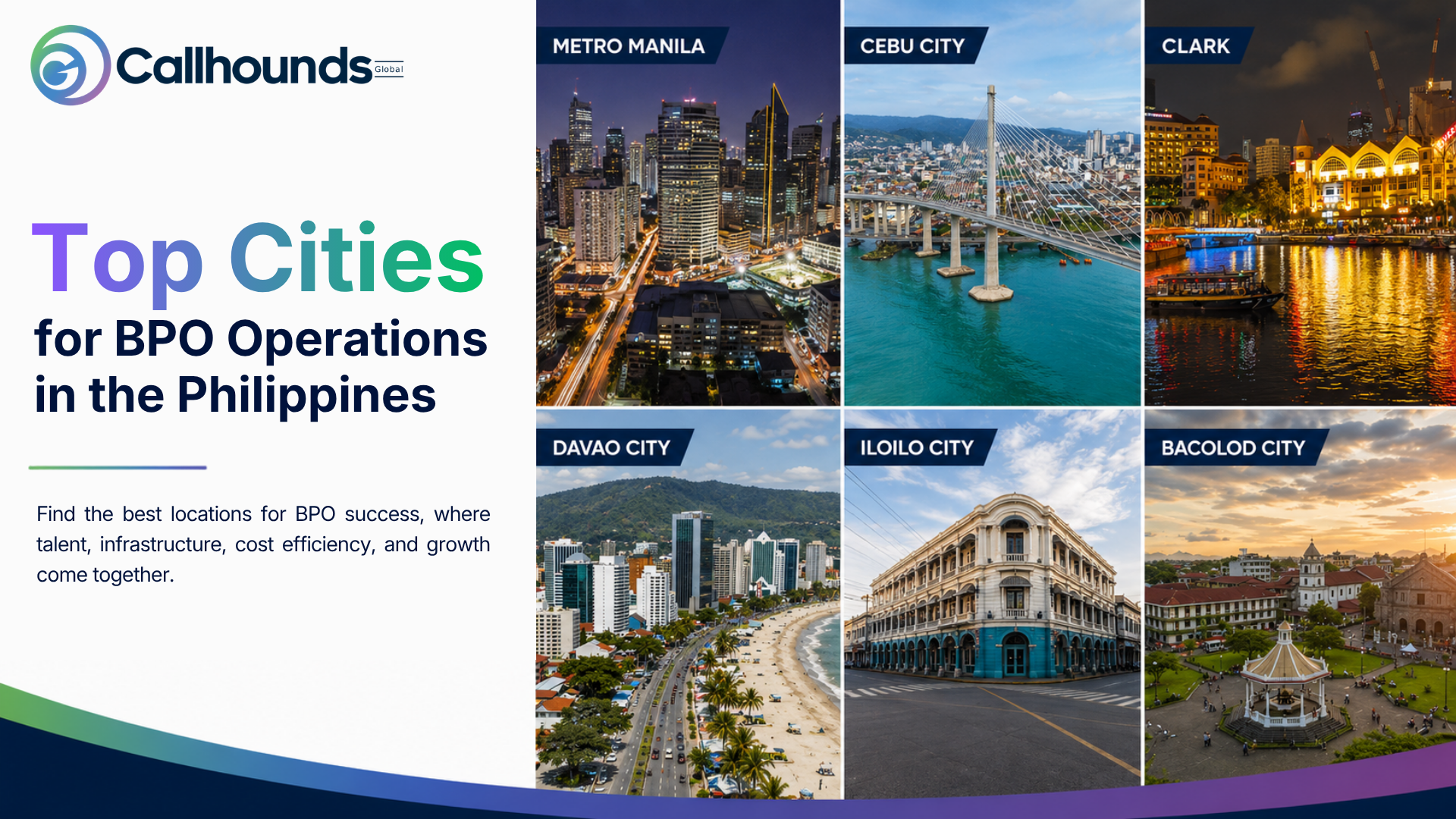
Manila isn’t the only BPO hub worth considering in the Philippines.
In 2026, businesses choosing where to build an offshore team need to look beyond Manila. Cebu City, Davao City, Iloilo City, Clark/Angeles, and Bacolod are emerging as strong alternatives, offering different advantages in talent availability, labor costs, retention, infrastructure, and scalability.
The city you choose can directly affect how quickly you can hire, how much you spend, and how long employees stay—making location one of the most important decisions in your outsourcing strategy.
This guide compares the top cities for BPO operations in the Philippines in 2026, using current labor and industry data to help US, UK, and Australian companies identify the outsourcing hub that best fits their service needs, budget, and growth plans.
The Philippines has held its position as one of the two largest voice and back-office outsourcing markets in the world for well over a decade, and 2026 has not changed that. A few factors keep client demand steady:
The country routinely places among the top nations in Asia for business English proficiency, and its university system produces hundreds of thousands of graduates each year across business, IT, nursing, and finance programs.
Decades of American cultural influence, combined with a media landscape that closely tracks US and UK entertainment and news, gives Filipino agents an instinctive read on the tone and expectations of Western customers.
Fully loaded staffing costs in the Philippines typically run well below equivalent roles in the US, UK, or Australia, even after accounting for management overhead and facility costs.
The Philippine Economic Zone Authority continues to extend tax incentives to outsourcing companies operating in accredited IT parks, a policy that has directly encouraged BPO growth outside Metro Manila.
Two decades of sustained outsourcing growth have produced a generation of Filipino team leaders, operations managers, and quality assurance specialists who understand Western client expectations firsthand, reducing the ramp-up time needed when a new account launches. This depth of experience has also helped strengthen BPO Operations in the Philippines, giving international companies access to established processes, skilled talent, and experienced management teams.
For a US, UK, or Australian company evaluating the country for the first time, these factors combine into a market that is no longer “emerging” in any meaningful sense. It is an established industry with its own regional specializations, and the city a company picks within that industry now matters as much as the decision to outsource to the Philippines at all.

Metro Manila, spanning Makati, Bonifacio Global City, Ortigas Center, and newer nodes like Alabang and Eastwood, remains the largest BPO market in the country by headcount and by the sheer range of services on offer. As a leading hub for BPO Operations in the Philippines, it attracts multinational headquarters, major banks, and large shared-service centers, creating the deepest bench of experienced managers and specialized staff in finance, legal process outsourcing, and IT support before anywhere else.
Office leasing costs in the capital have climbed since the pandemic, and salaries for senior and technical roles sit above the national average, though still far below US or Australian pay scales. Traffic remains a genuine operational factor, which is why most large providers now run hybrid schedules to protect attendance and retention.
Best suited for: enterprise-scale operations, finance and accounting outsourcing, legal and IT process work, and multi-function shared service centers.
Cebu City, along with neighboring Mandaue and Lapu-Lapu, has spent the past decade building a second-tier BPO market that now rivals mid-sized US metros in scale. A steady flow of university graduates, a lower cost of living than Manila, and direct international flights make it an easy choice for companies scaling past their first pilot team.
Attrition in Cebu tends to run lower than in Manila, partly because the local BPO community is tighter-knit and partly because the cost-of-living leaves employees with more disposable income at similar salary levels. Healthcare information management, software development, and customer support are strengths here.
Best suited for: mid-sized and scaling operations, technical support, healthcare BPO, and software development teams.
Davao City, the economic center of Mindanao, has quietly become one of the more compelling choices for companies seeking geographic diversification within BPO operations in the Philippines, particularly those looking to reduce exposure to Luzon’s typhoon and earthquake risks. Local universities, including the University of Southeastern Philippines and Ateneo de Davao, contribute to a growing pipeline of IT and healthcare graduates, while operating costs remain meaningfully lower than in both Manila and Cebu.
Local governance has remained stable, and the city’s strong medical education sector gives Davao a particular edge for healthcare-related outsourcing services such as medical billing, coding, and clinical documentation support.
Best suited for: healthcare BPO, IT support, back-office processing, and companies prioritizing regional risk diversification.
Clark Freeport Zone in Pampanga has grown steadily as an alternative to Manila for companies that want lower costs without giving up proximity to the capital. Clark International Airport supports easy travel for client visits, and PEZA-accredited zones within the Clark Development Corporation area extend fiscal incentives that lower day-to-day operating costs for accredited locators.
Search interest in outsourcing roles based in Angeles and Clark has climbed noticeably over the past two years, a signal that both investors and job seekers are treating the area as a serious alternative rather than a fallback option.
Best suited for: US-facing customer support, logistics coordination, and hybrid or satellite office setups.
Iloilo City has built one of the strongest reputations in the country for staff retention, supported by respected academic institutions such as the University of the Philippines Visayas, Central Philippine University, and West Visayas State University. Headcount in the local BPO sector grew by roughly a fifth between 2023 and 2025, and the PEZA-accredited Iloilo Business Park continues to attract larger investors.
As part of the broader BPO Operations in the Philippines, Iloilo stands out for its relatively small, close professional community. Managers often know their talent pool well, which can translate into more consistent service quality and stronger workforce stability over time.
Best suited for: healthcare BPO, knowledge process outsourcing, specialized back-office work, and companies that prioritize long-term staff retention over rapid scale.
A handful of additional cities are picking up real BPO investment heading into 2026 rather than simply appearing on aspirational lists:
The table below summarizes how the leading cities stack up on the factors that matter most when picking a location.
| City | Region | Relative Cost | Best For |
| Metro Manila | National Capital Region | Highest | Enterprise, finance, legal, IT |
| Cebu City | Central Visayas | Mid-high | Mid-size scaling, healthcare, tech support |
| Davao City | Davao Region | Mid-low | Healthcare BPO, back office, risk diversification |
| Clark/Angeles | Central Luzon | Mid-low | US-facing support, logistics, hybrid setups |
| Iloilo City | Western Visayas | Low-mid | KPO, healthcare, long-term retention |
| Bacolod | Western Visayas | Low | Finance and insurance process outsourcing |
Cost alone rarely tells the full story. The table below adds context on graduate pipelines and staff retention, two factors that heavily influence long-term service quality.
| City | Graduate Pipeline Strength | Typical Attrition | Notable Advantage |
| Metro Manila | Very strong, all sectors | Moderate to high | Widest specialist talent pool |
| Cebu City | Strong (IT, healthcare) | Lower than Manila | Balanced cost and capability |
| Davao City | Growing (IT, health) | Lower than national average | Geographic risk diversification |
| Clark/Angeles | Moderate, growing fast | Moderate | PEZA incentives, airport access |
| Iloilo City | Strong (health, KPO) | Among the lowest nationally | Long-term staff stability |
Picking a city is not a matter of following whichever name comes up most often in search results. A short evaluation against six factors usually narrows the list quickly:
The right answer typically comes down to the mix of service type, target headcount, and growth timeline rather than any single “best” city. A company such as Callhounds Global that already operates across multiple Philippine locations can match a client’s requirements to the city, or combination of cities, that fits best, rather than defaulting to whichever hub is most familiar. For a broader look at how providers across the country compare, this rundown of the best outsourcing companies in the Philippines is a useful starting point before narrowing down a shortlist.
Location decisions inside the Philippines matter, but it helps to remember why the country keeps winning outsourcing contracts against competitors like India, Vietnam, and Latin America in the first place. Cultural alignment with US and UK customers, decades of contact center experience, and a workforce that treats customer service as a respected profession rather than an entry-level job all play a part. A closer look at why global companies hire in the Philippines lays out the fuller picture for teams still weighing the country against other outsourcing destinations.
None of that removes the need to pick the right city. A talented workforce in the wrong location, priced for the wrong budget, still produces a mismatched outcome.
Every city profiled above draws from the same underlying strength: a workforce raised on English-medium education, familiar with Western media and customer expectations, and known across the industry for patience and courtesy under pressure. This piece on the Filipino talent advantage explains the roots of that reputation in more depth, and why it shows up consistently, no matter if a team sits in Makati or in a smaller provincial hub.
Key Takeaways
Metro Manila is usually the easiest starting point for a first offshore team because of its large talent pool, mature vendor ecosystem, and easy client access, though Cebu is a close second for companies that want lower costs from day one.
Yes. Office leasing and average salaries in Cebu typically run below Manila rates while still drawing from a strong graduate pipeline in IT, healthcare, and customer service fields.
Iloilo City consistently reports some of the lowest attrition rates among major Philippine BPO hubs, a trend attributed to its tight professional community and strong work-life balance culture.
Yes. Nightshift staffing to cover US Eastern or Pacific hours is standard practice across Manila, Cebu, Davao, Clark, and Iloilo alike, and local talent pools in each city are experienced with the schedule.
Many mid-sized and larger outsourcing programs do exactly this, pairing Manila for specialized or client-facing roles with a secondary city like Cebu or Davao for cost efficiency and geographic risk diversification.