

Top 10 Companies Using AI for Customer Service in 2026
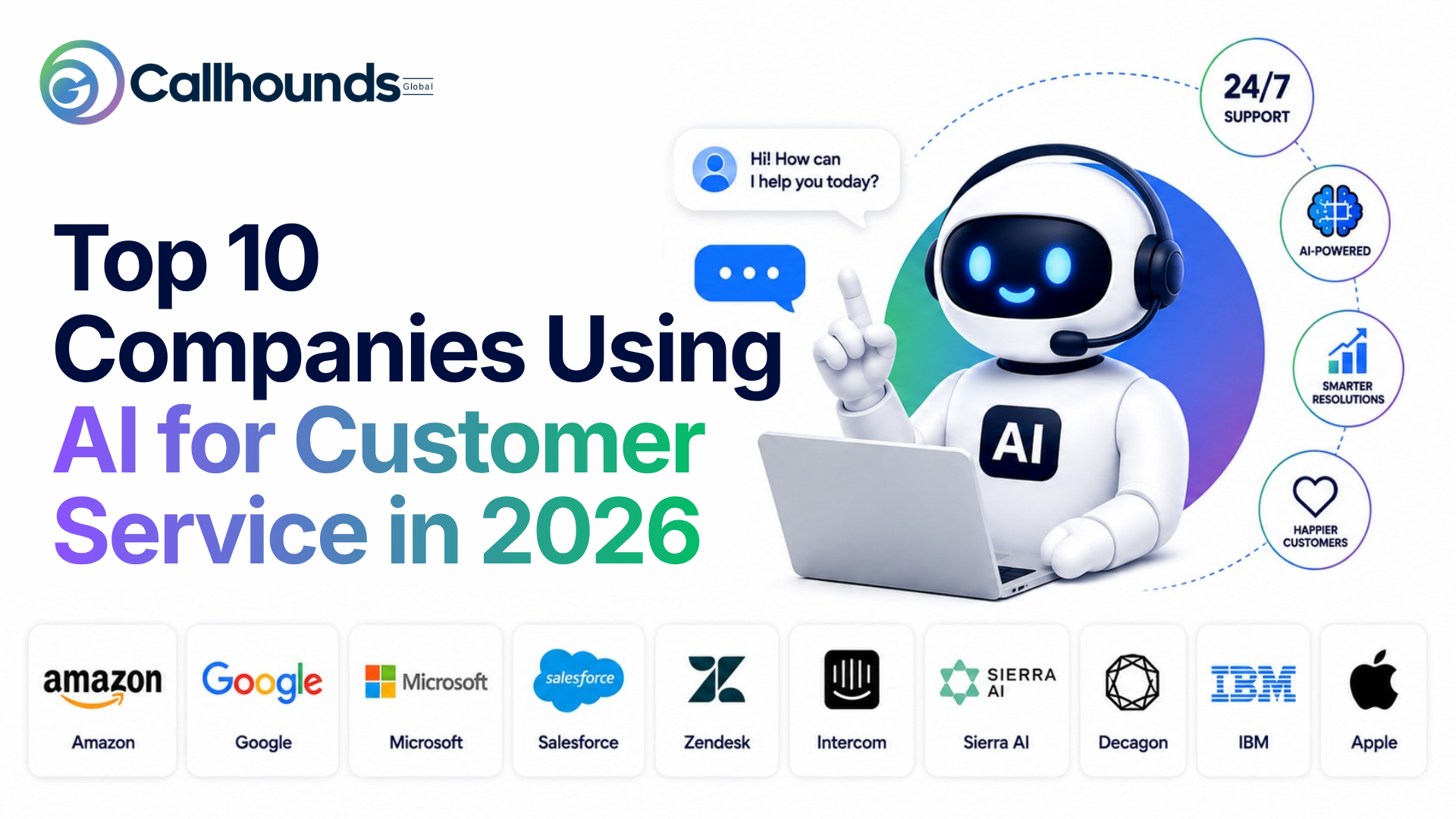
AI for Customer Service is changing how companies handle support in 2026, and the biggest shift isn’t just faster replies.
Amazon, Google, Microsoft, Salesforce, Zendesk, Intercom, Sierra AI, Decagon, IBM, and Apple are using AI to answer customer questions, resolve support issues, assist human agents, and even anticipate problems before they escalate.
But here’s the bigger question: What are these companies doing differently with AI for customer service, and what can your business learn from them?
The difference isn’t simply budget or company size. It’s how they approach AI.
Some use AI to automate tier-one support. Others use it as a copilot that helps agents work faster. Others are using AI to identify and solve customer problems before customers even reach out.
This article breaks down the AI for customer service strategies behind these 10 companies, what makes each approach different, and how businesses of any size can apply the same lessons to modernize their support operations.
Most businesses ask if they should add AI to their support desk. That question is already settled; the real question is which model of AI for customer service fits the business, the ticket volume, and the customer base. A company selling software with a small, technical user base needs different tools than a retailer fielding order questions from a general audience. The ten companies below sit at different points on that spectrum, which is why the list works better as a set of patterns to study than a single template to copy.

| Company | AI System / Product | Primary Use Case | Best Fit For |
| Amazon | Alexa, Rufus, AI-driven fulfillment support | Voice assistance, order tracking, personalized recommendations | Large-scale retail and e-commerce |
| Google Assistant, Contact Center AI (CCAI) | Conversational search, enterprise contact center automation | Companies building custom voice and chat bots | |
| Microsoft | Copilot for Service, Dynamics 365 Customer Service | Agent-facing copilots, case summarization | Enterprises already on Microsoft’s stack |
| Salesforce | Agentforce, Service Cloud, Einstein | Autonomous case resolution inside CRM | Sales and service teams needing a unified record |
| Zendesk | Zendesk AI Agents, Copilot AI, AutoQA | Ticket automation and quality scoring for existing helpdesks | Mid-size to large support teams on Zendesk |
| Intercom | Fin AI Agent | Omnichannel resolution across chat, email, and messaging | SaaS companies with high ticket volume |
| Sierra AI | Sierra Agent OS | Voice-first, branded autonomous agents | Consumer brands needing white-glove deployment |
| Decagon | Decagon AI Agents | High-autonomy chat and voice agents with editable logic | Tech-forward teams wanting direct control |
| IBM | watsonx Assistant, Watson Orchestrate | Enterprise virtual agents and workflow automation | Regulated industries needing audit trails |
| Apple | Siri, Apple Business Chat, on-device support tools | Consumer-facing voice help and guided troubleshooting | Hardware and consumer electronics support |
Amazon runs one of the largest customer service operations in the world, and it treats AI as the layer that makes that scale usable rather than overwhelming. Alexa handles millions of voice requests daily, from order status checks to product questions, using natural language processing that keeps improving with use.
Amazon’s shopping assistant, Rufus, extends that same approach into pre-purchase questions, helping shoppers compare products before they ever need to contact a human. Behind the scenes, machine learning models predict shipping delays and flag account issues before a customer notices, which cuts down on the volume of tickets that reach a live agent in the first place. The lesson for smaller businesses is not to replicate Alexa; it is to notice how much of Amazon’s AI budget goes toward preventing tickets rather than just answering them.
Google’s Contact Center AI (CCAI) platform is built for businesses that want their own branded voice and chat agents rather than a one-size-fits-all bot. It combines natural language understanding with real-time agent assist, surfacing suggested answers and next steps to human agent’s mid-call. Google Assistant applies the same underlying technology on the consumer side, answering questions and completing simple tasks through conversation.
What sets Google apart is depth of language coverage and search-grade understanding of intent, which matters for any company fielding questions in more than one language across the US, UK, and Australia. For businesses debating will AI replace call centers, Google’s model is a useful data point: it augments live agents with real-time suggestions rather than removing them from the call.
Microsoft’s Copilot for Service sits inside the tools support agents already use, drafting responses, summarizing long email threads, and pulling relevant case history into view without forcing agents to switch screens. Dynamics 365 Customer Service adds predictive case routing, so tickets land with the agent most likely to resolve them on the first attempt. Microsoft’s approach leans heavily on the idea that AI should make existing staff faster rather than replace them outright, which is a fit for companies with a smaller support team that cannot easily hire more people during a busy season. Businesses already using Microsoft 365 or Teams often see the fastest return here, since the AI features are built directly into tools employees already know.
Salesforce built Agentforce as an autonomous layer on top of Service Cloud, letting AI agents resolve customer cases directly inside the CRM without a separate chatbot platform bolted on. Einstein, Salesforce’s older AI layer, still handles prediction and next-best-action suggestions for human agents, while Agentforce takes on full conversations end to end when the case is simple enough.
Because everything runs on the same record of the customer, an agent handing off from AI to human does not lose context, which is often the biggest complaint customers have about automated support. Companies already running their sales and service operations through Salesforce get the most out of this, since the AI has full visibility into the customers’ history from the first message.
Zendesk repositioned itself around what it calls resolution, wrapping its long-standing ticketing platform in an AI layer that includes customer-facing AI Agents, a Copilot for human agents, and an automatic quality scoring tool called AutoQA. The platform reports automation rates above 80% on eligible tickets, and its AI sits directly inside the helpdesk that many support teams already run daily operations through.
The upside is a short setup time for teams already on Zendesk; the tradeoff, based on user feedback, is that AI output is only as strong as the knowledge base feeding it. A poorly maintained help center produces a poorly performing AI agent no matter which vendor built it, and that pattern holds across every platform on this list, not just Zendesk.
Intercom’s Fin AI Agent works across chat, email, and messaging apps, and it is built to hand off cleanly to a human when a question goes beyond its confidence level. Public resolution numbers vary by industry and ticket type, typically landing somewhere in the 40% to 65% range in production rather than the higher figures often quoted in marketing material, a gap that shows up across most AI customer service platforms once real ticket mix is factored in.
Fin can plug into an existing helpdesk like Zendesk or Salesforce rather than replacing it, which makes it a reasonable fit for a company that wants to add AI without ripping out its current stack. Intercom’s pricing model, billed per resolution rather than per seat, also ties cost more directly to results.
Sierra AI, founded by former Salesforce co-CEO Bret Taylor, focuses on voice-first agents built for named consumer brands rather than a generic off-the-shelf bot. Its clients include companies like Sonos, WeightWatchers, and ADT, and Sierra reports resolution rates in the 70% to 80% range for some of its highest-profile deployments, though vendors define “resolution” differently and those figures should be read with that caveat.
Sierra’s white-glove, vendor-managed deployment model appeals to larger companies with strict compliance and security requirements, and it comes at a real cost: year-one contracts commonly run into six figures. For a business this size, the honest lesson is less about the tool and more about the discipline: Sierra’s results depend on a clean knowledge base and real system access, the same two ingredients any smaller support team needs before adding AI of its own.
Decagon takes a different path from Sierra, giving customer experience teams direct, editable control over agent logic through what it calls Agent Operating Procedures, rather than locking that logic inside vendor-managed configuration. Public customers include Notion, Substack, and Duolingo, with Decagon reporting deflection rates as high as 80% on some accounts, meaning the ticket never reached a human at all.
That distinction between deflection and full resolution matters more than most buyers realizes, since a deflected ticket is not always a solved problem for the customer. Decagons fit companies that want to move fast and adjust logic themselves without waiting on engineering, which is part of why it has grown quickly among tech-forward support teams.
IBM’s watsonx Assistant and Watson Orchestrate target enterprise and regulated industries where audit trails and governance carry as much weight as speed. Watson Assistant builds virtual agents that resolve routine inquiries and route the rest with full logging, which matters for banks, insurers, and healthcare organizations that need to show exactly how a decision was made.
IBM’s approach is less flashy than Sierra’s or Decagon’s consumer-brand case studies, but it is built for a buyer who cares more about compliance than a slick demo. Any business in a regulated field considering AI for customer service should look at how IBM handles logging and human oversight, since that model transfers directly to smaller compliance-sensitive operations.
Apple applies AI to customer service mostly through Siri and its Apple Business Chat integration, focused on guided troubleshooting for its own hardware and software rather than a general-purpose support platform other companies can license.
Siri answers device questions and walks customers through basic fixes before a support case ever opens, while on-device diagnostics flag hardware issues and suggest next steps automatically. Apple’s model shows the payoff of self-service done well: many issues never need a human because the AI catches and resolves them earlier in the journey, at the point where the customer is troubleshooting alone rather than already frustrated on hold.
Vendor marketing pages tend to round up, so it helps to separate the claim from the measured outcome. The table below lines up commonly cited figures against what independent testing and customer-reported data tend to show.
| Metric | Vendor Claim (Typical) | Independently Reported Range | What It Means for Buyers |
| Chat resolution rate | 70% to 86% | 38% to 65% in production | Ask for resolution data from your own ticket mix, not a curated benchmark set |
| Cost per resolution | Varies by pricing model | $0.62 to $2.00 for AI vs. roughly $7.40 for a human agent | AI is cheaper per ticket, but only on tickets it can fully close |
| Voice AI share of inbound volume | N/A | Around 19% of total contact center volume | Any evaluation limited to chat is missing a growing part of the picture |
| Deflection vs. full resolution | Often reported together | Deflection can overstate success if the customer did not actually get help | Ask specifically if a “resolved” ticket means solved or just closed |
The pattern across nearly every case study, from Amazon down to smaller platforms like Decagon, is the same: a clean knowledge base, real access to backend systems, and a narrow starting scope produce good numbers. Skipping any of those three steps produces disappointing numbers no matter how much a vendor charges.
A business does not need Amazon’s engineering budget to use the same logic these ten companies rely on. Start with the highest-volume, lowest-complexity questions, the ones agents answer the same way dozens of times a day and let AI take those first.
Keep a fast, visible path to a human for anything involving money, health, or a genuinely upset customer, because the debate over AI vs human agents and what customers prefer usually comes down to trust in exactly those higher-staking conversations. Measure resolution honestly rather than counting every closed ticket as a win and revisit the setup every few months as ticket patterns shift.
Timing matters here, too. AI adoption does not happen in isolation from the rest of the support operation, and a business that automates its front line while leaving scheduling and staffing untouched often sees the two working against each other.
Poor coverage during peak hours undercuts even a good AI deployment, since customers who need a human still need one to be available; that is part of why how scheduling impacts customer experience has become its own line item in support planning for 2026, right alongside AI investment.
Across the ten companies profiled here, a few patterns repeat regardless of industry or company size:
None of this replaces a well-run support operation; it changes what that operation spends its time on. The companies getting the most out of AI for customer service are not the ones with the biggest AI budget. They are the ones that already have clean data, clear escalation paths, and a support team willing to adjust the setup as it runs.
The ten companies covered here did not get their AI right on the first attempt, and none of them ran on AI alone. What they share is a willingness to test, measure, and adjust rather than treat a chatbot as a finished project.
A business that wants the same results does not need Amazon’s scale or Sierra’s contract size to start; it needs accurate data, a clear plan for when AI hands off to a person, and honest measurement of what is getting resolved. Building that foundation now, rather than waiting for a bigger budget or a bigger team, is what separates the companies still fielding the same complaints next year from the ones already ahead of them.
Key Takeaways
There is no single best answer, since it depends on the type of business. Amazon and Apple show the strongest results in self-service and prevention for consumer products, while Salesforce and Zendesk lead teams that need AI built directly into an existing CRM or helpdesk. Sierra AI and Decagon are worth watching for companies building a support model from scratch in 2026.
No major company on this list runs a fully automated support desk. Even Amazon and Apple, with the largest AI investments, keep human agents for complex, sensitive, or high-value conversations. AI mainly takes over repetitive, low-risk questions and supports agents on the rest.
Pricing varies widely, from roughly $15 to $170 per agent per month for platforms like Zendesk and Freshdesk, to per-resolution pricing near $1 to $2 per ticket for tools like Intercom’s Fin. Enterprise platforms like Sierra AI and Decagon typically start in the tens of thousands of dollars per year and are built for higher-volume operations.
Deflection means a ticket never reached a human agent at all, while resolution means the customer’s actual problem was solved, by AI or otherwise. A high deflection rate can look impressive without meaning the customer got real help, so it is worth asking vendors which figure they are reporting.
Begin with a narrow set of high-volume, low-complexity questions, make sure the knowledge base behind the AI is accurate and current, and keep a clear, fast path to a human agent for anything more sensitive. Measure results against real ticket data before expanding the AI’s scope further.