

Talent Retention Strategies: 8 Ways to Keep Top Talent

Your best employees may already be planning their exit.
Talent retention isn’t just about keeping people happy. It’s about giving skilled employees compelling reasons to stay, through fair pay, clear career growth, supportive managers, sustainable schedules, and meaningful recognition.
In BPO and customer support, where turnover can disrupt productivity, customer experience, and team performance, losing one experienced employee can create a much bigger operational impact than the vacancy itself.
So, what makes employees stay?
This guide breaks down 8 proven talent retention strategies for BPO and outsourcing teams, the key metrics you should track, and a practical 90-day retention plan you can put into action this quarter.
Talent retention is an organization’s ability to keep its high-performing, high-potential, and hard-to-replace employees over time. It’s narrower than general employee retention, which tracks everyone on payroll. A company can post a respectable overall retention rate and still lose the exact people it can’t afford to lose top closers, senior agents, experienced team leads, and the specialists who know a client’s account inside out.
It also doesn’t mean chasing zero turnover. Some departures are healthy. Someone moves into a role you can’t offer, or a poor fit leaves on good terms. The number worth watching is regretted attrition, meaning the exits you wish had never happened. Every talent retention strategy below aims at that group.
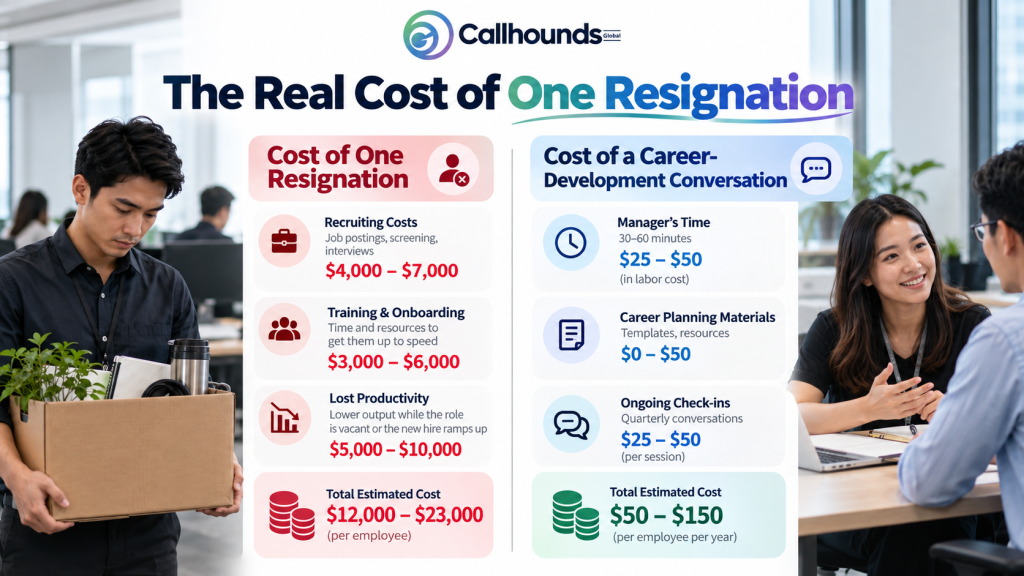
Gallup estimates that replacing a single employee can cost anywhere from one-half to two times that person’s annual salary once you count recruiting, onboarding, lost productivity, and knowledge gaps. Its exit research adds a harder fact: 52 percent of employees who left voluntarily said their manager or organization could have done something to prevent it. More than half of those resignations were avoidable.
In outsourcing, the costs stack up in extra ways. A departing agent leaves a client who must explain their business to a stranger and customers who notice the change in call quality. Table 1 shows how the two paths compare.
Table 1: What Turnover Costs vs. What Retention Protects
| Cost Area | When a Skilled Employee Leaves | When You Keep Them |
| Recruiting | Job ads, sourcing, interviews, assessments | Little to no added hiring spend |
| Training and ramp-up | Weeks or months before the new hire reaches full speed | Skills keep compounding |
| Productivity | Output dips during the vacancy and the learning curve | Steady, predictable performance |
| Quality and customer experience | Inconsistent handling and more escalations | Stable quality scores and stronger customer relationships |
| Team morale | Coworkers absorb extra work and question their own futures | Trust builds and peers stay |
| Institutional knowledge | Account history and process know-how walk out | Knowledge stays and gets passed to new hires |
Pay won’t repair a broken culture, but below-market pay guarantees an exit line. Review salaries against the local market at least twice a year, and look at total compensation: base pay, performance incentives, night differentials, health coverage, paid leave, and allowances. In the Philippines, where the BPO sector competes for the same pool of graduates, small differences in take-home pay and benefits often decide which offer a candidate accepts. Explain how pay bands work. Employees who understand how pay is set trust it more, and trust keeps people from browsing job boards on their breaks.
People rarely leave a role they can see a future in. Map the ladders: agent to senior agent, then team lead, quality analyst, trainer, operations manager, and account manager. Attach skill requirements and rough timelines to each step, so promotions aren’t a mystery. LinkedIn’s Workplace Learning research found that 94 percent of employees said they would stay longer at a company that invested in their careers. Give every employee a development plan, review it quarterly, and treat internal promotions as a leadership KPI.
Gallup’s engagement research keeps landing on the same conclusion: the direct manager shapes the work experience more than any perk. Yet many team leads get promoted for personal numbers and receive almost no coaching training. Teach them how to run useful one-on-ones, give specific feedback, handle conflict, and spot burnout early. Then track attrition by the manager. If one leader’s team turns over at twice the rate of the others, you’ve found where to coach.
Round-the-clock operations strain people. Predictable rosters, fair shift bidding, at least two weeks’ notice on changes, and enough recovery time between rotations go a long way. Where the work allows it, offers hybrid or remote options. Night-shift employees also need safe transport, decent meal options, and breaks that are protected. Small schedule fixes often cost little and show up quickly in engagement surveys.
Generic praise fades fast. Specific recognition sticks. “You stayed on that escalation for forty minutes and the client renewed” lands harder than “good job.” Mix peer-nominated awards, manager shout-outs in team meetings, incentives tied to quality, and client-facing recognition when a customer sends a compliment. Make sure the program reaches quiet performers, not only the loudest ones.
Customer-facing work means absorbing frustration all day. Offer counseling or an employee assistance program, train leaders to recognize burnout, and give agents a way to decompress after a rough call. Add practical support to health coverage that includes dependents, wellness days, and workloads that match staffing. People who feel looked after tend to return loyalty.
Retention starts before day one. Describe the job honestly, including the shift pattern and the tough parts, so new hires know what they’re signing up for. Then treat the first 90 days as a retention program of its own: a buddy system, a structured training path, weekly check-ins, and early wins. Many early exits trace back to a rough start rather than a bad job. Remote onboarding needs extra care because new people can’t absorb culture by simply sitting near it.
Exit interviews tell you what went wrong after it’s too late. Stay interviews ask current employees what keeps them, what might push them out, and what they’d change. Gallup found that roughly half of the departing employees said nobody had talked with them about their job satisfaction in the three months before they left. Ask four questions each quarter, write down the answers, and act visibly on at least one theme, so people see that speaking matters.
BPO work adds pressures that a typical office job doesn’t. Teams in the Philippines often serve clients in the US, UK, and Australia, which means overnight shifts, weekend coverage, and rosters that shift with client demand. Many employees also support extended families, so stable income, dependent health coverage, and a predictable schedule weigh heavily when they compare offers.
Employee loyalty and customer loyalty are also tied together. The logic behind customer retention programs, where keeping a client cost less than winning a new one, applies to your staff too, and the two feed each other. Experienced agents resolve issues faster and handle complex cases with less supervision, which lifts satisfaction scores. If your customer satisfaction is sliding, check tenure before you rewrite scripts. Our guide on how to improve csat scores covers the metrics that respond when staffing settles down.
Some companies solve the problem by partnering with a provider that has already built the career ladders, training systems, and shift structures needed to keep people. If you’d rather not build that from scratch, look at customer support outsourcing to see how a dedicated Philippines-based team can carry the load while your own leaders focus on growth.
Not every lever pays off at the same speed. Table 2 helps you decide where to start based on effort and time to results.
Table 2: Talent Retention Levers
| Lever | Best For | Effort | Time to Results | Common Mistake |
| Market-based pay review | Roles poachers target | Medium | 1 to 2 quarters | Raising base pay but ignoring bonuses and benefits |
| Career pathing | High performers and early-tenure staff | Medium | 2 to 4 quarters | Publishing ladders with no promotion timeline |
| Manager coaching | Teams with uneven turnover | Medium to high | 1 to 3 quarters | One workshop and no follow-up |
| Schedule redesign | 24/7 operations | Low to medium | Weeks to 1 quarter | Changing rosters without notice |
| Recognition programs | All teams | Low | Weeks | Rewarding only the top numbers |
| Wellbeing support | High-stress roles | Medium | 1 to 2 quarters | Offering a hotline nobody knows about |
| Stay interviews | Any team whose leader will act | Low | Immediate insight | Collecting feedback and doing nothing |
If you must pick two starting points, pair stay interviews with a schedule review. Both are cheap, fast, and reveal what your people care about before you commit a larger budget.
You can’t improve what you only look at once a year. Track these numbers monthly and split them by team, manager, shift, and tenure band:
Pair the numbers with stay-interview notes. The data shows where people leave. The conversations explain why.
Talent retention isn’t a perk program or a one-time raise. It’s a habit of paying attention to what your best people need before they start looking elsewhere. Start small: talk to five top performers this month, fix the first thing they mention, and measure again in ninety days.
Callhounds Global builds and manages dedicated support teams in the Philippines for companies in the US, UK, and Australia, with career paths, training, and shift structures designed to keep good people. If you want to talk through your own retention challenges or explore a stable offshore team, get in touch with us.
Key Takeaways
Talent retention is an organization’s ability to keep its highly performing and hard-to-replace employees over time. It relies on fair pay, career growth, strong management, work schedules, and recognition, so people choose to stay rather than feeling stuck.
The most reliable strategies are market-based pay, visible career paths, manager coaching, predictable schedules, specific recognition, wellbeing support, a structured first 90 days, and regular stay interviews. Start with the two that address the complaints you hear most often.
Divide the number of employees who stayed through the entire period by the number you had at the start, then multiply by 100. For talent retention specifically, run the same calculation on high performers or critical roles only, and compare it with your company-wide figure.
Overnight shifts, high call volume, repetitive stress, and strong competition for the same candidates all raise the odds of turnover. Clear promotion paths, humane scheduling, and wellbeing support offset those pressures more than pay alone.
Schedule fixes and recognition programs can shift engagement within weeks. Pay adjustments and manager coaching typically show up in turnover data within one to two quarters. Career pathing takes longer, often two to four quarters, because it depends on promotions happening.