

PEZA Explained for Foreign Businesses
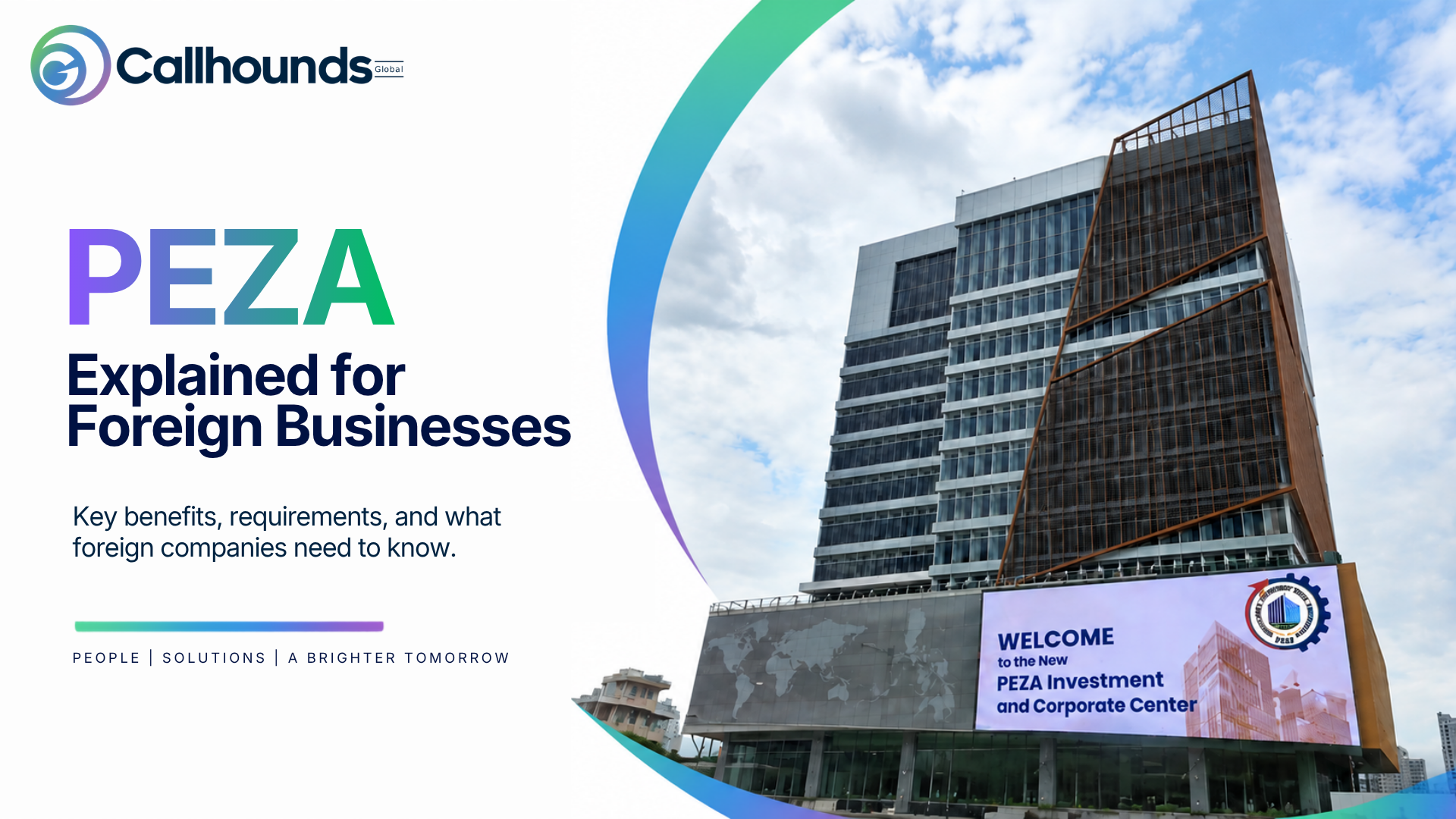
A founder in Austin signs a lease for office space in Cebu before asking a single question about taxes. Eight months later, an accountant walks him through what a PEZA registration could have saved him, and by then, the window to apply for some of it has already closed. PEZA, short for the Philippine Economic Zone Authority, is the government agency that grants qualified export and IT-focused companies operating inside designated economic zones an income tax holiday, a reduced special corporate tax rate, duty-free importation of equipment, and a faster path through customs and permitting.
For business owners in the United States, the United Kingdom, and Australia weighing an entry into the Philippine market, that one registration decision often decides if the first few years of operation build a foundation or drain a budget on taxes and paperwork.
The Philippine Economic Zone Authority is a government agency attached to the Department of Trade and Industry. Its job is to develop, regulate, and promote special economic zones, often called ecozones, where businesses that export goods or services, or that operate in information technology, manufacturing, or logistics, can register for a package of tax and administrative privileges. For a company based overseas, PEZA functions as a single point of contact that replaces a maze of local permits, customs procedures, and tax filings with one coordinated registration.
The agency was created under the Special Economic Zone Act of 1995 (Republic Act 7916) to support three goals: build the export sector, pull in foreign and domestic capital, and generate employment in industries such as manufacturing, information technology, and logistics. Nearly three decades later, those same goals still shape how PEZA reviews new applications, with an added emphasis on higher-value activities such as software development, shared services, and green technology.
PEZA does not build factories or office towers on its own. Instead, it partners with local government units and private developers who construct and manage the zones, while PEZA sets the standards, approves the location, and monitors ongoing compliance. Each ecozone runs largely as a self-contained community: it manages its own utilities, security, and basic infrastructure, and it reports back to PEZA on how well it supports the businesses registered inside it.
For a foreign business, this structure means two layers of decision-making. First, the company applies to PEZA for registered enterprise status, which is tied to the type of activity it plans to run, export manufacturing, IT-enabled services, logistics, and so on. Second, the company selects a specific zone or building that fits its operations, since incentives are only available to activity carried out within an accredited location. Getting both of those choices right at the outset saves months of rework later.
PEZA oversees several categories of zones, and picking the right one depends on what the business does day to day:
A company that plans to run a customer support center, for example, would typically look at an IT park or IT building rather than a manufacturing zone, since the incentive structure and infrastructure are built around office-based, service-driven work.
Businesses registered with PEZA can access two broad categories of benefits: fiscal incentives, which reduce or defer tax liability, and non-fiscal incentives, which cut down on paperwork and processing time.
On the fiscal side, the headline benefit is the income tax holiday, which exempts a registered enterprise from corporate income tax for a set of years. After that period ends, the company moves into either a 5% special corporate income tax on gross income, in place of all national and local taxes, or an enhanced deductions option that applies a standard corporate tax rate but allows extra deductions for items such as depreciation, labor training, and research spending. Companies also gain VAT zero-rating on local purchases tied to their registered activity and duty-free importation of capital equipment and raw materials.
Non-fiscal incentives focus on speed. PEZA-registered companies work through a one-stop-shop for permits, apply for visas for foreign staff and their immediate family members, and use online systems for import and export documentation instead of paper-based approval chains at multiple agencies.
Table 1: PEZA Fiscal Incentives by Enterprise Type
| Incentive | Export-Oriented Enterprise | Domestic Market Enterprise |
| Income Tax Holiday | 4 to 7 years, with extensions possible for priority activities | 4 to 7 years |
| After ITH: tax option | 5% SCIT or Enhanced Deductions for 10 years | Enhanced Deductions for 5 years |
| VAT on local purchases | Zero-rated, tied to the registered activity | Zero-rated, subject to BIR conditions |
| Import duties | Duty-free on capital equipment, raw materials, and spare parts | Limited duty and VAT relief on equipment not locally available |
| Export sales | Exempt from export taxes and related charges | Not applicable |
Republic Act 12066, known as the CREATE MORE Act, took effect in late 2024 and remains the framework PEZA works within for approvals in 2026. It builds on the earlier CREATE Act by adjusting several details that matter directly to a foreign applicant:
Because these rules continue to shift as implementing guidance comes out, a foreign business should confirm current requirements directly with PEZA or a Philippine tax advisor before filing, rather than relying on any single article, including this one.
PEZA is not the only government body offering investment incentives in the Philippines. The Board of Investments (BOI) runs a parallel program, and the CREATE MORE Act brought both agencies closer together under the same Strategic Investment Priority Plan. The practical difference now comes down to location and flexibility rather than the tax rate alone.
Table 2: PEZA vs. BOI at a Glance
| Factor | PEZA | BOI |
| Location requirement | Must operate inside an accredited economic zone or IT building | Can operate anywhere in the country |
| Best fit for | IT-BPM offices, export manufacturing, logistics hubs inside a zone | Domestic-facing projects, facilities outside zone boundaries, renewable energy plants |
| Customs support | Integrated import and export processing within the zone | Standard customs process through the Bureau of Customs |
| Tax structure | ITH followed by 5% SCIT or Enhanced Deductions | ITH followed by Enhanced Deductions, aligned under CREATE MORE |
| Physical footprint | Requires a zone-based lease or purchase | More freedom to choose office or plant location |
A company planning an IT-enabled service center in an established tech park in Metro Manila or Cebu will usually find PEZA the better fit. A company building a facility outside zone boundaries, such as a renewable energy plant in a rural province, will likely look at BOI instead.

Processing time varies by project size and completeness of the application, so working with a local consultant or legal counsel familiar with current PEZA procedures tends to shorten the timeline considerably.
Even with a fast registration path, foreign businesses run into a handful of recurring problems after they set up in a PEZA zone. Staffing is usually the first one: hiring at the pace a growing operation needs, while also meeting local labor law requirements, takes longer than most first-time entrants expect. Understanding local tax and reporting obligations under the newer VAT rules is a second common gap, since the requirements have shifted more than once in the past two years.
Cost planning is a third issue. A business that only budgets for the tax incentives can be caught off guard by the ongoing cost of running local operations, office space, utilities, payroll, and support staff. Reviewing a current outsourcing cost in the Philippines pricing guide before finalizing a budget help set realistic expectations for staffing costs alongside the tax savings a PEZA registration provides.
Registering with PEZA solves the tax and customs side of setting up in the Philippines, but it does not solve staffing. Many foreign companies that register as a PEZA entity choose to work with a local outsourcing partner to build out the operational side of the business, particularly functions that do not need to sit inside company headquarters.
For companies that need a front-line team handling inbound inquiries, a customer support outsourcing partner can staff and manage that function without the new entity needing to hire and train an internal team from scratch.
For businesses running outbound sales or scheduling functions, and appointment setting outsourcing partner can handle lead follow-up and calendar management while the core team focuses on closing deals and building the product.
Pairing a PEZA registration with the right outsourcing setup means a foreign business gets the tax benefits of operating inside a zone and the staffing flexibility of a partner that already understands local labor requirements, recruitment timelines, and day-to-day management.
PEZA gives foreign businesses a structured, government-backed path into the Philippine market, with tax relief and administrative shortcuts that are hard to match by setting up a standard domestic corporation on its own. The registration process rewards preparation: choosing the right zone, confirming the business activity qualifies under the current Strategic Investment Priority Plan, and budgeting for staffing and operations alongside the tax incentives.
For a founder weighing an entry into the Philippines from the United States, the United Kingdom, or Australia, understanding how PEZA works before signing a lease can turn what would have been a costly guess into a plan with a clear return.
PEZA is the Philippine government agency that grants tax and non-tax incentives to companies operating inside accredited economic zones. Businesses in export manufacturing, IT-enabled services, logistics, agro-industrial processing, and tourism can apply, provided their activity appears on the current Strategic Investment Priority Plan.
Timelines vary by project size and how complete the application package is, but most straightforward IT or service-sector applications move through initial evaluation within a few weeks to a couple of months. Larger projects that require Fiscal Incentives Review Board approval typically take longer.
Yes, in most cases. Export-oriented enterprises that meet the 70% export sales threshold are generally eligible for full foreign ownership, and the minimum paid-in capital rule that applies to many domestic-market businesses does not apply to them.
Both agencies now operate under the same Strategic Investment Priority Plan following the CREATE MORE Act, so the tax structures are similar. The main difference is location: PEZA requires the business to operate inside an accredited zone, while BOI allows operations anywhere in the country.
Companies under the 5% special corporate income tax option pay that rate in place of most national and local taxes tied to their registered activity. Companies that choose the enhanced deductions option instead pay the standard corporate tax rate but claim additional deductions, and both options still carry reporting obligations to PEZA and the Bureau of Internal Revenue.