

Payroll Outsourcing Explained: How It Works & What It Costs
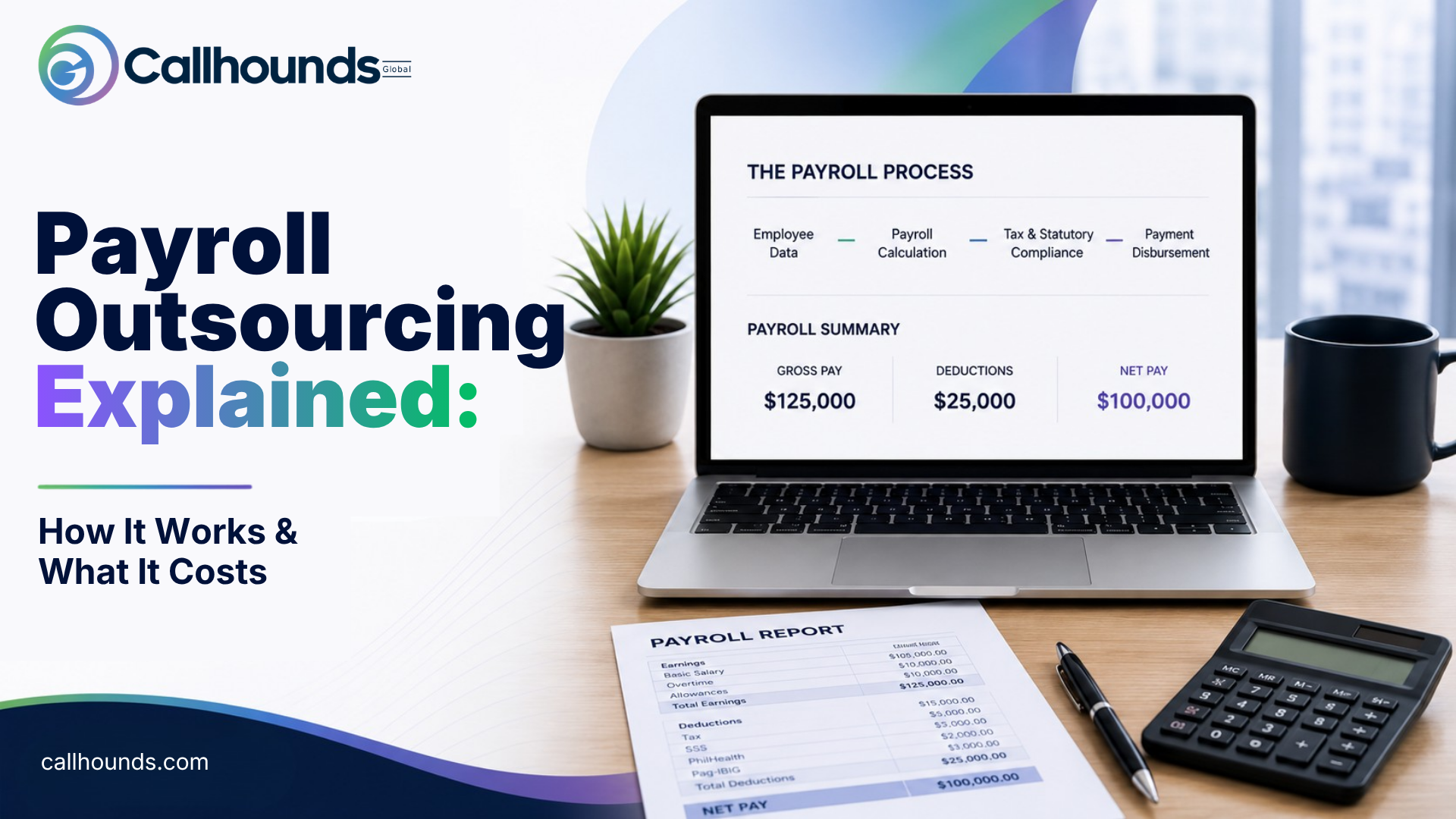
Every payday, someone must get the math right: wages calculated, taxes withheld, forms filed on time, and paychecks sent out without a single missed deadline. Payroll outsourcing is the practice of hiring an outside provider to handle some or all that work, including calculating payroll taxes, tracking labor regulations, and getting employees paid accurately and on schedule. For companies that would rather spend their hours on customers and growth instead of tax tables, outsourcing turns payroll from a recurring source of stress into a service that runs quietly in the background.
This guide breaks down how payroll outsourcing works, what it costs, where the real risks sit, and how to pick up a provider that fits a growing, often multi-location business.
Payroll outsourcing means transferring part or all the payroll process, from wage calculations to tax filing, from an internal team to an outside provider. In most arrangements, the provider runs the numbers and files the paperwork, while the employer still supplies accurate hours and wage data and signs off on the final pay run. That split matters because outsourcing payroll does not automatically remove an employer’s legal obligations; it changes who does the work, not who ultimately owns the outcome.
Providers generally offer tiered packages that scale from basic wage processing to fully managed services that include tax filing, compliance monitoring, and year-end reporting. The right tier depends on company size, the number of pay locations, and how much internal HR or finance support already exists.
A typical outsourcing arrangement follows a repeatable cycle. The employer submits hours, new hires, raises, and any deductions before each pay period closes. The provider then calculates gross and net pay, withholds the correct payroll taxes, and processes payments through direct deposit, paycheck, or pay card. Behind the scenes, the provider files tax deposits with the relevant agencies and keeps records aligned with current regulations.
At year-end, the provider typically generates Form W-2 and 1099 forms and handles the associated filings. Many packages also include a self-service portal, so employees can view pay stubs, tax documents, and benefits information without routing every request through HR.
What’s Typically Included in a Payroll Outsourcing Package
Coverage varies by provider and plan, but most packages are built around these core functions:
Some providers also operate as a professional employer organization, or PEO, which goes a step further by becoming the employer of record and taking on a larger share of employment liability. That arrangement suits businesses that want to outsource HR functions broadly, not just payroll calculations.
Most businesses turn to payroll outsourcing for a combination of time savings, accuracy, and compliance support.
Time savings show up quickly once payroll stops eating into hours that could go toward product, sales, or customer support. Self-service portals add to that by letting employees check pay stubs and update their own information without pulling HR staff away from higher-priority work.
Accuracy tends to improve because automated systems reduce the manual data entry errors that come with spreadsheets, and integrations with time-tracking and benefits platforms to keep information consistent across systems.
Compliance is often the strongest reason to be outsourced. Payroll providers track changing tax rates and labor rules, so an internal team does not have to, and they usually take the lead filing out the required paperwork. That is particularly useful for companies operating across multiple states or countries, where the rules rarely stay the same for long.
Timing matters, too. Many founders build the payroll outsourcing decision into their earliest hiring plans rather than waiting until the internal workload becomes unmanageable, a pattern also covered in our piece on outsourcing for startups and why you should start early. Waiting until payroll errors or missed filings force the issue is usually the more expensive path.
Pricing structures vary, but most providers charge a base monthly fee plus a per-employee cost, and the total climbs as more services get added on top of basic wage processing.
Table 1: Payroll Outsourcing Pricing by Service Tier
| Service Tier | Typical Monthly Cost Per Employee | What’s Usually Included |
| Basic Payroll Processing | $30 to $45 | Wage calculations, tax filing, direct deposit |
| Full-Service Payroll | $45 to $80 | Basic processing plus compliance monitoring, year-end forms, self-service portal |
| PEO or Bundled HR and Payroll | $80 to $150+ | Full-service payroll plus benefits administration, HR consulting, and employer-of-record support |
Employers should weigh these direct costs against what they would otherwise spend internally, including staff time, compliance risk, software licensing, and the administrative burden of tracking regulatory changes across every jurisdiction where employees work.
Choosing between the two options comes down to control, cost structure, and how much regulatory complexity a company is prepared to manage internally.
Table 2: In-House Payroll vs. Outsourced Payroll
| Factor | In-House Payroll | Outsourced Payroll |
| Cost Structure | Fixed overhead and staff salaries | Per-employee and per-payroll fees |
| Control | Full control over every step | Shared control, with the provider handling execution |
| Compliance Liability | Falls primarily on the company | Shared with the provider, though the employer still carries some responsibility |
| Data Security | Data stays entirely in-house | Data is shared with a third-party system |
| Best Fit | Larger companies with dedicated HR and payroll staff | Small to mid-sized companies without a full payroll department, or fast-growing teams with multiple locations |
Neither option is universally better. A company with a large, established HR department and a single pay location may keep more value by running payroll in-house, while a fast-growing or multi-location team usually gains more from outsourcing.
Outsourcing payroll reduces some risks while introducing others, and it pays to plan for both sides of that trade.
Data security is the most common concern, since employee wage data, bank details, and tax information all move through a third-party system. Providers with SOC 2 certification, encryption standards, and role-based access controls address most of this concern, but it is worth confirming those protections before signing a contract rather than after.
Vendor dependency is another factor. Switching providers mid-year can be disruptive, so it helps to review contract terms, data portability, and transition support up front.
Hidden fees show up when add-on services, such as off-cycle payroll runs or year-end filing corrections, are billed separately from the base package. Reading the fee schedule closely before signing avoids surprises later.
Shared, rather than eliminated, liability rounds out the list. Employers typically remain responsible for the accuracy of the data they submit and for final sign-off, so outsourcing reduces exposure without removing it entirely. This due diligence matters even more in regulated industries, where the same standards apply when building, scaling, and outsourcing support teams for financial services the right way.

A short evaluation process helps narrow the field before committing to a contract:
Providers that provide staff with their support and back-office teams with experienced, well-trained professionals tend to deliver steadier service than providers, spreading a smaller team across too many accounts. That staffing depth, including the kind of talent pool described in the Filipino talent advantage explained, often shows up in response times and error rates more than in a sales pitch.
Payroll gets noticeably more complicated once a company hires across state lines or national borders. Multi-jurisdiction payroll means tracking different tax rates, filing deadlines, and labor laws at the same time, and a small miscalculation in one location can trigger penalties that outweigh months of outsourcing fees.
For distributed teams, providers generally fall into two categories. Traditional payroll outsourcing keeps the employer as the legal employer of record, with the provider handling calculations and filings. A PEO or employer-of-record model shifts more of that legal responsibility to the provider, which can simplify international hiring but usually comes at a higher cost.
Currency handling, local statutory benefits, and country-specific reporting requirements all factors into which model makes sense. Companies hiring in just one or two additional countries often do fine with a payroll provider that supports those specific jurisdictions, while companies scaling across many countries at once tend to lean toward a broader employer-of-record setup.
Payroll outsourcing is not a one-size-fits-all decision, but for most growing businesses, it trades a fixed internal cost and a rising compliance burden for a predictable monthly fee and a partner who tracks the regulatory details full-time. The businesses that get the most out of it tend to be the ones that treat provider selection with the same care they would apply to any other core vendor relationship: checking security practices, confirming jurisdictional coverage, and asking how support actually works once a problem shows up outside business hours.
Key Takeaways
A payroll outsourcing provider calculates employee wages and deductions, withholds and files payroll taxes, processes of payments, and typically handles year-end forms such as W-2s and 1099s. Many providers also offer a self-service portal so employees can check pay stubs and tax documents directly.
Costs typically range from around $30 per employee per month for basic wage processing to more than $100 per employee per month for full-service plans that include benefits of administration or PEO-level support. Most providers charge a base monthly fee plus a per-employee rate.
It can be provided that the provider maintains strong security practices such as SOC 2 compliance, data encryption, and role-based access controls. Employers should confirm these protections during the evaluation process rather than assuming every provider meets the same standard.
Standard payroll outsourcing handles wage calculations and tax filing while the employer remains the legal employer of record. A PEO goes further by becoming the employer of record itself, taking on more employment liability while also typically bundling in broader HR services.
Yes, in most cases. Basic payroll outsourcing plans are often priced lower than the cost of hiring or training internal staff to handle payroll and compliance manually, which is one reason many small businesses outsource payroll from their very first hire.