

Outsourcing Technical Support Teams: A 2026 Guide to Cost, Control, and Coverage
A technical issue at 2 a.m. should not become a customer complaint by 9 a.m.
That is where outsourcing technical support teams can make a measurable difference. Instead of waiting for the next in-house shift, businesses can work with an external provider that recruits, trains, and manages dedicated technical support agents to handle product issues, software problems, connectivity concerns, and other technical requests around the clock, often at a lower cost than building the same operation internally.
But outsourcing technical support is more than simply adding another team to your operation. Location, support tiers, ticketing system integration, escalation processes, staffing, and accountability all determine whether outsourcing improves response times and customer experience or creates another layer of complexity.
This guide breaks down the key decisions support leaders need to make before choosing an outsourcing partner.
Technical support outsourcing is a service arrangement in which a third-party company staffs and operate part or all your technical help desk. The agents answer phone calls, live chat, email, and social messages, then troubleshoot issues with your software, hardware, accounts, or network services. Good providers work inside your own ticketing platform and knowledge base, so your customers get answers that sound like your brand.
Three models cover most arrangements. A dedicated team works only on your account and learns your product deeply. A shared team serves several clients and costs less, but agents switch between products. A hybrid model keeps your senior engineers in-house for Tier 2 and Tier 3 while the provider handles volume at Tier 1. Many US, UK, and Australian companies begin with the hybrid setup because it keeps product knowledge close while the outsourced agents absorb repetitive tickets.
This is different from outsourcing general customer service. Technical support agents need to read logs, walk a user through configuration steps, reproduce bugs, and write clean escalation notes for engineers. If you want the broader picture of how service teams fit together, the guide on customer support outsourcing covers the inbound side in detail.
Support leaders rarely outsource because of one reason. They usually hit a wall on two or three at the same time: ticket volume outgrows the team, hiring takes four months, and the best engineers spend their days on password resets. Here are the reasons that come up most often.
Industry research points the same direction. Many companies outsource to cut costs, but a growing share cite access to talent and speed as the deciding factor. For a deeper look at the motivations behind these decisions, read why companies choose to outsource customer support.
Neither option wins in every situation. A startup with 200 tickets a month and a complex product may do better with two strong in-house engineers. A company handling 8,000 tickets a month across three time zones will almost always need outside capacity. The table below lays out the trade-offs side by side.
| Factor | In-House Team | Outsourced Team |
| Cost structure | High fixed cost: salary, benefits, equipment, office, software, management | Per-agent or per-ticket pricing; lower fixed cost; software may be bundled |
| Hiring speed | Often 6 to 16 weeks per role, longer for senior engineers | Typically 3 to 6 weeks for a new team, using an existing talent pipeline |
| Coverage | Limited to local hours unless you pay shift premiums | 24/7 or follow-the-sun across several time zones |
| Product knowledge | Deep and immediate; agents sit near engineers | Built through training; strong with documentation and a dedicated team |
| Scalability | Slow; each hire needs recruiting, onboarding, and a desk | Fast; add or reduce seats with notice defined in the contract |
| Control | Full day-to-day control | Shared control through SLAs, QA scorecards, and reporting |
| Best for | Highly specialized products with few tickets | High-volume Tier 1 and Tier 2 work, 24/7 needs, rapid growth |
Table 1: In-house vs. outsourced technical support
The hybrid path deserves a second look. Keeping Tier 3 engineers in-house while outsourcing the first two tiers gives you product depth where it matters and capacity where volume lives.
Almost every support function can move to an outside team if the processes are written down. The most common roles include:
Tier 1 is the easiest starting point because scripts and decision trees cover most issues. Tier 2 follows once your knowledge base is current and agents show consistent first-contact resolution. Tier 3, which involves code-level debugging or architecture decisions, usually stays with your engineers, though some providers now staff developers for it as well.
Pricing depends on location, language, seniority, and contract model. Providers generally quote one of three ways: a monthly rate per full-time agent, a rate per handled ticket or contact, or a blended managed-service fee. Per-agent pricing is the most predictable for steady volume, while per-ticket pricing suits seasonal demand.
The planning ranges in Table 2 show how a fully loaded in-house agent in the US compares with an offshore agent. They are estimates for budgeting, not quotes, and your actual numbers will shift with skills, language needs, and shift schedules. For a country-specific breakdown, see the outsourcing cost in the Philippines .
| Cost Line (per agent, per month) | US In-House | Philippines Outsourced | Notes |
| Base salary or agent rate | $3,500 to $5,000 | $1,200 to $2,200 | Rate varies by tier and language |
| Benefits and payroll taxes | $700 to $1,300 | Included in rate | Provider carries labor compliance |
| Equipment, software seats, workspace | $400 to $800 | Often included | Confirm what is bundled |
| Recruiting and training | $300 to $700 (amortized) | Included or one-time fee | Ask about replacement terms |
| Management overhead | $300 to $600 | $100 to $300 | Account manager time is shared |
| Estimated total | $5,200 to $8,400 | $1,500 to $3,000 | Roughly 40 to 65% lower |
Table 2: Planning ranges for a Tier 1 or Tier 2 technical support agent. Verify against current provider quotes.
Watch for line items that sit outside the base rate: telephony charges, security audits, premium shift differentials, and minimum seat commitments. A cheaper headline price can climb quickly if the contract treats these as add-ons.
Outsourcing carries real risks, and teams that skip the planning stage tend to learn about them from angry customers. The good news is that each risk has a known fix.
Quality can slip when agents are far from the product. Counter it with weekly QA reviews, shared call and chat recordings, calibration sessions with your own team, and CSAT targets written into the contract.
Support agents see customer accounts, billing details, and sometimes health or financial records. Ask providers for ISO 27001 certification, role-based access controls, clean-desk policies, and encrypted connections. If you serve EU or UK customers, confirm how the provider handles GDPR transfer rules. The Philippines also has its own Data Privacy Act, which providers operating there must follow. Healthcare clients should ask about HIPAA readiness, and anyone taking card data should ask about PCI DSS.
Time zones and accents are the two worries that come up most. Overlap hours, a shared chat channel, and accent and voice assessments during hiring close most of the gap. American English-fluent talent is one reason the Philippines remains a leading destination for US-facing support.
Agents can only be as good as the documents they read. Treat your knowledge base as a living product, assign an owner, and update it with every release.
Negotiate data ownership, transition assistance, and reasonable notice periods upfront. You should own your tickets, recordings, macros, and documentation regardless of who runs the team.
Rate cards are easy to compare, but they tell you little about how well a provider can handle your product. Use this checklist when you evaluate vendors:
Request a paid pilot before signing a long contract. Real tickets reveal more than any sales deck. Companies comparing support partners can also review how BPO providers structure customer support outsourcing services for inbound channels, then adapt the same evaluation questions to technical work.
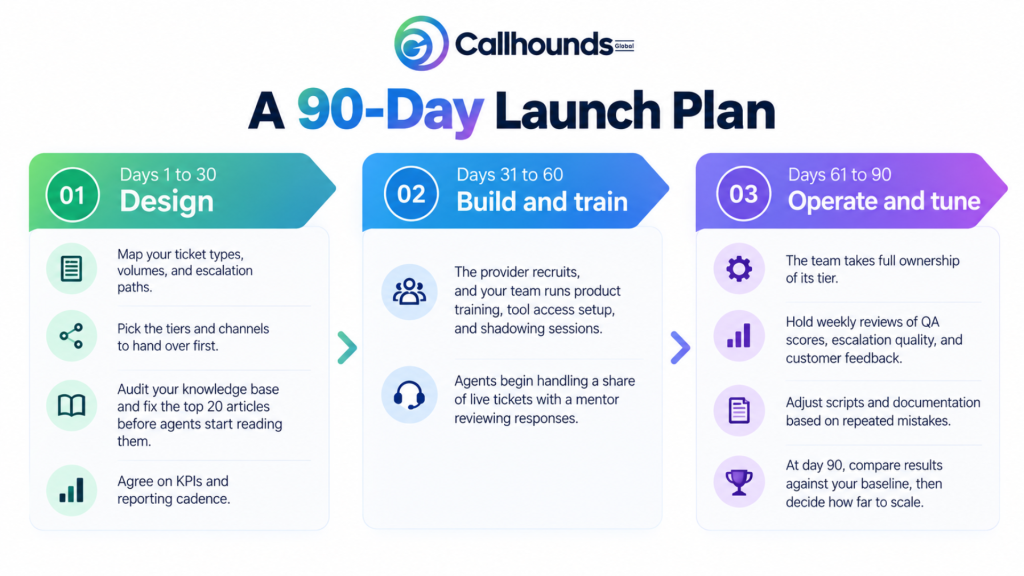
Map your ticket types, volumes, and escalation paths. Pick the tiers and channels to hand over first. Audit your knowledge base and fix the top 20 articles before agents start reading them. Agree on KPIs and reporting cadence.
The provider recruits, and your team runs product training, tool access setup, and shadowing sessions. Agents begin handling a share of live tickets with a mentor reviewing responses.
The team takes full ownership of its tier. Hold weekly reviews of QA scores, escalation quality, and customer feedback. Adjust scripts and documentation based on repeated mistakes. At day 90, compare results against your baseline, then decide how far to scale.
Pick a short list and review it weekly. The metrics that matter most for technical support are:
Compare each number to your in-house baseline from before the launch. If a metric slips for two weeks in a row, treat it as a signal to retrain or adjust the process, not to switch vendors on day 15.
Outsourcing technical support teams works best when you treat the provider as an extension of your own department. Start with a clear scope, write down your processes, choose a partner on security and training depth, and measure results against a baseline. Companies that follow those steps usually end up with lower costs, faster response times, and engineers who spend their hours on harder problems.
If your queue is growing faster than your hiring, a small pilot is the lowest-risk way to learn what outsourced support can do for your customers.
Key Takeaways
It means contracting a third-party provider to hire, train, and manage agents who handle your customers’ technical issues. The agents use your ticketing system, knowledge base, and escalation rules, and they report performance through shared dashboards.
Offshore Tier 1 and Tier 2 agents in the Philippines commonly run from about $1,500 to $3,000 per month fully loaded, compared with $5,000 or more for a US in-house agent. Final pricing depends on language skills, shift schedules, tier, and contract model.
Start with high-volume, repeatable Tier 1 tasks such as account access, setup help, and basic troubleshooting. Move Tier 2 work after your documentation is current and quality scores are stable. Keep complex engineering escalations in-house or with a dedicated senior team.
It can be if you pick a provider with verified controls. Look for ISO 27001 certification, role-based access, encrypted systems, agent background checks, and compliance with GDPR, HIPAA, or PCI DSS where they apply to your customers.
Most providers can launch a pilot team in 4 to 8 weeks, including recruiting, training, and system access. A full ramp to steady-state quality usually takes about 90 days.