

Is Offshore Social Media Marketing Right for Your Business?

Your last post went live nine days ago, and nobody on your team noticed. That quiet gap is where most social media marketing efforts fall apart. Offshore social media marketing is right for your business when you need steady daily output, meaning content, scheduling, community replies, and reporting, at a lower cost than an in-house hire, and you’re ready to give a remote team clear brand guideline. It’s a poor fit when your brand relies on real-time local news, heavy legal review, or an executive’s personal voice in every post.
Plenty of owners learn this the hard way. They hand the account to a busy employee, then to a freelancer who disappears after three months, then to an agency retainer that costs more than a full-time salary. Somewhere in that loop, the question shifts from “who should post for us?” to “where should the work happen?”
This guide gives you a straight answer. You’ll see what an offshore team handles, how it compares with other models, what it costs, where it falls short, and how to run a 30-day test before you commit. It’s written for business owners and marketing leads in the US, UK, Australia, and beyond who want social media marketing that runs every single day, not just when someone finds a free hour.
Social media marketing is the practice of using platforms like Facebook, Instagram, LinkedIn, TikTok, YouTube, and X to build awareness, start conversations with customers, and drive sales. Offshore social media marketing means a dedicated team in another country, often the Philippines, does that work as an extension of your own staff.
They post on your accounts, follow your style guide, answer to you directly, and work hours that overlap with yours. That’s the real difference from a typical agency package. With an agency, you buy a bundle of deliverables from a rotating cast. With an offshore team, you usually get a person or a small squad who learn your brand the way an employee would.
Think of the work as five lanes. Some businesses hand over all five. Others start with one or two and add more as trust builds.
This covers captions, carousels, short-form video edits, graphics, and story sequences. A good social media specialist adapts one idea across formats: a long customer story becomes a LinkedIn post, an Instagram carousel, and a 30-second reel. They work from your brand kit, so colors, fonts, and tone stay consistent without you checking every draft.
Posting at the right hour on the right platform sounds simple until you manage four accounts across three time zones. An offshore team builds the calendar, queues posts in your scheduling tool, and publishes while you sleep. Your US morning feed is already live when you wake up.
Comments and direct messages are customer service now, planned or not. Support-trained agents answer questions, route complaints, and flag anything sensitive. Providers with a call center background, including Callhounds Global, tend to bring ticket discipline to this lane: response-time targets, tagging, and clear handoffs.
Your team sets up campaigns inside your budget cap, builds audiences, runs A/B tests on creative, and reports on spend. You still approve budgets and targeting rules. They handle repetitive setup and monitoring.
Weekly reports show what worked: reach, saves, link clicks, and follower growth. Social listening goes a step further by tracking brand mentions, competitor moves, and questions customers keep asking. Those questions often become your next ten posts.
No model wins every time. The right pick depends on your budget, how much control you want, and how much coverage you need. Here’s how the four common options stack up.
Table 1: Social Media Marketing Models Compared
| Model | Typical Cost Profile | Coverage | Control | Best For |
| In-house hire | Highest: salary, benefits, tools, and management time | One person, business hours | Full | Brands with complex approvals and a larger budget |
| Freelancer | Low to moderate, billed by project or hour | Limited, often part-time | Moderate | Small budgets and short campaigns |
| Local agency | High monthly retainer | Shared team, set deliverables | Moderate | Businesses wanting a full strategy package |
| Offshore dedicated team | Moderate: often well below a local hire | Dedicated hours, extended coverage | High, you direct the work | Growing brands needing daily execution |
Notice what the offshore row trades. You give up the corner office down the hall. You gain daily coverage and a team that’s yours rather than shared with twenty other clients.
If three or more of this sound familiar, an offshore team probably fits.
Offshore social media marketing isn’t a cure-all, and a good provider will tell you so. Think twice if any of these describe your situation:
In these cases, a hybrid setup often works better. Keep the voice and approvals in-house, and send the production work offshore.
Dedicated Philippines-based social media specialists commonly cost 50% to 70% less than the fully loaded cost of a comparable hire in the US, UK, or Australia. Fully loaded means salary, payroll taxes, benefits, equipment, software seats, and the management time you spend. Treat those percentages as a planning range, not a quote. A junior content assistant and a senior paid-social specialist sit at very different price points.
Cost isn’t only about the monthly invoice, though. A cheap team that needs constant rework isn’t cheap. Judge cost against output: posts published on schedule, replies sent within your target window, and reports delivered without chasing.
The smartest way to control spend is to decide which tasks go offshore and which stay close to you. Here’s a practical split.
Table 2: Which Social Media Marketing Tasks to Offshore
| Task | Offshore Fit | Keep In-House? | Notes |
| Content calendar drafting | High | Final approval only | Share monthly themes and promotions up front |
| Graphics and short-form video editing | High | No | Needs a brand kit and sample posts |
| Scheduling and publishing | High | No | Use platform roles, not shared passwords |
| Comment and DM replies | High | Escalations only | Write an approved-response library |
| Ad setup and reporting | Medium to high | Budget and targeting rules | Set spend caps and review weekly |
| Crisis response | Low | Yes | Offshore team flags, you decide |
| Founder or executive thought leadership | Low | Yes | Offshore team can edit and format |
| Brand strategy and positioning | Low | Yes | Offshore team executes it |
Once you see the split on paper, the decision gets easier. Most of a social program’s weekly workload is repeatable production, and that’s the part offshore teams handle best.
Plenty of countries offer offshore talent. The Philippines keeps showing up for English-language social media marketing, and the reasons are practical.
English skills and cultural fluency. Filipino professionals grow up with American and British media, so memes, slang, and holiday references land naturally. That matters when a caption has to sound like a neighbor, not a translator.
A social first workforce. DataReportal’s Digital 2026 report counted 95.8 million social media user identities in the Philippines as of October 2025, equal to roughly 82% of the population. Your team doesn’t study these platforms from the outside. They use them daily.
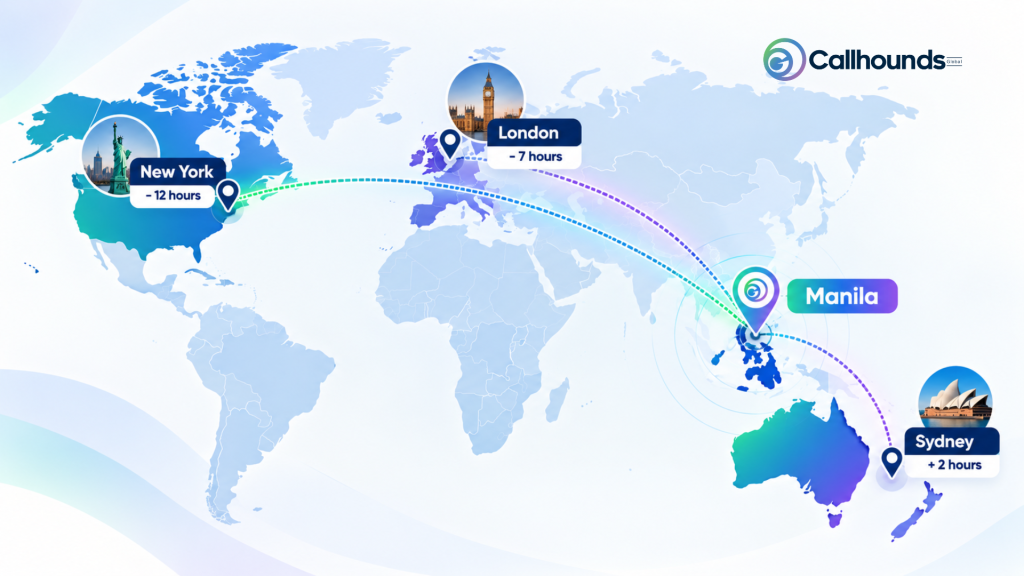
Time zone leverage. Manila runs 12 to 16 hours ahead of the US, 7 to 8 hours ahead of the UK, and 2 to 3 hours behind Australia’s east coast. For US brands, that means posts are drafted, scheduled, and replied to while you’re asleep. For Australian businesses, the overlap is nearly complete.
Talent depth. The country has a mature outsourcing industry, which means a large pool of people trained in customer communication, not just design or copy. If you want to see what that bench looks like, the page on hire offshore social media marketers in the Philippines walks through the roles available. And if you’re weighing a general assistant first, hire a virtual assistant in the Philippines explains how that route works and what it typically covers.
Most offshore projects don’t fail because of the country or the people. They fail because the setup was thin. A few habits separate teams that last from teams that churn.
Start with one role, then grow. A single social media specialist who handles content, scheduling, and replies is enough for most small and mid-sized brands. Add a video editor or paid-social specialist once the base is steady. If you expect scale, how to hire a virtual assistant team in 2026 lays out how to stack roles without losing control.
Write the brand voice down. Include three sample posts you love, three you’d never publish, a list of words to use and avoid, and your stance on emojis and humor. Two pages beat a two-hour call.
Build a response library. List your top 20 customer questions with approved answers, plus rules for what to escalate: refunds, complaints, legal threats, press inquiries. Your team replies fast on routine items and hands off the rest.
Control access properly. Never share passwords. Use Meta Business Suite roles, LinkedIn page admin levels, and two-factor authentication so you can add or remove people in seconds.
Hold a short weekly check-in. Fifteen minutes. Review last week’s numbers, approve next week’s calendar, and name one thing to test.
Honesty builds trust, so here are the real risks and the fixes that work.
Brand voice drift. Posts slowly lose your personality. Fix it with a monthly voice review and by keeping a “gold standard” folder of your best posts.
Delayed reactions to live events. A team asleep in your time zone can’t react to breaking news. Fix it by setting a “pause and flag” rule for sensitive moments and keep one in-house person on call.
Cultural misfires. A joke or reference that works in Manila may not work in Manchester. Fix it by sharing audience notes and having a local reviewer approve of anything edgy.
Security gaps. Shared logins and unmanaged devices invite trouble. Fix it with role-based access, two-factor authentication, and a signed confidentiality agreement.
Turnover. Any remote role can see people leave. Fix it by choosing a provider that handles recruitment, backup coverage, and documented processes, so your know-how doesn’t walk out with one person.
You don’t need a long contract to find out if this works. Run a pilot.
If your social media marketing suffers from gaps, slow replies, or a budget that can’t stretch to a local team, offshore is worth a serious look. If your brand depends on founder-led takes, heavy compliance review, or same-hour local reactions, keep that core close and offshore the production around it.
Either way, test before you commit. A 30-day pilot with three clear metrics will tell you more than any pitch deck.
Callhounds Global builds dedicated offshore teams in the Philippines for businesses in the US, UK, and Australia, from social media specialists to full support operations. Reach out to our team to talk through your goals, and we’ll tell you honestly if offshore the right fit is.
Key Takeaways
Yes, if you need consistent output and can’t afford a full-time local hire. A single offshore specialist can cover content, scheduling, and replies for a fraction of the cost. It’s less useful if you haven’t set your brand voice or goals, because a remote team needs direction to perform.
Costs vary by role and experience, but dedicated Philippines-based specialists commonly run 50% to 70% below a comparable US, UK, or Australian hire. Ask providers for a fully loaded monthly rate that includes management, equipment, and backup coverage so you can compare offers fairly.
Usually, yes. Filipino professionals are well exposed to Western media, and good providers train teams on your audience, slang, and seasonal calendar. You can close any gap with sample posts, audience notes, and a local reviewer for sensitive or humorous content.
It’s safe when you control access the right way. Use platform roles such as Meta Business Suite permissions instead of sharing passwords, turn on two-factor authentication, and require a confidentiality agreement. You can remove access instantly if the relationship ends.
Expect better consistency within the first two to four weeks, since posting and replies become reliable fast. Engagement and follower growth usually take two to three months to show a clear trend. Lead and sales impact depends on your offer, audience, and ad budget.