

How Startups Can Offer 24/7 Support
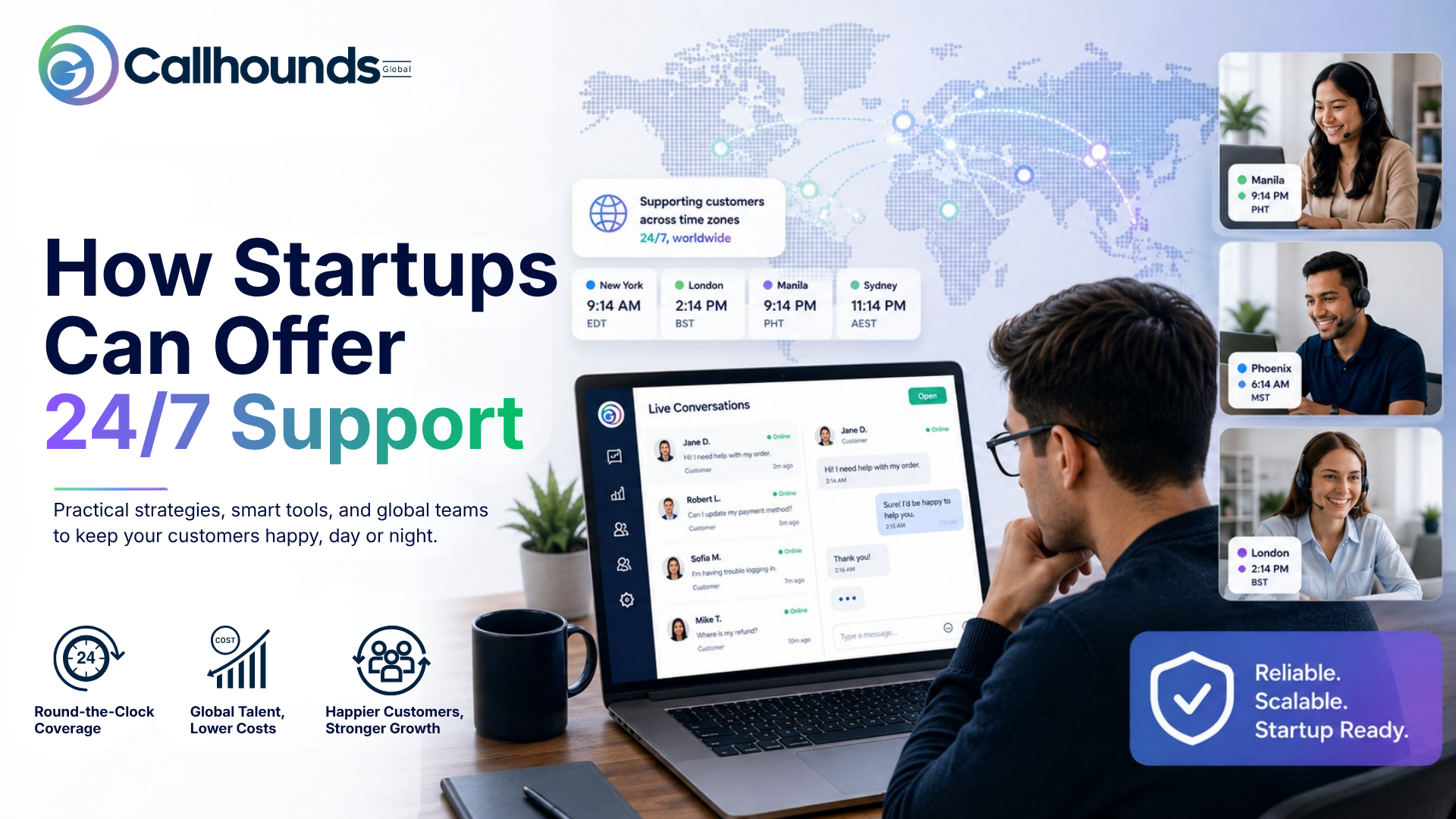
Miss one customer after hours, and you might lose them forever. That’s why 24/7 support for startups is no longer a luxury; it’s a competitive advantage. The good news is you don’t need to hire an expensive overnight team to provide round-the-clock coverage. By combining self-service resources, automated ticket triage, and a small outsourced or fractional support team with your existing in-house staff, even a five-person startup can respond to customers 24/7 while keeping costs under control.
This guide explains the most effective support models, essential tools, and step-by-step approach founders use to deliver reliable around-the-clock customer service without adding a full overnight shift before the business is ready.
Customers no longer think in business hours. A shopper in Singapore, a SaaS user in São Paulo, and a mobile app user in Los Angeles can all try to reach a five-person startup within the same hour, and each one expects a reasonably fast answer regardless of the local clock. Research from customer experience surveys consistently finds that a large share of buyers expects an immediate reply to the moment they reach out, and many will simply switch providers after one slow or unhelpful experience.
For an early-stage company, that pressure is amplified. Startups rarely have brand loyalty to fall back on the way an established company does, so a missed message during a free trial or an unanswered question before checkout tends to end the relationship before it starts. Founders who treat availability as a growth lever, not just a cost center, usually see the difference in trial-to-paid conversion and in early retention numbers.
There is also a competitive angle. Larger, well-funded competitors already answer instantly through chatbots and outsourced teams. A startup that only replies during office hours looks smaller and less reliable by comparison, even if the underlying product is better.
Search behavior has shifted alongside customer expectations. People increasingly type full questions into search engines and AI assistants. Things like “does this app have support on weekends,” and they expect a direct, current answer rather than a marketing page. A startup helps content, FAQ pages, and support documentation now function as part of its search and discovery strategy, not just its customer service operation. Writing that content clearly, with direct answers near the top of each page, tends to perform better both with human readers and with the AI systems now summarizing search results.
Before comparing solutions, it helps to be honest about what a homegrown night shift really costs. Most founders underestimate this by a wide margin.
None of these means overnight coverage is a bad investment. It means the “just hire someone” instinct is usually the most expensive way to solve the problem, especially for a company that hasn’t yet validated steady after-hours demand.
| Model | Typical Monthly Cost Range | Response Speed | Best Fit Stage | Main Trade-off |
| Solo founder answering everything | Low direct cost, high personal cost | Inconsistent, depends on founder’s sleep | Pre-launch to first paying customers | Burnout and slow scaling |
| In-house night shift hire | Highest ongoing cost | Fast once trained | Later-stage, high overnight volume | Salary, turnover, management overhead |
| Chatbot or automation only | Low, most software cost | Instant for simple questions | Any stage with routine, repeatable questions | Struggles with complex or emotional issues |
| Outsourced or fractional support team | Moderate, scales with volume | Fast, live agents around the clock | Seed to Series B | Requires clear documentation and onboarding |
| Hybrid: automation plus outsourced escalation | Moderate, most efficient per ticket | Instant first response, fast escalation | Most growth-stage startups | Needs some setup and workflow design upfront |
Most startups that succeed at 24/7 coverage do not pick one tool. They stack three layers, each catching what the previous one misses.
A well-built help center answers a large share of questions before anyone must respond at all. This includes:
Founders sometimes skip this step because it feels less urgent than “hiring someone,” but it is usually the cheapest layer to build and the one with the highest return per hour invested.
Chatbots, automated email replies, and AI-assisted ticket routing catch the repetitive questions that would otherwise eat up an agent’s night. A basic setup can:
This is also where AI Overviews and answer-engine behavior matter for the support content itself. Clear, direct answers written for a help center tend to perform well both for customers searching your site and for AI-driven summaries pulling from public documentation, which is a secondary but real benefit of investing in this layer properly.
For anything automation cannot resolve, a small, outsourced team fills the gap without the overhead of full-time hires. This is where many founders benefit from reading a startup founder’s guide to customer support before signing a contract, since pricing structures and shift models vary widely between providers.

The build-versus-outsource question comes up early for almost every founder, and the right answer depends less on company size and more on ticket predictability and complexity.
| Signal | Points Toward In-House | Points Toward Outsourcing |
| Ticket volume overnight | Consistently high and predictable | Low, sporadic, or unpredictable |
| Complexity of typical issue | Highly technical, product-specific knowledge required | Routine questions, billing, account access, order status |
| Current team bandwidth | Founders and staff have room to train and manage a new hire | Team is already stretched thin |
| Budget stage | Later funding round with stable runway for fixed payroll | Early stage, need cost to flex with volume |
| Speed to launch | Willing to wait weeks for hiring and training | Need coverage within days |
Many founders find the clearest answer after reading lessons from scaling a BPO company, since it shows how larger operations decide when to bring functions in-house versus keep them with a partner, a decision that mirrors what an early-stage company faces on a smaller scale.
Coverage alone is not the goal. A startup should track a small set of numbers to confirm the investment is paying off:
Reviewing these numbers monthly, not quarterly, lets a founder catch problems, like a chatbot answering incorrectly or an outsourced team missing a shift, before they damage customer trust.
It also helps to separate metrics by channel. A startup selling primarily through a mobile app will see different after-hours patterns than one selling through a website contact form and blending the two together can hide real gaps. Founders who segment their data by channel, time zone, and issue type usually spot which part of the support stack needs attention long before customers start complaining publicly.
Founders exploring outside help for the first time often benefit from a resource on why startups should start outsourcing early, since timing mistakes in either direction, too early or too late, tend to be costly.
Another mistake worth naming directly: assuming one region can cover every time zone comfortably. A single overnight agent based in one city still has to sleep, take breaks, and occasionally call out sick, so “24/7” coverage built on a single person is fragile in the same way a single in-house hire would be. Real round-the-clock coverage usually means either a rotating team or a provider with staff already spread across time zones, which is one more reason outsourced models tend to outperform a single new hire for this specific problem.
This sequence avoids the two most common failure modes: over-investing in headcount before demand is proven, and under-investing in structure before handing tickets to an outside team.
Offering 24/7 support as a startup is not about matching a big company’s headcount. It is about matching a big company’s availability using a smaller, smarter stack: clear self-service content, automation for repeatable questions, and a flexible human team for everything else. Founders who build this tiered system early tend to protect early customer relationships without stretching their runway, and they usually find that the structure scales cleanly as the company grows rather than needing to be rebuilt from scratch later.
Key Takeaways
A startup can offer 24/7 customer support by combining a self-service knowledge base, automated chat or email responses for routine questions, and a small outsourced or fractional agent team for anything that needs human touch. This tiered setup covers most hours of the day without requiring a full internal night shift.
In most cases, yes, especially for overnight or weekend coverage. Outsourcing avoids the shift of differentials, training time, management overhead, and idle payroll that come with an in-house night shift, and costs typically scale with ticket volume instead of staying fixed.
The best first step is usually building a clear, searchable help center covering the most common questions, followed by setting up automated acknowledgment replies. These two steps alone often resolve or hold over a large share of after-hours tickets before any outside team gets involved.
No. AI chatbots handle routine, repeatable questions well, but complex, sensitive, or unusual issues still need a person. The most reliable approach pairs automation for first response with human agents, in-house or outsourced, for escalations.
The right time is usually earlier than founders expect. As soon as customers are spread across multiple time zones or after-hours, inquiries start affecting conversion or retention. Waiting until support volume becomes unmanageable often means losing customers in the meantime.