

Holiday Peak Customer Service for Ecommerce

Black Friday isn’t your customer service problem. The preparation gap before it is.
The first week of October is when ecommerce brands should already be preparing for holiday peak customer service, before ticket volumes explode, response times slow down, and frustrated shoppers start leaving negative reviews.
From November through January, your support team may face a surge of questions about delayed orders, failed promo codes, returns, refunds, shipping updates, and missing packages. Without enough capacity and the right workflows, that surge can quickly turn into lost sales and unhappy customers.
The solution isn’t simply hiring more agents. It’s building a support operation that can handle peak demand before peak demand arrives.
That means adding agent capacity early, automating repetitive questions like order tracking, routing complex tickets to the right people, and keeping experienced agents available for issues automation cannot resolve.
This guide gives ecommerce operators in the United States, United Kingdom, Australia, and Philippines a practical plan for preparing for the holiday rush, including a staffing timeline, task allocation matrix, cost comparison, and readiness checklist.
Black Friday is November 27. Your peak-season customer service plan should already be underway.
Peak season changes the nature of the work, not just the amount. In spring, most conversations are product questions and routine account changes. In December, they are urgent and emotional: a gift that must arrive by the 24th, a refund that must clear before a card statement closes, a size exchange needed before a family gathering.
The money moving through the system explains the pressure. Adobe reported that U.S. consumers spent $257.8 billion online during the 2025 holiday season, up 6.8% from the previous year. Every one of those orders is a possible support contact, and brands should plan for 2026 to land at or above that mark.
Patience shrinks as volume grows. A shopper who waits a day for an answer in November will not wait at all in December. They open a competitor’s tab. Live chat customers expect a reply in about a minute, email customers expect a same-day answer, and social media complaints play out in public. A slow reply is not a private failure. It becomes a review.
There is a people cost as well. Overtime through November and December burns out agents, and January attrition leaves you short-staffed for the returns wave. Teams that treat holiday peak customer service as a one-month sprint usually pay for it in the quarter that follows.
Good staffing starts with knowing what your team will face. Almost every holiday queue is dominated by the same four categories, which makes them predictable and, with preparation, manageable.
Order-status questions typically make up 30% to 40% of tickets in a normal month, and industry benchmarks show that share climbing to 50% or higher in peak weeks. Delivery dates are tied to hard holiday deadlines, so customers check tracking several times a day. One carrier scan delay can trigger hundreds of near-identical contacts. The fix is rarely more agents. Proactive shipping emails, a branded tracking page, and delay notices sent before customers ask will remove a large share of this volume.
The second surge arrives from late December through January. Size swaps, gift returns, warranty claims, and gift card balance questions all land at once. If return authorizations sit in a backlog, restocking stalls and customers write back angrier. A self-service returns portal, a clear policy page, and a seasonal extension of the return window cut the load before it reaches an agent.
These contacts deserve priority because the revenue is still in the cart. Failed Buy Now, Pay Later approvals, expired promo codes, and mobile checkout errors send shoppers away within minutes if no one answers. Staff chat on cart and checkout pages first and give agents the authority to fix a coupon issue on the spot.
Wrong addresses, missing gift receipts, split shipments, and damaged packages require judgment. These cases are fewer in number but heavier in emotion. Give your agents clear authority to reship, refund, or credit within set limits, so a customer is not bounced between departments in the week before Christmas.
Support volume does not wait for Thanksgiving. Early-bird promotions and gift research push tickets up in late October, and Cyber Week brings the steepest climb, with inbound requests often 80% or more above baseline. The table below turns that pattern into a working schedule.
Table 1: Q4 holiday support readiness timeline
| Window | Actions | Why It Matters |
| Early October | Confirm headcount, sign outsourcing or seasonal contracts, and audit last year’s ticket data by channel. | New agents need weeks of runway before live queues. |
| Mid-October | Train agents on products, policies, and tools. Build macros and help center articles. Test chatbots and the tracking page. | Mistakes found in testing cost nothing. |
| Late October | Soft launch with live queues. Score quality, coach agents, and publish shipping cutoff dates. | Early promotions trigger the first spike. |
| Early to mid-November | Freeze policy changes, finalize escalation paths, and set the Cyber Week schedule. | Consistent answers prevent repeat contacts. |
| Nov. 26 to Nov. 30 | Run huddles daily, watch queues hourly, and activate overflow coverage. | Thanksgiving through Cyber Monday is peak intensity. |
| December | Update delivery deadline banners, monitor carrier delays, and send proactive delay notices. | WISMO volume peaks as deadlines close in. |
| Late December to January | Shift staff to returns and exchanges, send surveys, and review KPIs. | The second wave arrives after the gifts are opened. |
Teams that start in November hand live customers to untested agents on their most profitable days. If you are reading this with less runway than you would like, narrow the plan: lock in capacity first, automate order tracking second, and train on your top ten questions third.
Holiday peak customer service does not require moving your whole operation to an outside team. The most resilient brands use a three-way split. Software handles the questions with one right answer; a trained outside team handles volume that needs a human, and your in-house staff keep the cases where discretion protects the brand.
Table 2: Task allocation matrix for peak season support
| Support Function | Automation | Outsourced Team | In-House Team |
| Order tracking (WISMO) | Primary: tracking page and bot | Handles exceptions and carrier disputes | Oversight only |
| Standard returns and exchanges | Self-service portal | Primary ownership | Approves policy exceptions |
| Pre-sale live chat | Bot answers basic FAQs | Primary ownership | Escalation only |
| Payment and coupon failures | Guided error messages | Primary ownership with checkout access | Fraud and billing disputes |
| VIP and influencer care | Not recommended | No involvement | Primary ownership |
| Damaged goods and warranty claims | Intake form | Initial intake only | Primary ownership |
| Overnight and weekend queues | First response | Primary ownership | On-call escalation only |
This split works because it matches cost to complexity. A tracking lookup does not need a senior agent, and a high-value customer with a damaged order does not need a script. For the day-to-day standards behind each row, including response targets and quality scoring, see our guide on ecommerce customer support .
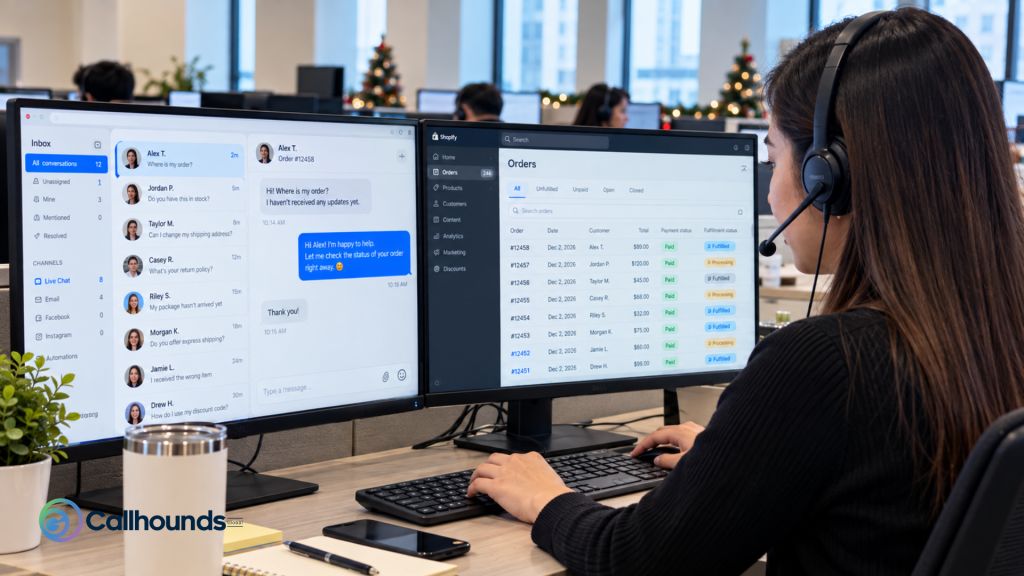
Most stores price a seasonal agent by the hourly rate and stop there. That number is the smallest part of the bill. Recruiting, paid training time before an agent takes a single live ticket, management hours, software licenses, and equipment all come before productive work begins. Then add the cost of errors: wrong refund amounts, mishandled returns, and chargebacks from customers who were given bad information.
Seasonal hires also leave in January, taking everything they learned with them. You pay to rebuild that knowledge next October. Year-round in-house hiring solves the retention problem but leaves you carrying the cost of peak-level headcount through the quiet months.
Outsourced capacity changes the math because the training, scheduling, and management overhead sit with the partner, and the team can scale up for Q4 and back down in February. The Philippines has become a common choice for U.S., UK, and Australian retailers for practical reasons: strong English fluency, familiarity with Western consumer culture, and a workforce that can cover overnight hours without graveyard-shift premiums. Brands weighing this route can read how bpo ecommerce support outsourcing works for online retailers in practice.
Outsourcing is not automatic relief, and it is worth being honest about the trade-offs. A new partner still needs your product knowledge, policies, and tool access, and that handoff takes time. Share your top ticket categories, tone guidelines, and escalation rules in early October, and treat the first two weeks as a pilot with daily quality reviews. Brands that skip this step often blame the partner for gaps that started with the brief.
Not every channel deserves equal staffing in a rush. Put your best people where the revenue and the risk are highest.
Use this list as a final gate before Cyber Week. If you can answer yes to all seven, your holiday peak customer service plan is in good shape.
A holiday customer is expensive to acquire and easy to lose. How you handle the return in January often decides if that person buys again in March. Treat a smooth exchange as a retention tool: confirm the new shipment quickly, send a short follow-up, and ask for feedback while the experience is fresh.
Then run a debrief. Compare your peak numbers against the plan: first response time, time to resolution, contacts per order, satisfaction scores, and the share of tickets resolved without an agent. Record what broke and what you would change and file it where next year’s team will find it in March instead of rediscovering it in November.
Holiday peak customer service is decided long before the first Black Friday order arrives. The brands that hold their quality through December start early, remove the repeat questions with self-service, assign each task to the right people, and rehearse before the rush. The ones that wait end up improvising in front of their best customers.
If your team needs extra hands this season, Callhounds Global provides trained ecommerce support agents from the Philippines who cover chat, email, and phone for brands in the US, UK, and Australia. Reach out in early October, while there is still time to train, test, and launch before the surge.
Key Takeaways
Holiday peak customer service is the preparation of staff, technology, and processes to handle the surge in support requests between November and January. It includes early hiring or outsourcing, self-service tools for order tracking and returns, clear escalation rules, and coverage across all channels and time zones.
Start in early October at the latest, and earlier if you can. New agents need training on your products, policies, and systems, and that takes several weeks. Brands that wait until November usually put untested staff in front of customers during Black Friday and Cyber Monday.
Many ecommerce teams report volume running between two and five times their normal levels, with the heaviest weeks around Cyber Week and the days before shipping cutoffs. Your own helpdesk data from last year is the most reliable forecast, so use it as the baseline.
It depends on volume and complexity. Seasonal hires give you direct control but carry recruiting, training, and turnover costs. Outsourcing shifts overhead to a partner and scales more easily, which suits repeatable tasks such as order tracking, returns, and live chat. Many retailers combine both keeping complex and VIP cases in-house.
Track first response time, average resolution time, customer satisfaction score, contacts per order, and the percentage of tickets resolved through self-service. Review them daily during Cyber Week so you can move staff between channels before a backlog form.