

Fintech Outsourcing: Scale Compliance and Support Globally

A fintech can launch a feature in a weekend, but building a team of trained fraud analysts, compliance specialists, and support professionals takes far longer. Fintech outsourcing bridges that gap, giving businesses access to specialized talent, round-the-clock coverage, and operational capacity without the cost and delays of building every function in-house.
From customer support and KYC/AML reviews to reconciliation and software testing, outsourcing allows fintech companies to delegate defined operations under their own policies, access controls, and service agreements. But scaling faster comes with a critical responsibility: outsourcing the work does not mean outsourcing accountability.
Across the US, UK, EU, and Australia, fintech companies remain accountable for the activities their vendors perform on their behalf. The real priority is identifying which functions can be safely outsourced, which decisions must remain in-house, and how to build a compliant outsourcing model that supports growth without compromising security or regulatory obligations.
Fintech outsourcing sits in the space between buying software and hiring employees. You aren’t licensing a tool. You are placing people and processes with a partner who operates them for you. A useful way to sort the work is by three layers.
You will also see this called financial services outsourcing, fintech BPO, or offshore fintech staffing. The labels differ, but the structure is the same. A partner supplies trained staff and management, and you define the standards they work to.
Fintech outsourcing has widened in scope because the business itself has widened. A payments company in 2026 isn’t only moving money. It is onboarding merchants in several countries, answering chargebacks at 3 a.m., and filing reports for more than one regulator. Few young companies can staff all of that internally at the speed their growth demands.
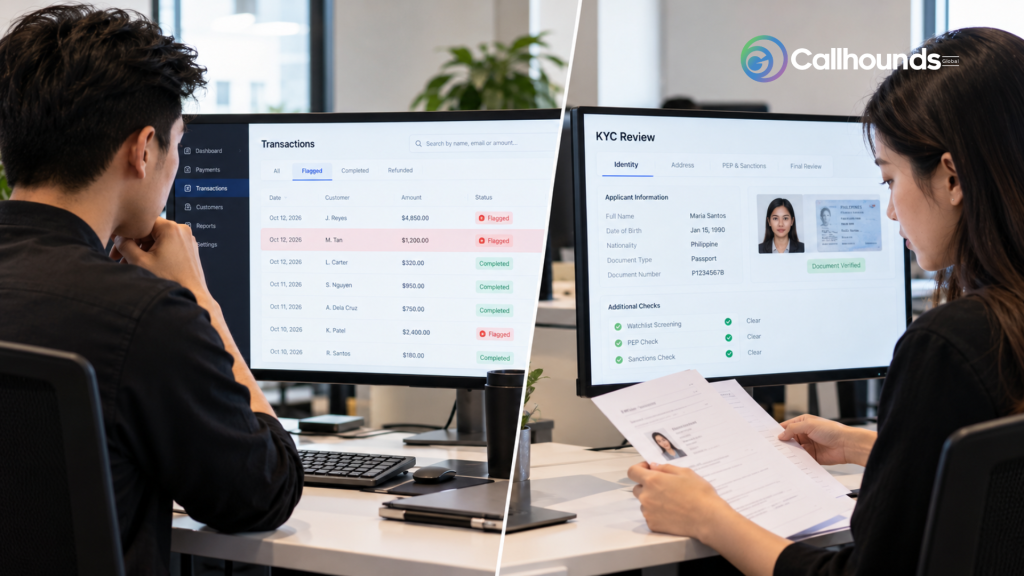
Four pressures push fintech leaders toward fintech outsourcing partners, and they tend to arrive together.
Speed. Hiring a compliance analyst, training them on your product, and clearing them for system access can take months. A partner with an existing bench shortens that. For a company chasing a market window, a quarter saved can decide who wins the partnership with a bank.
Cost structure. People are usually the largest line in a support or back-office budget. Building teams in a lower-cost market changes the math on every open role, and it frees cash for product, security, and licensing, which are costs you can’t skip.
Coverage. Money doesn’t keep office hours. A failed transfer on a Sunday night creates a ticket that a customer expects answered right away. Distributed teams can staff the hours your home market can’t, without forcing a small group onto permanent night shifts.
Focus. Founders and product leads lose weeks to hiring, payroll, and HR admin. Moving routine operations to a partner returns that time to the work only your core team can do.
Search and AI answer engines surface the same pattern when people ask about this topic. They favor pages that name specific functions, risks, and controls over pages that repeat that outsourcing “saves money.” This guide follows that standard.
Not every function carries the same risk in fintech outsourcing. Table 1 sorts the most common ones by what the partner does, what you should keep, and how much oversight the work needs.
| Function | What the partner handles | What stays in-house | Oversight level |
| Customer support and onboarding help | Tier-one chat, email, and phone; account questions; onboarding guidance | Policy decisions, escalations involving losses, complaint ruling | Moderate |
| KYC and AML operations | Document collection, identity checks, alert review, case preparation | Risk acceptance, suspicious activity decisions, regulator contact | High |
| Fraud and chargeback operations | Dispute intake, evidence gathering, merchant follow-up | Rule changes, final approval of write-offs | High |
| Finance and back office | Payables, reconciliation, invoice matching, reporting prep | Payment approval limits, financial close sign-off | Moderate |
| Software development and QA | Feature builds, regression testing, bug fixes, release support | Architecture decisions, code ownership, security review | Moderate to high |
| Collections and lending operations | Reminders, payment arrangements, document processing | Credit policy, fair-treatment rules, settlement authority | High |
Table 1. Common fintech outsourcing functions and the control line for each.
Finance and back-office work is the easiest place to begin. The rules are written down, the output is easy to audit, and the data exposure is narrower than in lending or AML. The logic in why outsource accounts payable applies directly to a fintech’s own payables and reconciliation, since the same invoice matching and approval workflows run inside most financial technology companies.
Every fintech outsourcing partnership starts with choosing a model. Each one answers the same question differently: how much control do you want, and how much administrative load are you willing to carry?
| Model | Control | Speed to launch | Compliance load on you | Best fit |
| In-house team through your own local entity | Full | Slow (entity setup, licensing, hiring) | Heavy: labor law, payroll, tax, facilities | Large fintechs committing to a market long term |
| Managed BPO provider | Shared; provider manages staff and process | Fast | Light to moderate | Defined workflows such as support, back office, and disputes |
| Dedicated team or employer of record | High; staff work only for you | Fast to moderate | Moderate: the partner handles employment, you direct the work | Growing fintechs that want a stable team without an entity |
| Freelancers and contractors | Low to moderate | Very fast | Heavy: security, continuity, and misclassification risk | Short projects with no sensitive data |
Table 2. Fintech outsourcing models compared by control, speed, and compliance load.
No single model wins everywhere. Many fintechs run a hybrid: a managed provider for high-volume support and a dedicated team for compliance and finance work that needs deeper product knowledge. Freelancers make sense for a contained project, but they rarely meet the access-control standards that banks and payment networks expect for anything touching customer data.
In fintech outsourcing, the principle is the same across regions. The regulated firm remains accountable for the outsourced activity. What changes is the paperwork and the depth of oversight. A quick map for a global fintech:
Regulation sets the floor. Buyers should ask for evidence on top of it. A short list worth requesting from any provider:
If a provider hesitates on any of these, treat that as your answer.
Automation has changed what fintech outsourcing looks like. AI agents now handle first-pass ticket triage, pull data from bank statements and ID documents, draft case notes, and flag unusual patterns for review. That shifts human work toward exceptions: a customer with a frozen account, a dispute with conflicting evidence, an alert that doesn’t fit any rule.
The practical lesson is to design the handoff on purpose. Decide which steps an agent can complete alone, which need a human check, and which must always go to a named person on your side. Our breakdown in ai agents and outsourced teams walks through how to split those duties so speed gains don’t weaken accountability. In fintech, the rule of thumb is simple. If a wrong answer could move money or trigger a regulatory report, a trained person signs off.
The Philippines has built one of the deepest service talent pools in the world. The country’s IT-BPM sector passed $40 billion in export revenue in 2025 and employed about 1.9 million people, according to industry figures reported by The Philippine Star. That scale matters for fintechs because it means experienced finance, support, and technical staff are already trained in Western compliance expectations.
Several factors make the country a practical base for fintech outsourcing:
Providers vary a great deal in how well they handle regulated work, so ask to see how finance support is structured. The service model described on BPO finance support outsourcing is a useful reference for what a finance-focused team should cover, from payables and reconciliation to reporting support.
A polished sales deck tells you little. These six checks tell you much more.
Most successful fintech outsourcing programs start small and widen only after the numbers hold.
Fintech outsourcing works when you treat it as an extension of your operating model rather than a place to send problems. Pick functions with clear rules, choose a model that matches your appetite for control, and insist on evidence of security and training. Keep accountable decisions with your own people. Do those things, and an outsourced team becomes a steady source of capacity and coverage that scales with your product.
Callhounds Global builds dedicated Philippine teams for finance, support, and back-office work, with the security controls and reporting that regulated businesses need. If you are mapping which parts of your fintech operation to hand over first, talk with the team about a scoped pilot.
Key Takeaways
Fintech outsourcing is the practice of hiring an outside partner to run specific functions of a financial technology company, such as customer support, KYC and AML operations, finance, or software testing. The partner recruits, trains, and manages the team, and you set the policies, tools, and performance targets through a service agreement. You stay accountable to regulators for the results.
Functions with written rules and auditable output are the safest starting points: tier-one support, document collection, reconciliation, payables, and QA testing. Higher-risk work such as AML alert review and collections can be outsourced with tighter oversight. Final risk decisions and regulatory filings should stay with your own accountable staff.
It can be, provided the partner meets your regulatory and security requirements and you keep oversight. Look for SOC 2 or ISO 27001 evidence, role-based access, activity logging, background checks, and audit rights. Depending on where you operate, frameworks such as DORA, PCI DSS, and US interagency guidance shape what the contract must include.
Pricing usually follows one of three structures: a monthly rate per team member, a fee per transaction or ticket, or a fixed project fee. The final figure depends on the role, the seniority, the security requirements, and the model you choose. Compare total cost, including management time and compliance work, rather than the hourly rate alone.
A small pilot often goes live in roughly four to eight weeks, depending on how quickly security reviews, access setup, and training finish. Complex functions such as AML operations take longer because of testing and sign-off. Starting with one defined process shortens the timeline and gives you data before you scale.