

Dedicated Teams vs Shared Teams Explained
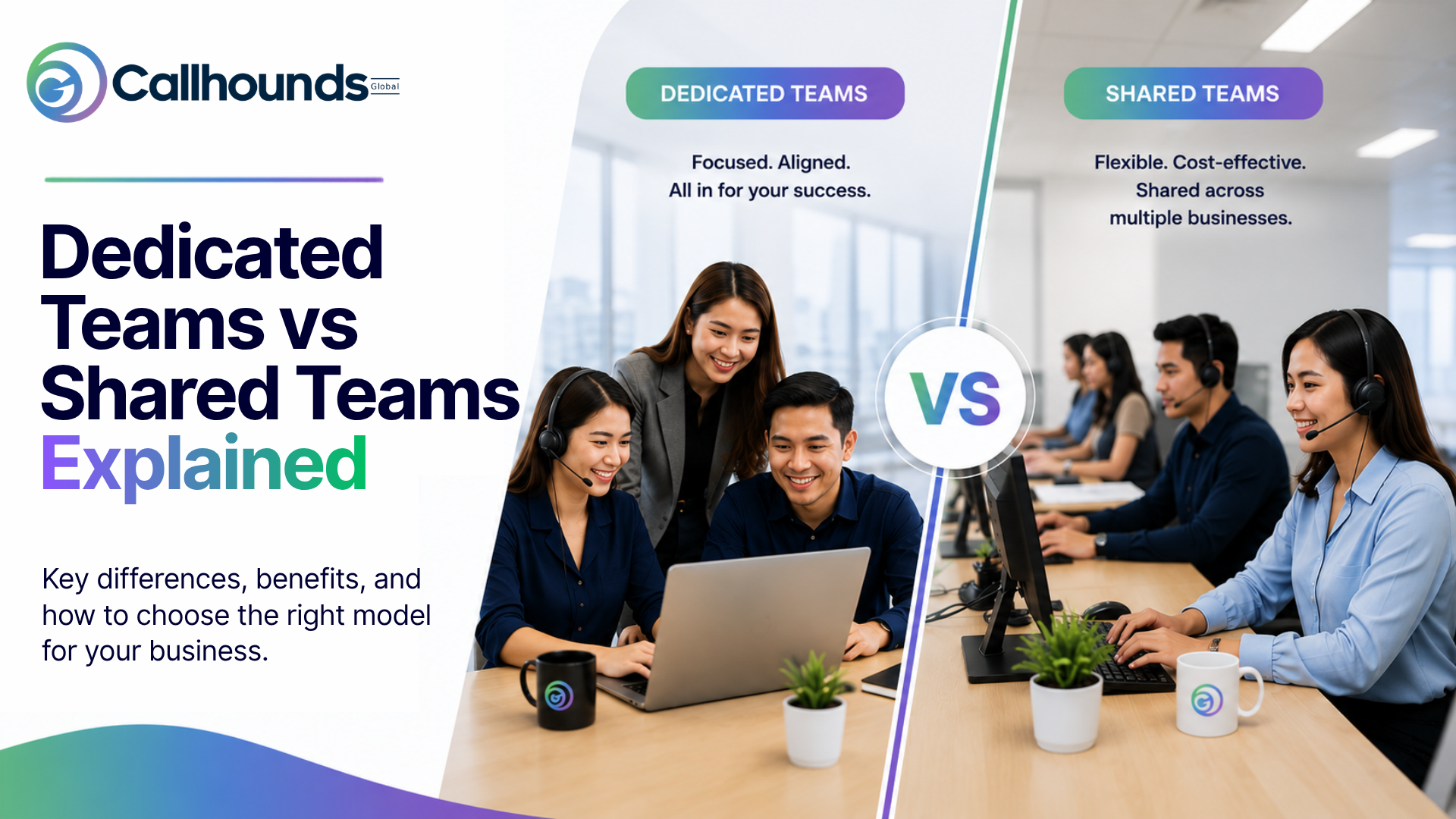
The biggest difference between dedicated and shared call center teams comes down to one thing: focus.
A dedicated team works exclusively for one company. Agents learn the same products, follow the same processes, and build deep knowledge of the brand, making them better suited for complex customer interactions and specialized support.
A shared team, on the other hand, serves multiple clients. Agents divide their time between different accounts, scripts, systems, and workflows. This model can be more cost-effective for businesses with lower or fluctuating call volumes, but it typically offers less dedicated attention to any single account.
The choice between dedicated vs shared call center teams affects them more than staffing costs. It can influence customer experience, agent performance, data security, product knowledge, scalability, and how closely an outsourced team operates with your in-house staff.
Dedicated teams prioritize consistency and specialization. Shared teams prioritize flexibility and cost efficiency. The right model depends on your call volume, security requirements, customer support complexity, and how much company-specific knowledge agents need to deliver the right experience.
Shared teams are the outsourcing equivalent of renting instead of owning. A company pays an hourly rate for agents who also work on other client accounts during the same shift or week. This arrangement suits businesses that need extra phone coverage during a product launch, a holiday shopping season, or a short marketing push, but don’t want to commit to a full-time headcount once the spike ends.
Because a shared agent juggles several client accounts, training tends to stay surface-level: enough to answer common questions and log tickets correctly, but rarely deep enough to handle edge cases the way a long-term employee would. Contracts are also easy to scale down or cancel once the workload passes, which is the main appeal for finance teams tracking seasonal spend closely.
The tradeoff shows data access. Shared agents typically log into several client databases across a single shift, which raises the number of systems exposed to potential breaches, credential leaks, or simple human error. For businesses handling payment details, health information, or other regulated data, that shared access is worth weighing carefully before signing a contract. Response times can also stretch during shared arrangements, since an agent mid-call on another client’s account can’t immediately pick up an incoming request from a different one.

A dedicated team functions closer to an extension of an in-house department than a rented service. These agents work full-time hours, exclusively for one client, and go through onboarding that mirrors what a new internal hire would receive: product training, tone-of-voice guidelines, escalation paths, and access to the same tools the client’s own staff use daily.
That depth of training pays off in workload variety. A shared agent tends to specialize in one narrow task, such as answering frequently asked questions; a dedicated agent can move between inbound support, outbound follow-ups, order corrections, and reservation management because the client relationship justifies the training investment. As call volume grows month over month, a dedicated team can absorb that growth without the client having to negotiate a new contract for every new task category added to the account.
Security is the other clear advantage. Dedicated agents connect to a single client system, which narrows the number of exposed data points considerably compared to a shared setup and satisfies data protection requirements common in health care, financial services, and travel booking. Managers also gain more direct oversight, since a dedicated team reports through a structure the client can shape, rather than one shared across several unrelated accounts.
The table below breaks down the practical differences business owners weigh most before signing an outsourcing contract.
| Factor | Dedicated Teams | Shared Teams |
| Staffing commitment | Full-time, exclusive to one client | Part-time or hourly, split across clients |
| Training depth | Extensive and brand-specific | Basic and task-focused |
| Data security | Access to one client database only | Access to multiple client databases |
| Setup speed | Slower, onboarding and training required | Faster, agents are often already trained |
| Cost structure | Higher fixed cost, lower cost per unit at scale | Lower hourly cost, less predictable at scale |
| Best for | High-volume, brand-sensitive, or compliance-heavy work | Seasonal spikes, short projects, overflow coverage |
Cost comparisons between the two models often get flattened into “dedicated costs more, shared costs less,” which misses the more useful math. Shared teams charge a lower hourly rate, but that rate covers less oversight, slower issue resolution, and agents who aren’t fully briefed on a company’s specific products. Dedicated teams cost more per seat upfront, but because agents stay with one client and improve over time, the cost per resolved ticket or completed call tends to drop as volume grows month after month.
Security follows a similar logic. A shared agent workstation might carry login credentials for four or five different client systems across a single week. A dedicated agent’s access stays limited to one company, one set of credentials, and one data environment. Companies in regulated industries, such as insurance, health care, and fintech, usually find that the security gap alone justifies a move to a dedicated model once volume passes a certain threshold.
Scalability is where dedicated teams show their long-term value most clearly. A shared team can flex quickly for a short burst, but that flexibility comes from pulling agents off other accounts, which limits how deep the coverage can go. A dedicated team scale by adding trained headcount that already understands the business, which keeps quality consistent even as the team grows.
Companies managing this kind of growth often rely on outside staffing practices to forecast call volume and build shift schedules around demand, a topic covered in more detail in workforce management explained, which applies to both dedicated and shared setups alike.
| Business Type | Recommended Model | Why |
| Seasonal retailer with holiday spikes | Shared team | Short-term coverage without a year-round commitment |
| Health care provider handling patient calls | Dedicated team | Stricter data access and compliance needs |
| Travel or hospitality booking service | Dedicated team | Deep product knowledge for reservation-heavy workflows |
| Startup testing a new support channel | Shared team | Lower cost while testing the process |
| SaaS company with growing ticket volume | Dedicated team | Consistent agents who learn the product over time |
| Event-based business with short campaigns | Shared team | Flexible hours matched to campaign length |
The pattern across that table is consistent: businesses with predictable, short-lived spikes lean toward shared teams, while businesses with steady growth, sensitive data, or complex products lean toward dedicated teams. A few businesses use both at once, running a small dedicated core team for the highest-value work and a shared pool for basic call overflow during busy periods.
Businesses that handle bookings, such as hotels, clinics, and travel agencies, tend to need the same reservation slot changes explained correctly every time a customer calls, which favors dedicated agents who already know the booking system inside and out.
A closer look at how these teams operate day to day is covered in reservation support teams explained, which walk through the workflow most reservation-heavy businesses eventually build around a dedicated staff instead of a rotating shared pool. For a business taking hundreds of bookings calls a week, the gap between an agent who checks a script and an agent who already knows the property, package, or provider tends to show up quickly in customer satisfaction scores.
One reason dedicated teams tend to outperform shared teams for long-term partnerships is culture. A shared agent working across five accounts has no realistic way of absorbing a company’s tone, values, or internal shorthand. A dedicated agent, working exclusively on one account for months or years, starts to sound like the company they represent on every call. Building that kind of culture across a remote or outsourced team takes deliberate effort: onboarding rituals, regular check-ins, and shared internal language all play a part.
The practices behind building that culture are broken down in how to build company culture in remote teams, which covers onboarding and communication habits that keep outsourced staff aligned with an in-house team even when they work from a different building or a different country entirely.
A few questions tend to settle the decision quickly for most business owners:
Businesses answering, “high volume,” “regulated data,” “deep knowledge,” or “ongoing” to most of these questions tend to land on dedicated teams. Businesses answering, “low volume,” “general data,” “simple script,” or “short-term” usually get more value from a shared team, at least for the first several months of an outsourcing relationship.
The difference between the two models becomes obvious within the first week of an outsourcing contract. A shared team typically joins with a short orientation, a shared knowledge base link, and a handful of macros for common replies. Agents log in, pull the next available account from a queue, and move through calls without much back-and-forth with the client beyond a monthly report. A dedicated team, by contrast, usually starts with several days of onboarding, direct access to the client’s tools, and a named point of contact on both sides.
Managers on the client side often sit in on early calls, adjust scripts based on real customer reactions, and treat the dedicated agents as an actual department rather than a vendor. That closer working relationship is why many businesses that start with a shared team eventually ask their outsourcing partner to convert part of that pool into a dedicated group once the account grows past a certain size.
The switch rarely happens all at once; most companies keep a shared pool for overflow while building a smaller, permanent dedicated core for the accounts, products, or customer segments that matter most to the bottom line.
Neither model is universally better; each solves a different staffing problem. Shared teams fit short bursts of demand, seasonal peaks, and businesses still testing how outsourcing fits into their operations. Dedicated teams’ fit companies with steady or growing volume, sensitive data, and a real need for agents who know the product well.
The businesses that get outsourcing right tend to start with a clear answer to one question: is this workload temporary or ongoing? Once that answer is settled, the rest of the decision, from staffing structure to data security requirements, tends to follow on its own. Callhounds Global works with businesses on both models, building shared pools for overflow support and dedicated teams for companies ready to treat outsourced agents as a permanent part of their operation.
Key Takeaways
A dedicated team works full-time for one client only, while a shared team splits hours between multiple clients on an hourly basis, moving between accounts throughout the day.
Per hour, yes, dedicated teams typically cost more. Per completed task at scale, dedicated teams often cost less overall because agents already know the product and need far less oversight.
Dedicated teams generally offer tighter data security because agents access only one company’s system instead of logging into several client databases across a single shift.
Yes. Many companies start with a shared team during a trial period to test outsourcing, then move to a dedicated setup once call volume or task complexity grows.
Shared teams are usually quicker to deploy since agents are often pre-trained on general call center tasks. Dedicated teams take longer to go onboard but tend to pay off with lower turnover and stronger long-term performance.