

Cost Avoidance vs Cost Savings: Understanding the Difference
Claiming $300,000 in cost savings means little if your general ledger tells a different story. Did your company spend less, or did it simply prevent future expense?
Cost savings reduce existing expenses. Cost avoidance prevents future costs. Both deliver value, but confusing the two can distort financial reports and undermine CFO confidence in procurement and operations decisions.
For businesses operating across the US, UK, and Australia with teams in the Philippines, understanding this distinction is critical when evaluating budgets, measuring outsourcing ROI, and reporting operational performance.
This guide breaks down the differences between cost avoidance vs cost Savings, how to calculate each, common reporting mistakes, and how outsourcing can deliver measurable results.
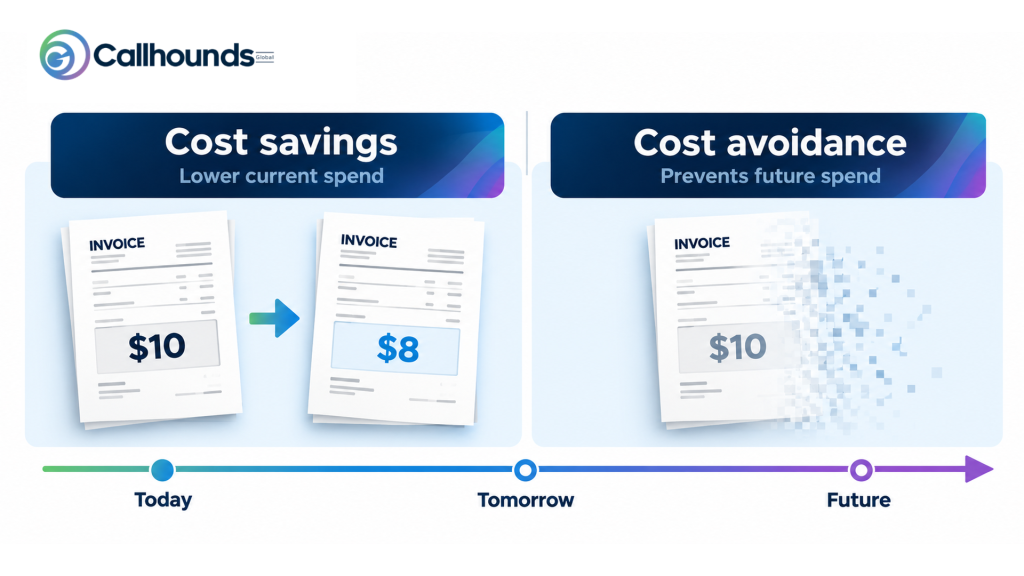
Cost savings and cost avoidance both protect your budget, but they work on different timelines. Savings work on the present. You paid $10 last quarter and you pay $8 now. Avoidance works on the future. You were on track to pay $10 next quarter, and a decision you made today keeps that bill from ever arriving.
Finance teams often label these two results hard savings and soft savings. Procurement groups, operations leaders, and project managers all use the terms, and the definitions hold across the US, UK, and Australia even when local vocabulary shifts a little. The table below puts the two side by side.
Table 1: Cost Avoidance vs Cost Savings
| Factor | Cost savings | Cost avoidance |
| Definition | A reduction in an existing, recurring, or committed expense | A prevented or reduced expense that has not yet occurred |
| Also called | Hard savings, cost reduction | Soft savings, cost prevention |
| Timing | Present or past spend | Future spend |
| How it is measured | Old cost minus new cost, checked against invoices | Estimated cost of inaction minus the cost of the fix |
| Evidence | Contracts, invoices, general ledger | Documented assumptions, risk estimates, quotes |
| On financial statements? | Yes, as a lower expense | Rarely, because no transaction occurs |
| Effect on next year’s budget | Budget can be lowered | Budget stays put, but risk goes down |
| Dispute risk | Low | High when baselines are weak |
| Example | Renegotiating a contract from $120,000 to $96,000 | Replacing aging equipment before it fails |
Cost savings are reductions in what you currently spend, achieved without cutting the quantity or quality you need. If you pay a supplier less for the same service, or you stop paying for something nobody uses, you have created a cost saving.
Because the money no longer leaves your account, you can verify the result. That is why finance teams trust these numbers, and why executives like to see them first.
The math is simple.
Cost savings = Previous cost − New cost
Cost savings % = (Previous cost − New cost) ÷ Previous cost × 100
Say a software contract was $120,000 and you negotiated the renewal down to $96,000. Your savings are $24,000, or 20%. Check the figure against the signed contract and the first invoice, and it will hold up under audit.
One caution: a saving counts only if the service level holds. Cutting an invoice by 15% while customer wait times double is not a saving. It is a cost that moved somewhere else.
Cost avoidance means acting now so that an expense you expect later never lands. Your spend does not go down. It simply stays below where it was headed.
That makes it harder to prove. The baseline is a forecast, not a receipt. Nobody can hand you the invoice for the server outage that did not happen, which is why many finance teams treat avoidance claims with a raised eyebrow until they are documented well.
Cost avoidance = Estimated cost of inaction − Cost of the proactive solution
Cost avoidance % = Cost avoidance ÷ Estimated cost of inaction × 100
Suppose your aging servers carry an estimated $150,000 in downtime and emergency repair if they fail. You replace them for $40,000. Your cost avoidance is $110,000, or about 73%.
A more careful version weights the estimate by probability. If the chance of failure within 12 months is 30%, the expected cost of inaction is $45,000 (30% of $150,000). On that basis, replacing the servers for $40,000 avoids only $5,000. The project may still make sense for risk reasons, but the weighted number keeps the claim honest, and it is the version a skeptical controller is most likely to accept.
Look closely at the price-cap example. Spend stays flat, so nothing drops in the ledger, yet the company clearly did better than the alternative. That is cost avoidance in its cleanest form.
Classification trips people up most when a single project produces both outcomes. The table below walks through five scenarios using illustrative numbers.
Table 2: Classifying common scenarios (illustrative figures)
| Scenario | What changed | Category | Amount to report |
| Telecom contract renegotiated | Monthly bill drops from $5,000 to $4,200 | Cost savings | $9,600 per year |
| Vendor renewal capped | Supplier asked for +8% on $60,000; you hold the price flat | Cost avoidance | $4,800 per year, and $0 in savings |
| Unused licenses canceled | 40 idle seats at $25 per month | Cost savings | $12,000 per year |
| Quality training program | Projected $50,000 in refunds and rework; program costs $12,000 | Cost avoidance | $38,000 (estimate, reported separately) |
| Inbound support moved offshore | Cost per agent falls from $4,500 to $2,700 per month | Cost savings | $1,800 per agent per month |
Figures are examples for explanation only and do not reflect client pricing.
Projects often blend the two. An offshore support team might cut your cost per agent (a saving) and spare you a lease expansion you had planned (avoidance). Report those on separate lines, each with its own evidence.
A few neighboring terms show up in the same meetings, so it helps to know where each one sits. Cost reduction is the umbrella phrase for any action that lowers spending, which makes cost savings a subset of it. Cost containment keeps spend from growing, so it sits closer to avoidance than to savings.
Return on investment, or ROI, measures the gain from a spend relative to what it cost. The gain can include hard savings, avoided costs, or both, which is exactly why the two need clear labels before they go into an ROI calculation. Using the right word keeps the conversation with finance short.
It matters because the two numbers lead to different decisions. Hard savings change next year’s budget. Soft savings change next year’s risk.
Consider a team that reports $500,000 in “savings,” of which $350,000 is avoidance. Leadership trims the budget by $500,000. Actual spending never fell by that much, so the department hits its new ceiling in the third quarter and asks for an emergency top-up. The original report was not dishonest. It was imprecise, and imprecision of that kind wears down credibility fast.
There is an audit angle as well. Savings trace back to documents. Avoidance depends on judgment, so reviewers will ask who set the baseline and why. A short written assumption log answers that question before anyone asks it.
Avoidance still deserves a seat at the table. Preventing a major outage, a compliance fine, or a wave of employee turnover protects revenue and reputation in ways a one-time price cut cannot. The aim is not to downplay it. The aim is to label it correctly.
A repeatable routine does more for your credibility than any single clever calculation. This six-step version works for most teams.
Outsourcing is one of the clearest places to see both effects in the same project. It is also a place where claims get exaggerated, so it pays to separate them cleanly.
When a business moves repeatable work, such as inbound customer support, to a skilled team in a lower-cost labor market, the cost per seat falls. That reduction is a measurable saving, visible in the monthly invoice compared with the in-house payroll it replaces. Many companies explore this route through inbound call center outsourcing when they need phone coverage without building another site.
The avoided costs are quieter but often larger over time: recruiting fees for roles you never had to fill, the training room you never built, the extra office space you never leased, the software licenses and telephony you never had to buy, and the churn cost of cycling through a high-turnover team. None of these appear as a line item going down, because they never appeared at all. They belong in your avoidance column, supported by the hiring plan or facilities quote you would otherwise have used.
Outsourcing is not automatically cheaper. Transition costs, management time, and quality gaps can wipe out the gain when the partner is a poor fit. Compare providers on service levels, security practices, and references, not just price. A guide to best outsourcing companies in the Philippines can help you build a shortlist, and the overview of offshore outsourcing services explains how the arrangement works from contract to daily operations.
Neither one wins by default. The right focus depends on your situation.
Mature finance teams run both in parallel. Savings keep today’s budget tight. Avoidance keeps tomorrow’s budget from blowing out. If a decision about scaling a team is on your desk, a look at offshore outsourcing services can show how both effects might play out in your own numbers.
Cost avoidance vs cost savings is really a question of honesty about timing. Savings are money you no longer spend. Avoidance is money you never had to spend. Both strengthen a budget, and both deserve credit, if each one is labeled for what it is and backed by evidence.
If you are weighing a move to outsourced support and want to see how it would look in your own savings and avoidance columns, Callhounds Global can walk you through the numbers. Contact our team to talk about your operation.
Key Takeaways
No. Cost savings lower an expense you already pay, so the reduction shows up in your ledger. Cost avoidance prevents an expense that would have occurred later, so spending never drops; it just stays below the forecast. Savings are measured against invoices. Avoidance is measured against estimates.
Neither is better in every case. Savings help when you need to lower this year’s spend. Avoidance helps when you need to prevent larger bills, such as outages, fines, or turnover. Most finance teams track both and report them on separate lines.
Generally, no. financial statements record transactions that happened, and when an expense is avoided, no transaction occurs. That is why avoidance is documented in procurement or project reports instead of the general ledger. Confirm the treatment with your finance team or auditor.
Subtract the cost of the proactive solution from the estimated cost of doing nothing. For a more cautious figure, multiply the cost of inaction by the probability it would occur before you subtract. Document the source of every assumption.
Yes. Outsourcing can reduce the cost per seat compared with in-house payroll, which is a saving. It can also prevent costs such as recruiting, office expansion, equipment, and turnover, which count as avoidance. Track them separately and net out transition and management costs.