

BPO Risk Management: How to Protect Outsourced Operations Before Something Breaks
One overlooked risk can bring your entire outsourced operation to a halt.
BPO risk management helps businesses identify, assess, and reduce threats before they disrupt operations. From data breaches and compliance violations to vendor instability, service failures, and business interruptions, every risk needs a clear mitigation strategy.
The biggest mistake? Waiting for something to break before preparing a response. Effective risk management starts before you sign the outsourcing contract and continues throughout the partnership. Without clear responsibilities, tested contingency plans, and measurable performance standards, even a reliable provider can become a point of vulnerability.
This guide covers the risks every outsourcing buyer should evaluate, a five-step framework for managing them, the contract clauses that matter, and the key metrics to monitor. Whether you’re outsourcing to the Philippines or another offshore destination, you’ll learn how to protect your operations, maintain service continuity, and build a more resilient BPO partnership.
Think of BPO Risk Management as a lifecycle discipline. The work begins at vendor selection, carries through onboarding and steady-state operations, and finishes with a planned exit. Each stage has its own failure modes. A weak selection process invites a financially shaky provider. A rushed onboarding leaves access rights wide open. A missing exit clause turns a bad relationship into a hostage situation.
It does not mean doing the provider’s job for them. A good provider runs its own internal risk program, with security controls, hiring checks, and site redundancy. Your job is to confirm those controls exist, understand where they stop, and cover the gaps with your own safeguards.
The accountability point matters more than most first-time buyers expect. Under regulations such as GDPR in the UK and EU, HIPAA in the US, and the Australian Privacy Act, the company that collects customer data usually remains responsible for protecting it, even when a vendor handles it day to day. Handing off a process doesn’t hand off the liability.
The data backs up the concern. Verizon’s 2025 Data Breach Investigations Report found that third-party involvement in breaches had doubled to 30%. IBM’s 2025 Cost of a Data Breach Report put the average cost of a third-party vendor or supply chain compromise at about $4.91 million, with an average of 267 days to identify and contain the breach, the longest of any attack vector it measured. These figures describe supply chains broadly, not BPO alone, but any provider with access to your systems or customer records falls within that risk landscape.
Most risk registers fail because they’re either too vague (“data risk”) or too long (140-line items nobody reads). Seven categories cover nearly everything a BPO engagement can throw at you. The table below shows how each one tends to appear, what to watch for, and the first control worth asking about.
Table 1: The Seven Core BPO Risk Categories
| Risk category | How it shows up | Early warning sign | Primary control |
| Data security and privacy | Leaked records, unauthorized access, shared logins | Slow answers to security questionnaires; shared credentials | ISO/IEC 27001 or SOC 2 report, role-based access, quarterly access reviews |
| Regulatory compliance | Fines, failed audits, call-recording violations | Agents unsure which rules apply to which client | Documented compliance training, annual audit rights, data-processing agreement |
| Operational and service quality | Missed SLAs, rising error rates, customer complaints | QA scores drifting down for three straight weeks | Clear SLAs, calibrated QA scoring, weekly operations review |
| Vendor and financial stability | Sudden price hikes, layoffs, provider acquired or closed | Late payments to staff, leadership turnover | Financial statements review, step-in rights, exit plan |
| Continuity and environmental | Outages, typhoons, power or internet failures | No documented recovery targets; single-site operation | Tested continuity plan, multi-site or work-from-home fallback |
| People and attrition | Knowledge loss, constant retraining, thin coverage | Attrition rising above the agreed band | Retention reporting, cross-training, bench capacity |
| Reputational and conduct | Rude or scripted-sounding service, viral complaints | Escalations about tone rather than accuracy | Conduct standards, call sampling, escalation protocol |
Three of these get underestimated more than the rest.
Data security. The weak point is seldom a dramatic hack. It’s usually a shared login, an agent who still has access after changing teams, or a spreadsheet of customer details sitting on a personal device. Limit what the provider can see to what the job needs. That one habit prevents more incidents than any single tool.
Continuity. Plenty of providers can tell you they have a plan. Fewer can tell you the last time they ran it, how long recovery took, and what they changed afterward. Ask for the drill results, not the policy.
People. Attrition is a risk category, not just an HR statistic. Every departure takes product knowledge and customer context out the door, and the quality dip shows up in your numbers a few weeks later.
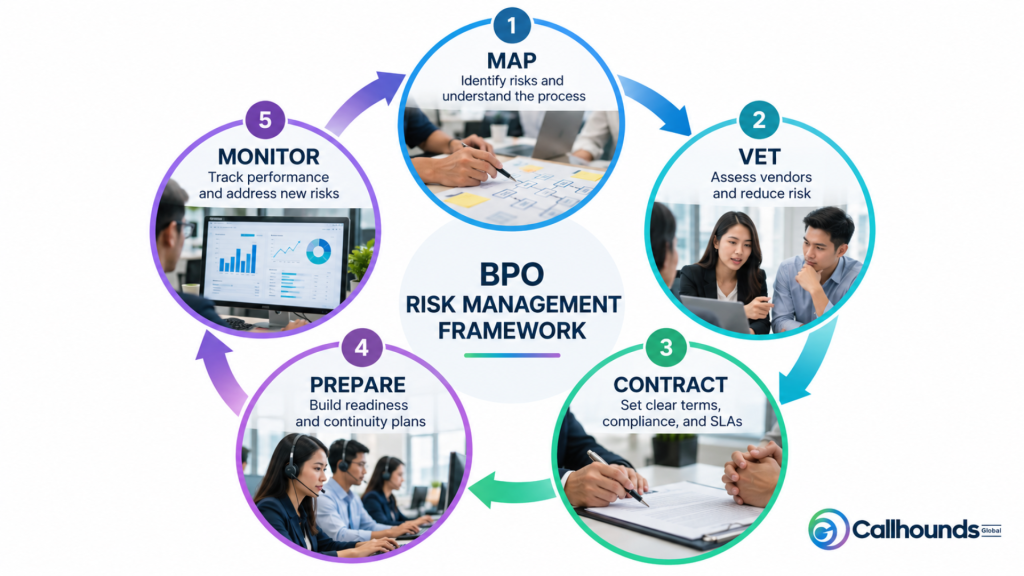
The BPO risk management framework below is deliberately plain. It borrows the logic of established standards such as ISO 31000 but trims it into something an operations lead can run without a consultant.
List every process you plan to outsource, then note what data it touches, which systems it needs, and what happens to your customers if it stops for a day. Score each process for impact and likelihood on a simple 1-to-5 scale. The highest scores get the strictest controls. Size is a poor guide here. A 3-person billing team can outrank a 40-person general inquiry desk.
Due diligence should feel a little uncomfortable for the provider. Ask for current security certifications and the date of the last independent audit. Request references from clients in your industry and call them. Visit the delivery site, or at least take a live video tour that includes the server room, the badge system, and the clean-desk policy. Review financial health, because a provider that can’t pay its people on time will eventually fail yours.
Anything you rely on should have a clause behind it. The next section covers the terms to look for.
Agree on what “down” means, how fast each process must come back, and where work moves if the primary site fails. Our guide to business continuity planning walks through the planning side in detail. Then run a drill. Simulate a site outage during a normal workday and time how long it takes to get calls answered again. The first drill nearly always exposes something: an expired VPN license, a missing laptop image, a phone tree with two wrong numbers.
Hold a risk review every quarter, and after any incident. Update the register, retire risks that have been closed, and add new ones. Regulations change, your own products change, and the provider’s team changes. A register that hasn’t moved in a year is probably out of date, not perfect.
A contract is the one place both sides must agree in plain language on who does what when something fails. Most disputes in outsourcing trace back to vague wording, not malice. Here are the clauses worth reading twice.
Have legal counsel review the final draft. This guide explains the risk logic, but it isn’t legal advice, and jurisdiction-specific rules vary.
One of the cleanest ways to cut down on finger-pointing is to agree on ownership before work starts. Cloud providers popularized this idea as the shared responsibility model, and it translates well to outsourcing. The table below shows a typical split. Adjust it for your own engagement.
Table 2: A Typical Client–Provider Risk Ownership Split
| Risk area | Client owns | Provider owns | Joint checkpoint |
| Data classification and access | Decides what data can be shared and who needs it | Enforces access rules, removes access on role change | Quarterly access review |
| Facility and network security | Sets minimum standards in the contract | Runs and audits site, network, and endpoint controls | Annual audit or certification review |
| Regulatory accountability | Final accountability for customer data | Follows documented procedures and reports incidents | Annual compliance review |
| Continuity and recovery | Defines critical processes and recovery targets | Maintains the plan, backup sites, and equipment | Drill at least twice a year |
| Training and quality | Supplies product knowledge and scripts | Hires, trains, coaches, and monitors agents | Monthly QA calibration |
| Incident response | Leads customer and regulator communication | Contains the incident and preserves evidence | Shared incident runbook |
The joint column is the one that saves you. Items in it are checked by both parties on a calendar, so nothing relies on someone remembering.
The Philippines is a major offshore hub for good reasons: deep English-language talent, cultural alignment with Western customers, and a mature BPO sector. It also has location-specific risks that smart buyers plan for. If you’re weighing the model itself, our overview of offshore staffing in the Philippines covers the setup in more depth.
Weather. PAGASA, the national weather service, reports that about 20 tropical cyclones enter the Philippine Area of Responsibility each year, with roughly eight or nine crossing the country. Providers worth hiring have a written typhoon protocol, backup power, redundant internet from more than one carrier, and a work-from-home fallback with pre-configured equipment. Ask to see all four.
Data privacy law. The Data Privacy Act of 2012 (Republic Act 10173) governs personal data handling and is enforced by the National Privacy Commission. Providers that serve overseas clients should be able to explain how it works alongside GDPR, HIPAA, or the Australian Privacy Act, and which standard applies when they differ.
Concentration. Placing every function with one provider at one site raises your exposure. Splitting critical processes across two sites, or keeping a small in-house team that knows the work, gives you somewhere to turn.
Offshore risk isn’t higher by default. It’s different, and the buyers who do best are the ones who ask location-specific questions during vetting instead of after the first outage.
A risk register tells you what could happen. Indicators tell you what’s starting to happen. Pick a small set, review them on a fixed schedule, and agree on thresholds that trigger action. A useful starter set includes the following. For the planning side of the response, see the guidance on business continuity planning.
When two or more of these move in the wrong direction at once, call a meeting. One bad number is noise. Three is a pattern.
Treating risk as a one-time exercise. The register gets built during procurement and never opened again. Six months later the process has changed and nobody noticed.
Sharing more data than the job needs. It’s convenient to hand over full customer records. It’s also how a small mistake becomes a reportable breach.
Skipping the exit plan. Nobody wants to discuss the end of the relationship at the start. That’s exactly when it’s cheapest to negotiate.
Trusting certificates over evidence. A security certification is a good sign, not a guarantee. Ask what the scope covered, when it was issued, and what the auditors flagged.
Good BPO risk management isn’t about expecting the worst from your provider. It’s about making sure that when something does go wrong, both sides already know the plan, the owner, and the clock. Map what matters, vet the partner, write the controls down, rehearse the response, and keep watching the indicators.
If you do only one thing this quarter, run a continuity drill on your most critical outsourced process and see how long recovery takes. The answer will tell you more than any policy document can.
Key Takeaways
BPO risk management is the process of identifying, assessing, and reducing the risks of outsourcing business processes to a third-party provider. It covers data security, compliance, service quality, vendor stability, continuity, and people-related risks, and it runs from vendor selection through contract exit.
The most common ones are data breaches or privacy violations, service quality drops, regulatory non-compliance, vendor financial instability, business disruption from outages or severe weather, and high staff turnover. The mix depends on the process: finance and healthcare work carries heavier data and compliance risk, while customer support leans more on quality and attrition.
Start with documentation: security certifications, audit reports, financial statements, and the continuity plan. Then verify it. Check client references, tour the delivery site, review drill results, and run a short pilot on a low-risk process. Score each finding against the risk categories in the table above so you can compare providers on the same basis.
At minimum: defined SLAs with remedies, breach notification timelines, audit rights, recovery time and recovery point objectives, subcontractor rules, liability and insurance terms, and a clear exit and data-return process. Have counsel review the final text for your jurisdiction.
Review the risk register at least quarterly and after any significant incident, contract change, new regulation, or major shift in your processes. Run continuity drills at least twice a year, and refresh the vendor due diligence file annually.