

Outsourcing Customer Experience Enablement in the Philippines

Outsourcing customer experience can be the difference between keeping a customer and losing them to a competitor.
Every unanswered inquiry, unresolved technical issue, and poorly managed customer interaction puts your brand reputation at risk. Customer experience outsourcing gives businesses access to trained support teams, technical assistance, customer journey analysis, and quality control without managing every operation in-house.
Why the Philippines? A strong English-speaking talent pool, customer-focused service culture, 24/7 coverage, and cost efficiencies make the country a strategic choice for brands looking to scale customer support without sacrificing service quality.
A failed payment at 11 p.m. should not become a lost customer by morning. With the right support team, customers get faster resolutions, businesses gain valuable insights into recurring problems, and product teams can address issues before they affect more people.
The goal is bigger than answering tickets. It’s about improving customer satisfaction, strengthening retention, and turning every interaction into an opportunity to build loyalty.
This guide breaks down what customer experience outsourcing includes, why the Philippines stands out, what it costs, the risks to consider, and how to choose the right partner and measure performance.
Callhounds Global builds and manages Philippines-based customer experience teams for brands in the US, UK, and Australia, helping businesses deliver consistent support while staying focused on growth.
Ask ten executives what outsourcing customer experience involves and nine will say “a call center.” That picture is about fifteen years out of date. Today the work splits into three layers.
The front line handles live conversations across voice, chat, email, social media, and messaging apps. The back line handles the work customers never see technical troubleshooting, escalations, billing corrections, and account reviews. The feedback loop turns all those conversations into decisions, through quality assurance, journey mapping, and reporting that tells product, marketing, and operations teams what customers keep running into.
A partner that covers only the front line is a staffing vendor. A partner that runs all three layers is doing customer experience enablement, and that difference shows up in retention numbers. The table below maps the core services to the metrics they should move.
Table 1: Core Customer Experience Services and the Metrics They Move
| Service | What It Covers | Primary Metric |
| Customer support (voice, chat, email, social) | Inquiries, order issues, account help, complaints | CSAT, first response time |
| Technical support | Troubleshooting, setup help, tiered escalation | First contact resolution, time to resolve |
| Customer journey mapping | Touchpoint audits, friction analysis, process redesign | Customer effort score, drop-off rate |
| Quality assurance and coaching | Call and ticket scoring, calibration, agent feedback | QA score, repeat contact rate |
| Voice-of-customer analytics | Theme tagging, trend reports, product feedback | NPS, churn rate |
Most brands pick one of three delivery models. A dedicated team works only on your account and learns your product deeply. A shared team spreads agents across several clients, which lowers cost but dilutes product knowledge. A hybrid setup keeps a dedicated core and adds shared overflow for peaks. If you’re still mapping the basics of offshore delivery, start with our ultimate guide to outsourcing in the Philippines before you build a shortlist.
The Philippines didn’t win this market by accident, and it didn’t win it on price alone. The IT and Business Process Association of the Philippines (IBPAP) forecasts about $42 billion in export revenue and nearly 1.97 million jobs for the sector in 2026, up from roughly 1.82 million direct employees at the close of 2024. That’s a workforce deep enough to staff programs for hundreds of global brands at once, with a mature training pipeline behind it.
Four factors explain the pull:
Buyers in the US, UK, and Australia keep reaching the same conclusion, and we lay out the reasoning in why global companies hire in the Philippines. The short version: few other countries combine scale, language, and operating maturity in one place.
Brands that outsource customer experience tend to cite the same five gains. The stakes are high, since one bad interaction can undo years of goodwill.
Labor is the largest line item in any support budget. Philippine rates commonly run 40 to 60 percent below comparable onshore teams once you count wages, benefits, workspace, and management overhead. The smart move is to reinvest part of that gap in training, coaching, and tooling instead of banking all of it. Cheap, undertrained support costs more in churn than it saves in payroll.
Customers don’t wait for business hours. With staggered shifts you can offer 24/7 voice and chat without asking your home team to work nights. Fast first responses are one of the most consistent drivers of satisfaction scores, and overnight coverage often removes the Monday-morning backlog entirely.
Product launches, holiday seasons, and billing cycles create spikes that in-house hiring can’t match. A partner can add trained agents in weeks and scale back when volume settles, so you pay for capacity when you need it.
QA analysts, workforce planners, and reporting specialists are hard to hire one at a time. A partner already employs them and spreads their time across your program, which means you get that expertise from the first week.
When routine tickets leave the building, your product, marketing, and success managers spend their hours on work only they can do. Most buyers cite these same reasons, and we unpack the decision process further in why companies choose outsourcing customer support.
Pricing varies by role, volume, language coverage, and technology stack, so treat the figures below as planning ranges, not quotes. They compare a fully managed Philippines program with an onshore in-house team, counting the costs most budgets forget.
Table 2: In-House Onshore Team vs. Outsourced Team in the Philippines (Planning Estimates)
| Factor | In-House Team (US, UK, or Australia) | Outsourced Team (Philippines) |
| Fully loaded cost per agent hour | $28 to $45 | $9 to $18 |
| Time to staff a new team | 2 to 4 months | 4 to 8 weeks |
| Hours of coverage | Business hours, plus overtime for nights | 24/7 with staggered shifts |
| Ability to scale for peaks | Slow, tied to hiring cycles | Fast, tied to the contract |
| Management overhead | Your supervisors and HR | Shared with the provider’s leadership |
| Compliance workload | Entirely yours | Shared, backed by certified provider controls |
Three line items catch first-time buyers off guard. First, onboarding: agents typically need three to six weeks before they reach full productivity. Second, tooling: help desk software, telephony, and QA platforms are either included in the rate or billed separately, so ask early. Third, internal oversight: a named owner on your side usually spends a good share of their week on the program during the first six months. Budget for all three and your forecast will hold.
Every outsourcing program carries risk. The brands that get burned usually skip one of these four safeguards.
A polished sales deck tells you very little. Use this checklist to separate real operators from good presenters:
The best outsourcing companies in the Philippines roundup is a reasonable place to build your shortlist, and Callhounds Global is glad to be measured against this same checklist.
Document your top 20 contact reasons, update your knowledge base, and set baseline numbers for CSAT, first contact resolution, and average handle time. Choose one channel and one customer segment for the pilot.
Go live with a small team. Review 10 to 15 interactions per agent each week alongside the provider’s QA lead, and fix documentation gaps as they surface.
Compare results to your baseline. If CSAT holds or improves and cost per contact drops, add channels or volume. If not, you’ll know exactly which piece to fix before you expand.
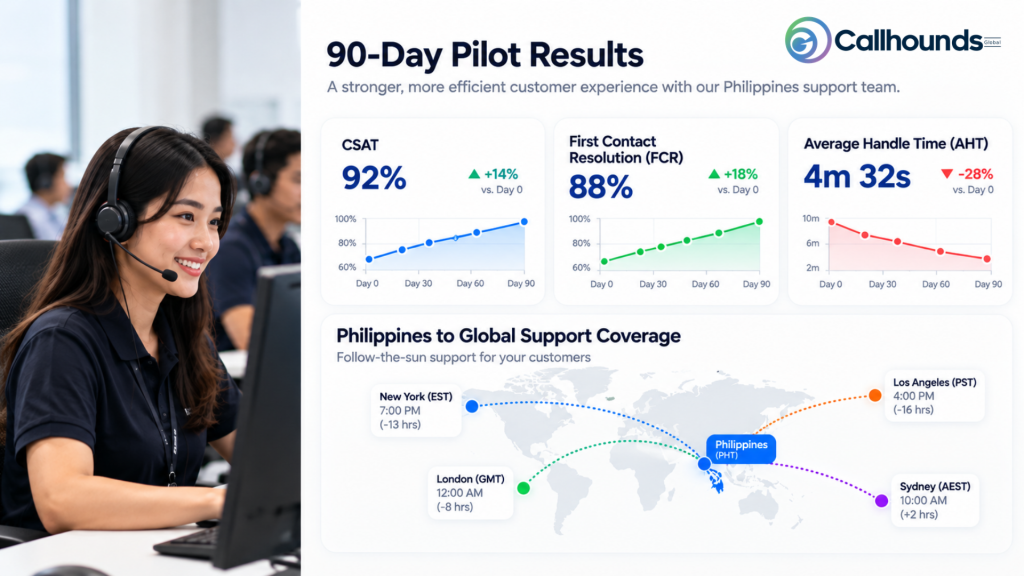
Outsourcing customer experience succeeds or fails on a short list of numbers. Track them from the first week.
Review these weekly with your partner and monthly with leadership. Numbers that only show up in quarterly reports arrive too late to change anything.
Outsourcing customer experience works when you treat the partner as an extension of your team instead of a line on the budget. The Philippines offers the talent, the time zone coverage, and the operating track record to make that possible. Start small, measure honestly, and scale what proves itself.
If you’re weighing the move, Callhounds Global can walk you through a pilot built around your channels, volume, and customers. Reach out to the team and bring your toughest ticket types.
Key Takeaways
Outsourcing customer experience means contracting an outside provider to run customer-facing work such as support, technical help, quality assurance, and feedback analysis. You keep control of strategy, brand voice, and customer data policy, while the provider supplies trained people, processes, and tools.
Planning ranges for 2026 run about $9 to $18 per agent hour for a fully managed program, depending on channel, language, and technical depth. Compare that with $28 to $45 for a loaded onshore hour. Setup, tooling, and overtime can shift the total, so request a line-item quote.
Yes, when you choose a provider with audited controls. Look for ISO 27001 and SOC 2 reports, PCI DSS for payment data, and HIPAA safeguards for healthcare. The Philippine Data Privacy Act of 2012 adds a national legal framework, and good providers also map their controls to GDPR and CCPA.
Most programs go live four to eight weeks after contract signing. Recruiting, product training, and system access take the most time. A clean knowledge base and a named owner on your side can shorten the timeline.
Keep strategy, brand voice, pricing decisions, and high-stakes account management close to home. Outsource repeatable, high-volume work such as tier-one support, technical troubleshooting, QA, and reporting, then bring insights back to your internal team.