

Top 10 Support Analyst Roles and Why They Matter

When systems fail, every minute costs your business time, productivity, and revenue.
Support analysts keep operations running by diagnosing and resolving technical, software, network, data, and customer issues before they escalate.
Here are the 10 support analyst roles every business should know:
Each role protects a different part of your operation, from employee devices and business applications to network infrastructure and critical reporting systems.
One problem can disrupt an entire operation. The right support team can prevent that.
A CRM login failure can stall sales. A billing portal issue can frustrate customers. A network outage can bring warehouse operations to a standstill. Without the right specialists, small technical problems can quickly become expensive business disruptions.
The solution? Put the right support analyst in the right role.
This guide breaks down what each of the 10 support analyst roles does, how they differ, and which positions your business should prioritize. It also explores why companies in the US, UK, and Australia are increasingly considering Philippine-based teams to strengthen technical support, improve operational efficiency, and maintain reliable service.
Because when business continuity matters, the right support team makes all the difference.
A support analyst is a professional who receives problems from users, finds the cause, fixes what can be fixed, and passes on what can’t to the right specialist. The title covers a wide range of jobs. Some analysts spend their days on hardware and operating systems. Others work inside a single business application, a network, or a customer-facing help channel.
What links them is a repeatable routine: log the issue, diagnose it, resolve or escalate it, and document the fix. That last step matters more than most teams realize. A well-written knowledge article turns one solved ticket into dozens of avoided ones.
Most support operations organize these jobs in tiers. Tier 1 handles first contact and common fixes. Tier 2 handles issues that need deeper technical work. Tier 3 works with engineers and developers on root causes. The ten support analyst roles below sit across those tiers, and in small companies one person often holds two titles.
Use this table to compare the ten roles side by side before reading the details.
| Role | Primary Focus | Typical Tier | What Breaks Without It |
| IT Support Analyst | Workstations, accounts, everyday tech | Tier 1 to 2 | Staff lose hours to unresolved device and login issues |
| Service Desk Analyst | First contact and triage | Tier 1 | Tickets pile up and reach the wrong team |
| Software Support Analyst | Application bugs and user guidance | Tier 2 | Defects never reach the developers |
| Technical Support Analyst | Complex hardware and software faults | Tier 2 | Hard problems bounce between teams |
| Desktop Support Analyst | Endpoint setup, patching, security | Tier 1 to 2 | Devices fall out of date and out of compliance |
| Systems Support Analyst | Servers, storage, infrastructure | Tier 2 to 3 | Core systems fail without warning |
| Application Support Analyst | Enterprise application uptime | Tier 2 to 3 | Critical apps slow down or go offline |
| Customer Support Analyst | Customer-facing technical help | Tier 1 to 2 | Customers leave after repeated bad experiences |
| Network Support Analyst | Connectivity and network security | Tier 2 to 3 | Outages spread across sites and users |
| Data Support Analyst | Data access, accuracy, protection | Tier 2 to 3 | Reports go wrong and sensitive data is exposed |
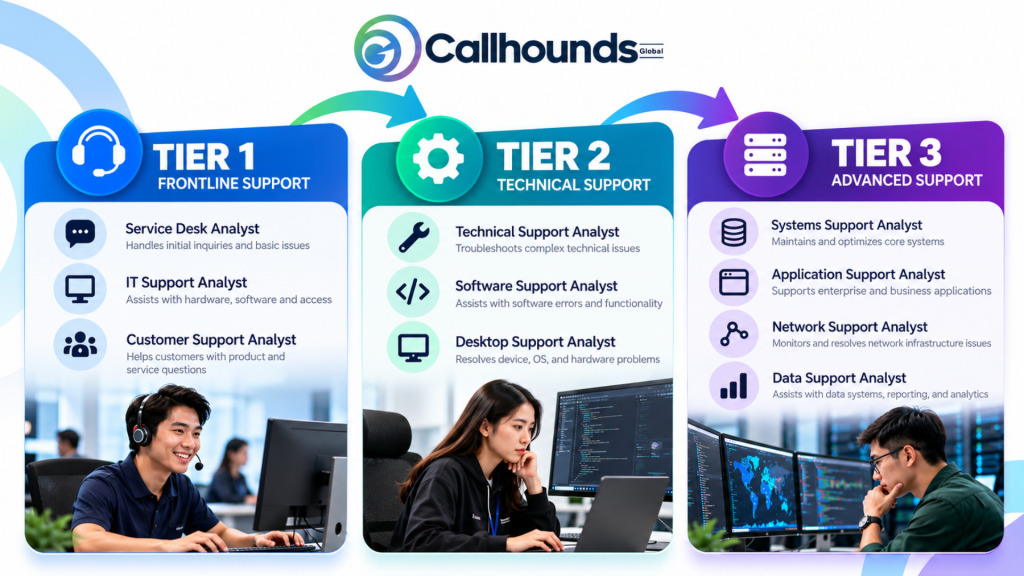
The IT support analyst is the all-around problem solver for everyday technology. Typical duties include setting up new employee accounts, installing software, resolving device problems, and keeping a log of recurring faults. A good analyst notices patterns. If printer errors spike every Friday or one laptop model keeps overheating, that pattern goes to management as a purchasing or policy decision instead of becoming another ticket.
Why it matters: this role keeps employees working. Every hour a team member spends stuck on a technical problem is an hour of lost output, and a responsive IT analyst cuts that loss at the source.
Service desk analysts are the first voice a user hears. They receive requests by phone, chat, email, and portal, then categorize each one, solve what they can on first contact, and route the rest with clear notes. The best ones ask two sharp questions before touching anything, which spares the specialist at the next tier from starting over.
Why it matters: speed and routing. A strong service desk raises first-contact resolution and keeps specialists focused on work that needs their depth.
Software support analysts handle problems inside applications: crashes, error messages, failed integrations, and confusing features. They reproduce the issue, check the logs, and write a clear bug report for the development team when the fault sits in the code. They also give users workarounds so work continues while a permanent fix is built.
Why it matters: they bridge users and developers. Without them, product teams hear about defects late and in vague terms.
When a problem goes beyond scripts and standard fixes, it lands with a technical support analyst. They investigate complex hardware and software faults, test configurations, apply system updates, and coordinate with engineering when a fix needs deeper changes. Their written case notes often become the reference material lower tiers rely on.
Why it matters: they cut the back-and-forth. Complex issues get one owner who sees them through instead of passing them around.
Desktop support analysts keep employee devices secure, patched, and usable, from the office desk to the spare-room setup of a remote employee. They deploy operating systems, install approved software, repair hardware, and confirm that each machine meets policy, such as disk encryption and current updates.
Why it matters: endpoints are where many security incidents begin. A disciplined desktop team closes those gaps before attackers find them.
Systems support analysts look after servers, storage, backups, and the platforms that business software runs on. They monitor capacity, apply patches during planned windows, test restores, and respond when something critical stops answering.
Why it matters: when a server fails, everything attached to it fails too. This role turns a single hardware fault into a short interruption instead of a company-wide outage.
Application support analysts own the health of specific business applications such as ERP, CRM, billing, or ecommerce platforms. They watch performance dashboards, investigate slowdowns, coordinate releases with developers, and confirm that each update leaves existing workflows intact.
Online retail makes the stakes obvious. A checkout page that fails during a sale costs revenue by the minute, and ecommerce customer support best practices in 2026 shows how support teams plan around those peaks.
Why it matters: critical applications stay available, and releases stop causing surprises.
The customer support analyst sits where technical skill meets service. They answer product questions, troubleshoot platform problems for customers, and track what people keep asking about so product and marketing teams can act on it. The strongest ones pair patience with enough technical depth to explain a fix in plain language.
The bar keeps rising. Customers expect fast, accurate answers on any channel, and what great customer support looks like in 2026 lays out what that standard looks like in practice.
Why it matters: this role shapes retention directly. Customers rarely remember the bug. They remember how the support conversation went.
Network support analysts manage routers, switches, firewalls, VPNs, and the links between offices and cloud services. They trace dropped connections, track bandwidth use, configure access rules, and watch for suspicious traffic.
Why it matters: a network problem is rarely small. One failing switch can cut off an entire office, and one misconfigured firewall rule can leave a door open. This analyst keeps the business reachable and protected.
Data support analysts keep business data accurate, available, and protected. They resolve access problems, repair broken reports and data pipelines, monitor database performance, and manage permissions so only the right people see sensitive records.
Why it matters: modern teams make decisions from dashboards. If the underlying data is wrong or late, every decision built on it is shaky, and the data support analyst is usually the first to spot that.
You don’t need all ten support analyst roles on day one. Match your first hires to the ticket type that costs you the most time.
| Your Biggest Pain Point | Start With | Add Next |
| Employees can’t get devices or logins working | IT Support Analyst | Desktop Support Analyst |
| Tickets arrive in every channel and get lost | Service Desk Analyst | Technical Support Analyst |
| Customers report bugs in your product | Software Support Analyst | Customer Support Analyst |
| Key apps slow down or fail after updates | Application Support Analyst | Systems Support Analyst |
| Offices or remote staff lose connectivity | Network Support Analyst | Systems Support Analyst |
| Reports are wrong or access is blocked | Data Support Analyst | Application Support Analyst |
| Customer complaints and churn are climbing | Customer Support Analyst | Service Desk Analyst |
When you screen candidates, look for three things. First, diagnostic habits: do they ask structured questions before they act? Second, clear writing, because documentation is half the job. Third, calm under pressure. Certifications such as CompTIA A+, CompTIA Network+, and ITIL 4 Foundation signal baseline knowledge, but proven troubleshooting counts for more.
Once the team is in place, track four numbers: first-contact resolution, time to resolution, reopen rate, and customer satisfaction. Together they show if your support analyst roles are solving problems or only closing tickets.
The labor data tells a nuanced story. The U.S. Bureau of Labor Statistics reports a median annual wage of $62,890 for computer support specialists as of May 2025. It also projects a 3% employment decline from 2025 to 2035, yet it expects roughly 48,700 openings each year, all from workers leaving the occupation. Read together, those figures suggest the work isn’t disappearing. Routine requests are increasingly handled by automation, while demand holds for analysts who can handle judgment-heavy problems.
AI tools now draft ticket replies, suggest fixes, and sort incoming requests. Analysts who use them well resolve more in less time. The human parts remain: judging an ambiguous fault, calming a frustrated user, and deciding if an alert is real. Businesses that treat support as a pure cost line often learn the price later, through churn, downtime, and security gaps.
Many US, UK, and Australian companies fill these positions through Philippine-based teams. The reasons are practical:
Callhounds Global, a BPO provider serving clients in the US, UK, and Australia, builds dedicated support teams in the Philippines, including service desk, technical, and customer support analysts. Before you choose any provider, check four things: security certifications, how customer data is handled, backup coverage for absences, and the reporting you’ll receive. The ultimate guide to outsourcing in the Philippines walks through costs, compliance, and team models in detail.
Support analyst roles are the quiet engine behind every productive team and every satisfied customer. Each of the ten covered here guards a different layer of the business, and the right mix depends on where your tickets come from. Start with the role that fits your biggest pain point, measure the results, and add specialists as you grow. If you’re weighing a Philippine-based team, read the ultimate guide to outsourcing in the Philippines and then talk to Callhounds Global about building a support team that fits your hours, tools, and standards.
Key Takeaways
A support analyst receives problems from users, diagnoses the cause, resolves what they can, and escalates what they can’t. They also document every fix so the next person solves the same issue faster. Depending on the role, the work covers devices, software, networks, data, or customer-facing technical questions.
A service desk analyst handles first contact, solving common issues and routing everything else. A technical support analyst takes over when a problem needs deeper investigation, such as a complex configuration fault or a system update. Service desk work is typically Tier 1, while technical support work is usually Tier 2.
Most small businesses should start with an IT support analyst or a service desk analyst, since both cover a wide range of everyday issues. If customers are your main source of tickets, a customer support analyst is the better first hire. Let your most frequent ticket type decide.
In the United States, the Bureau of Labor Statistics reports a median annual wage of $62,890 for computer support specialists as of May 2025. Pay varies by role, seniority, industry, and country. Network, systems, and data analysts generally earn more than entry-level service desk staff.
For many companies, yes. The Philippines offers a deep pool of English-fluent technical talent, lower costs than Western markets, and time zone coverage that extends your support hours. Success depends on choosing a provider with strong security practices, clear reporting, and dedicated rather than shared staff.