

Ecommerce Inbound Marketing Services: How Online Stores Earn Traffic, Trust, and Repeat Orders in 2026
What if your ecommerce store could attract buyers without paying for every click?
That’s the power of ecommerce inbound marketing services, managed programs that bring shoppers to your store through search-optimized content, email, social media, and live chat, then guide them from their first visit to checkout and eventually a second purchase.
Instead of chasing shoppers with constant retargeting ads, inbound marketing creates useful content that answers questions, compares products, builds trust, and helps customers make confident buying decisions.
A shopper searching for the best ergonomic chair for lower back pain, for example, may discover your buying guide, compare two products in a table, ask a question through live chat, and eventually purchase, all without your store paying for each individual visit.
That’s the inbound advantage: creating content and experiences that keep attracting qualified shoppers long after they are published.
This guide breaks down what ecommerce inbound marketing services include, how they differ from paid marketing, what to look for in a provider, and how to build an effective 90-day strategy. It’s designed for ecommerce store owners and marketing teams in the US, UK, Australia, and the Philippines, with a focus on creating original, accurate, experience-driven content that aligns with Google’s evolving search standards.
Inbound marketing is the practice of earning attention by being useful. Instead of pushing a message at people who never asked for it, you publish the answers they’re already searching for, then make it easy to buy once they’re convinced. Ecommerce inbound marketing services hand that work to a dedicated team of researchers, writers, SEO specialists, email marketers, social managers, and support agents who run the program for your store day in and day out.
HubSpot popularized the framework, and a four-stage version still fits online retail well:
The real difference between inbound and traditional paid marketing comes down to who starts the conversation and who pays for every visit. Table 1 shows how the two approaches compare for an online store.
Table 1: Inbound vs. Paid Marketing for Ecommerce
| Factor | Inbound Marketing | Paid / Outbound Marketing |
| How shoppers find you | They search, read, and come to you | You interrupt them with ads, banners, or cold outreach |
| Cost over time | Higher up front, then falls per visit as content ages well | Steady or rising, and it stops when the budget stops |
| Trust building | Educates before it sells | Pitches first, builds trust later |
| Speed to results | Often several months for search; weeks for email and chat | Days |
| Best for | Long-term growth, healthier margins, repeat buyers | Launches, clearance events, short promotions |
| Main risk | Slow start and a need for steady publishing | Ad fatigue and rising click costs |
Most stores need both. Paid media suits launches and sales events. Inbound is the base layer that keeps working when the budget gets cut.
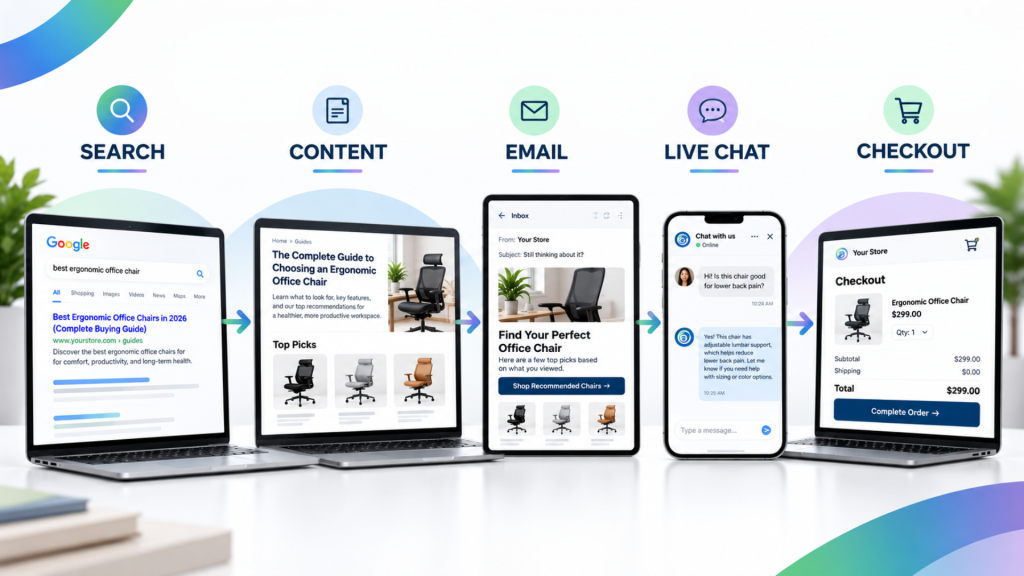
A solid program covers seven working parts. Some providers offer a few of them. The better ones run all seven as one connected system.
Everything starts with who’s buying and what they’re typing. The team pulls demographics and behavior from GA4, query data from Google Search Console, and customer language straight from support tickets and reviews. Then it sorts topics by intent. Someone searching “how to measure for a mattress” needs a guide, while “queen hybrid mattress free returns” is ready for a product page. Writing the wrong intent is the quickest way to rank and still earn nothing.
This is the backbone. It covers keyword mapping, category page copy, buying guides, comparison pages, and technical work like site speed, Core Web Vitals, structured data, and internal linking. Original product descriptions matter here. Copying the supplier’s text gives Google no reason to prefer your page over the other fifty stores selling the same item.
Long-form posts still earn links and answer questions, but short video and original photography now carry just as much weight as shoppers. A good team plans a content calendar around seasons, product launches, and the questions your customers ask most often.
Email is the channel you own outright. Services typically build welcome series, browse and cart abandonment flows, post-purchase sequences, and win-back campaigns, then segment lists so a first-time buyer doesn’t get the same message as a ten-time customer. SMS adds a faster layer for shipping updates and restocks alerts, if you have consent.
Social media works best as a conversation, not a billboard. Teams repost customer photos, answer comments within hours, run short product demos, and point people to guides that solve their problem. The goal is familiarity, so your brand name feels safe by the time someone’s ready to buy.
Many agencies skip this piece, and it’s often where the sale is won. A shopper with a question about size, compatibility, or delivery dates will leave if nobody answers. Live chat catches that moment, and every transcript shows you what your content is missing. Our guide on ecommerce live chat strategies for higher sales in 2026 walks through scripts, response targets, and proactive triggers that lift conversion. Post-purchase service closes the loop, and ecommerce customer support best practices in 2026 covers the standards that keep reviews positive and customers returning.
None of it counts unless you can see what’s working. Providers set up GA4 events, tie organic and email traffic to revenue, and run A/B tests on product pages, checkout steps, and email subject lines. Reporting should show orders and revenue, not only sessions.
Where the work gets done changes the cost, the speed, and how much oversight you’ll need. Table 2 shows how the four common models stack up.
Table 2: Delivery Models for Ecommerce Inbound Marketing Services
| Model | Relative Cost | Launch Speed | Coverage | Best For |
| In-house team | Highest: salaries, benefits, tools, turnover | Slow: hiring takes months | Local business hours | Large brands wanting full control |
| Freelancers | Low to moderate, varies by person | Fast for single tasks | Uneven, depends on availability | Small projects and one-off content |
| Marketing agency | High: premium retainers | Moderate | Business hours, often one region | Brands that need senior planning |
| Dedicated outsourced team | Moderate: flat monthly cost | Fast: trained in weeks | Extended or 24/7 across time zones | Growing stores needing marketing plus support |
In-house teams give you the most control, but a full inbound squad (SEO lead, writers, designer, email specialist, chat agents) is a heavy payroll commitment, and one resignation can stall a quarter. Freelancers are flexible but hard to coordinate. Traditional agencies bring polish and planning, often at premium retainers. A dedicated outsourced team sits in the middle: you get trained people who work only on your account, at a lower cost than building the same bench locally.
Callhounds Global builds dedicated teams in the Philippines for online retailers that want inbound marketing and customer support under one roof. The setup works well for stores selling to the US, UK, and Australia, for a few practical reasons:
If you’re weighing the support side of this model, the page on bpo ecommerce support outsourcing explains how dedicated ecommerce support teams are structured and what they handle.
Outsourced writers can meet the bar when the process supports it: a product training session before drafting, access to the actual products or sample units, a subject matter expert who reviews every claim, and an editor who checks sources. Without that process, any team, local or offshore, produces the generic content core updates push down.
Anyone can promise more traffic. These seven checks separate serious providers from the rest.
Track a short list and review it monthly. Vanity numbers can wait.
Give organic channels at least a quarter before judging them. Early wins tend to show up first in email and chat, while search rankings build more slowly.
Audit the site for technical issues, thin pages, and missing schema. Build two or three buyer personas from your own data. Map your top 30 keywords to pages. Set up GA4 conversion events, install live chat, and fix your most important product and category pages first.
Launch the welcome, abandoned cart, and post-purchase email flows. Publish the first four to six buying guides and comparison pages, each with original images and a named author. Turn the ten most common chat questions into FAQ content and start collecting reviews.
Review what’s ranking, what’s converting, and what isn’t. Refresh the underperformers, add internal links between guides and product pages, test new subject lines and page layouts, and lock in a repeatable monthly calendar. Then decide which channels deserve more budget.
Online shoppers are researching longer, asking more questions, and trusting stores that answer them honestly. Ecommerce inbound marketing services give you a repeatable way to be that store. Start with the foundations: helpful content with real experience behind it, email flows that respect the customer, and fast, human support that turns questions into sales. Then measure revenue, refine, and let the compounding do its work.
Ready to build an inbound program backed by a dedicated team? Contact Callhounds Global at callhounds.com to talk through your store, your markets, and your goals.
Key Takeaways
Ecommerce inbound marketing services are managed programs that attract online shoppers through SEO, helpful content, email, social media, and live chat, then guide them to buy and return. A dedicated team handles research, creation, publishing, and reporting so the store earns traffic instead of paying for each visit.
Email and chat improvements often show results within the first month or two. Organic search usually takes three to six months to build real momentum, depending on competition and site history. Content published today keeps working long after the effort is made.
Pricing depends on scope: the number of content pieces, channels, and support hours. Agency retainers usually cost the most, freelancer rates vary widely and dedicated outsourced teams in the Philippines typically cost less than assembling the same skills in the US, UK, or Australia. Ask for a quote tied to deliverables and revenue goals.
They do different jobs. Paid ads deliver fast traffic for launches and sales but stop when spending stops. Inbound builds assets that bring in visitors at a lower cost over time. Most healthy stores run inbound as the foundation and add paid campaigns where the data supports it.
Yes, if the process is built for it. That means product training, hands-on access to items, expert review of every claim, named authors, and cited sources. Location matters far less than the workflow behind the content.